Taiwan Matters! The PRC flag has never flown over Taiwan, and don't you forget it!

"Taiwan is not a province of China. The PRC flag has never flown over Taiwan."

Stick that in your clipboards and paste it, you so-called "lazy journalists"!

Thanks to all those who voted for Taiwan Matters!
in the Taiwanderful Best Taiwan Blog Awards 2010!
You've got great taste in blogs!

Sunday, November 08, 2009

permalink

How can East Asia achieve democracy?

Remembering the events that brought about the fall of the Berlin Wall

On November 9, 2009, Germans will celebrate the 20th anniversary of the fall of the Berlin Wall.

Twenty years ago on October 7, 1989, the 40th anniversary of the German Democratic Republic (AKA East Germany), the communist leadership wanted adulation, but the people offered defiance. The East Germans were supposed to be celebrating the "accomplishments" of socialism, but instead they staged three days of protests in Plauen, Dresden, and Leipzig. Read the Beginning of the end of East Germany, and take note of how the police responded to the demonstrators in Dresden and in Leipzig.

There is a lesson to be learned here for East Asians: At a crucial moment, police discipline -- namely their submission to authority -- should not compel an officer to act against his own citizens (i.e. to kill or harm unarmed civilians against his conscience merely because he is following orders), and of course this must be accompanied by wise decisions by the authorities (usually the top leadership of a nation). Demonstrators against a nation's leadership can be non-violent concerned citizens whose request is simple, freedom. It is how the police react to unarmed crowds that determines the course of such events. Confrontation and violence are the inevitable result when crowds are mishandled and provoked by the police. Unnecessary casualties follow unwise decisions; therefore, people in authority are always responsible for the outcomes.

Back to 1989 Berlin…
Several weeks of civil unrest -- actually starting as early as the summer of 1989 (known as the Peaceful revolution) -- took place in several cities. This finally led the East German government to announce on November 9, 1989 that all its citizens could visit West Germany and West Berlin. Shortly thereafter, crowds of East Germans climbed onto and crossed the wall, joined by West Germans on the other side in an atmosphere of celebration. The fall of the Berlin Wall did not come easily -- it only happened due to East Germans' defiance against their rulers.

Twenty years later, in East Asia, the picture looks grim. Democracy is under the threat of communism. Taiwan is on the verge of being converted from a young democracy to communism. Are people in East Asia more tolerant towards repressive rulers? How can this be happening?

The Berlin Wall stood for 28 years; that was long enough. But in Taiwan, from 1945 to 2009 -- 64 long years -- Taiwanese have not had a formally recognized nation to call their own after the General Order No.1 which initially brought the Chinese Nationalist Party government and their Republic of China (KMT-ROC) to the island to act as an administrator for the Allied Forces. This was then complicated by the defeat of the KMT by the Chinese Communists in 1949 which extended the KMT-ROC's temporary stay rather permanent as a Chinese government-in-exile on Taiwan waiting to retake China. The Taiwanese lived under a dictatorship -- led by the KMT's Chiang Kai-shek and his son -- for nearly five decades after WWII.

Although Taiwan did democratize to some extent, it did not normalize. Taiwan had a short period of some attempts to normalize their country when the DPP came into power (8 years from 2000 to 2008), but it ended with no success -- only rebukes from western leaders who believe that a Taiwanese referendum on UN membership was unnecessary troublemaking. When western politicians see economic opportunities with China, the rights of Taiwanese to build a nation of their own is not important anymore.

However, since the KMT regained power in 2008, this brief period of further strengthening of democracy is gradually being replaced by the seemly democratic election of a president (Ma Ying-jeou [馬英九],) who won on empty promises about "improving the economy" and "no unification" during his term; but his hidden agenda -- which should be apparent to nearly everyone by now -- was to bring Taiwan under Chinese Communist control through the illusion of cross-strait détente.

Similarly, the period from 1949 to 2009 has been six long decades for Chinese dissidents who were living either abroad or in "black jails" while their rulers celebrated and marched on a chemically-induced sunny October 1 this year with a show of force. Chinese citizens take advantage of every opportunity to stay abroad once they have completed their education because they admire the freedom that their own country cannot offer. Minorities within Chinese-controlled territories receive worse treatment from China's Han Chinese citizens. People belonging to minority groups are being continuously executed by the Chinese authorities without fair trials.

This explains why most of the post-World War II Chinese immigrants to Taiwan (the so-called "mainlanders" -- those who don't identify Taiwan as their "motherland" yet have no qualms about exploiting it), who have been able to visit China since long ago (contrary to the situation in Berlin-Wall-era Germany), are somewhat hesitant to embrace their original motherland. These mainlanders obviously have doubts, because no one would like to go back to authoritarian rule after they have enjoyed a period of freedom fought and gained by their Taiwanese counterparts, those who have always identify themselves as Taiwanese, against Chiang Kai-shek's dictatorship. But the young democracy in Taiwan may not stay for long, it is like a bubble: it may stay and shine for a little while, then it will burst up in the air.

I have a dream, a sweet dream in which a democratic China lives side by side with Taiwan, Tibet, and East Turkestan, all free and democratic. [My note: Initially taken from here, I added the word "sweet."]

But, I also have a recurring nightmare -- a nightmare in which a "greater China" under the existing one-party rule continues to interfere with all kinds of cultural activities globally (book fairs, film screenings, sports competitions, etc.) and causes all businesses to self-censor to meet the standards approved by the Chinese leadership; all computer makers pre-install firewalls demanded by the Chinese leaders; and all the Taiwanese aboriginal and non-aboriginal languages and traditions become extinct while the cultures of Tibet and East Turkestan are placed onto shelves visible only in museums.

While George H.W. Bush, Helmut Kohl, and Mikhael Gorbachev are going to meet in Berlin to celebrate the fall of the Berlin Wall symbolizing the beginning of democracy for Eastern Europe, I wonder what will happen in East Asia?

Are Taiwanese all too pessimistic and simply waiting for the Economic Cooperation Framework Agreement (ECFA) to be signed between the KMT and the CCP and be implemented upon them? Isn't the European Chamber of Commerce in Taiwan very selfish and short-sighted to support the signing of the ECFA, even if it comes at the expense of Taiwan's sovereignty? Are Taiwanese waiting for a "Gandhi" to lead Taiwan's version of civil disobedience? It is certainly encouraging to see that there will be organized demonstrations in the coming days (Lîm Gī-hiông speaks out in Taiwanese). David Reid has more info in English on the demo, and here's a bilingual post on DEMO! Taiwan Democracy Movement.

I don't see why the money spent on renovation and upgrading the Confucius temple should not have been allocated for job creation. It doesn't make sense that Taiwanese have to remit taxes to the central government while the KMT continues to sell-off the national assets which belonged to the people in the first place. Why should the Taipei City government get a portion of its debt to the National Bureau of Health Insurance written-off while the outstanding amount is absorbed by the central government? Unfair rules simply need to be challenged one by one until they are fully abolished in Taiwan!

Civil disobedience does not always need to be carried out on the streets; it can also come in the form of economic measures such as defying the remittance of taxes. If the KMT-dominated Legislative Yuan could purposely delay the passing of the Executive Yuan's annual budget back when the DPP was in power, why can't Taiwanese withhold paying taxes to the central government until the KMT returns its stolen assets to the people? And should local governments collect taxes since there have been problems of unfair distribution among different regions of the nation (similar to the two-level tax system of a federal and a state or provincial tax)? These are just some suggestions that should be explored further.

Any successful civil disobedience movement would require massive participation because the KMT government has a finite number of prosecutors and jails. They won't be able to throw everyone in jail.

The fall of the Berlin Wall showed us the power of the people, when almost the whole nation came out to demonstrate against their communist rulers -- they were simply unstoppable!


Taiwan needs a wise leader amid the changing status quo. A recent opinion poll on Ma Ying-jeou's performance revealed by a pan-blue media outlet gave him a 58.6% disapproval rating. Imagine if the poll had been done by a neutral organization. The result would have looked even worse for Ma.

Ma was a true supporter of dictatorship camouflaged beneath Harvard-educated fake democratic clothing! He is but a leader who looks back and admires how Chiang Kai-shek did it and is totally unfit for facing future challenges. If a citizen takes no action to oppose Ma's policies, one can only live with the consequences of Ma's misguidance.

While most western politicians continue to appease the Chinese communist officials and applaud Ma's cross-strait policy, let's remind them that the new focus for our world of the future -- as human beings -- is not which country will dominate world politics with its military or economic power, but rather how humans can survive by overcoming the immediate problems of climate change, energy shortage, and hunger.

Hence, a country's success is measured not by how it can dominate outer space or by the number of nuclear warheads it has, but rather by how its citizens would like to live in their own country, free of hunger and feeling content economically and politically. The people of Taiwan are among the most peace-loving and innovative citizens of the world, so give the Taiwanese the dignity they deserve.

Regardless of who claims sovereignty over Taiwan, whether it's the ROC (the current administrator) or the PRC (the ones who have never administered the island yet who make false claims and threaten Taiwan with the use of force), all those who have stood in the way should now step back and allow the Taiwanese to hold a national referendum on the status of Taiwan -- a long-overdue expression of democracy. This small island nation may just turn out to be the lighthouse which will transform the remaining communist countries in East and Southeast Asia into ones which respect their citizens' freedom.

For further reference:
* Documentary film about the history of the construction of the Berlin Wall

* Ma's attempt to market the ECFA on the annual Europe Day Dinner by the ECCT

(This post was edited by Tim Maddog.)

Labels: , , , ,

__________________________________________________
Wednesday, June 24, 2009

permalink

Iran and Taiwan

I don't want to compare too much here, as Iran and Taiwan are very different places, with distinct historical backgrounds, but what is happening there appears to confirm one of my worst fears.

We are now in an era where the concept of a "right to bear arm"s is effectively irrelevant; an uprising, even if it has the support of the majority of the people, is impossible to sustain without the assistance of the police and armed forces.

I am not arguing that the Iranian population is armed, because they are not; rather, I am reminding us all that if the government has tear gas and tanks, you're screwed, even when they don't have to use them. Iran's unarmed populations is already unable to affect change even with this strong popular uprising; a few AK-47s wouldn't make a difference versus the government's weaponry. Without the army, you're fucked. And with the army, you're probably also fucked, since they'll probably just take control instead of handing things over to a civilian government. [I haven't backed up this last statement with facts yet, but I suppose I should dig for the evidence that supports me.]

I am hopeful but pessimistic about the protesters' chance to affect change; I suspect any similar uprising in Taiwan would have the same moderate tendencies and the same useless result. And that reminds us that time is all the shorter. We must act while there is still a chance to affect change via the ballot box.

Labels: ,

__________________________________________________
Thursday, September 20, 2007

permalink

915 UN for Taiwan - I was there!

(TM) Kaohsiung, Taichung, and points between

The correspondents
This past Saturday, Michael Turton and Craig Ferguson were together in Taichung scoping out the old fogeys and hired babes at the Chinese Nationalist Party's (KMT) rally. Feiren and I were (separately) in Kaohsiung, as was Wally Santana of AP. The dateline on a Reuters piece o'crap by Ralph Jennings (a veritable king of loaded language) says he was in Taipei (345 kilometers away from Kaohsiung), and while Bloomberg's Tim Culpan wrote about it, too, he may as well have been phoning it in from an alternate universe beneath KMT headquarters. (Read on, and you'll see why I say so.)

Many participants in the SocialForce.tw discussion took part in overseas rallies, including ones at the Dag Hammarskjold Plaza in New York, the Federal Building in Los Angeles, the TECO office in El Monte, CA, Vancouver, British Columbia, Canada, and many other places.

I can only wonder how many people around the globe took part in the day's events supporting Taiwan's entry into the UN.

From here to there
First, some details gathered on my personal adventure to Kaohsiung.

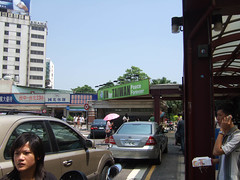
My wife and I boarded a Taiwan Railways train at the station in downtown Taichung, where there was a nice big "UN for Taiwan" banner hanging out front. (Be sure to also check out Michael Turton's impressive panorama of the same scene taken 2 days later when there were far fewer people.)

Taichung Station for UN Taiwan

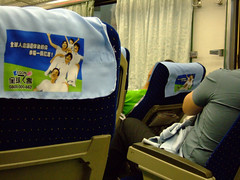
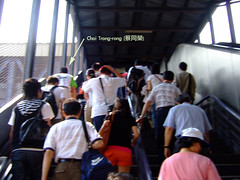
I didn't know if I'd see or be able to notice anybody aboard who might be headed to the Kaohsiung rally. Imagine my surprise when DPP heavyweight Chai Trong-rong (蔡同榮) got on my car in Chiayi (嘉義) wearing a green-sleeved "UN for Taiwan" jersey and sat a couple rows in front of me. He reclined in his seat and snoozed through most of the journey there, but before disembarking, a smiling supporter had grabbed his attention, so I didn't get the chance to say hello.

Chai Trong-rong snoozing  Entering Kaohsiung

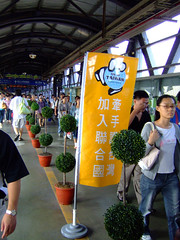
At the station in Kaohsiung, it was more crowded than Wal-Mart the day after Thanksgiving. I photographed a couple of the same kind of banners that Feiren saw there.

Banners at Kaohsiung Train Staion

So that's why they call 'em "5-star" hotels!
Leaving the train station by taxi, my wife and I headed to our hotel -- a high-class joint a short distance from the start of the parade route. But we were both tired and hungry. I had hardly slept at all on Friday night because I was so excited about the upcoming rally. We looked for food, but of the two nearby places on the map the hotel provided, one was already closed for their afternoon break, and the other apparently no longer existed at that location. So, we went back to the hotel and ordered room service.

By the time we had eaten, the parade had already gotten underway, so we were trying to see how the media was covering it. When I turned on the tube, it was tuned to TVBS where Lee Tao was busy spouting his usual nonsense and looking like his head was about to explode. SET was missing in action. FTV was present and accounted for, so we stuck mostly with that channel.

The TV images showed huge crowds, and we were in an air-conditioned room sitting on a comfortable bed. But I didn't come all that way just to sit there!

4:40 PM - Lots of people  5:04 PM - Will the bridge hold them all?  5:19 PM - Aerial shot of lots of people

Inertializing...
Since the parade was well on its way, we hailed a taxi and headed for Nong 16 (農16), which was the end of the parade route and the site of the evening rally. The ride was not short (costing NT$150), so I didn't regret skipping the long walk in that heat. We were able to get out just a short distance behind the big stage.

Pure energy
There was so much happening, I have to refer to my photos and videos to get everything in order. Also, even though I was trying to not to fill my memory cards with images, I filled 3 of them.

Sign the petition - UN for Taiwan  One letter per person - UN for Taiwan  George Kerr's Formosa Betrayed (Mandarin)

Miscellaneous observations
Kaohsiung mayor Chen Chu (陳菊) had lots of energy with which to fire up the crowd. An aboriginal singer-rapper let the rhythms flow in an exciting rapid-fire manner, yet he carried a wonderful melody at the same time. There were many different kinds of T-shirts for sale. I got myself a special one with a design which I'll keep secret. ;-)

The crowd was composed of people of all ages. I saw a guy walking with an upside-down ROC flag hanging from a ragged broom. A man in front of me had flags from earlier pro-democracy rallies I'd attended (228 Hand-in-Hand, 326 Democracy/Peace/Protect Taiwan). There were people as far as the eye could see (with more and more arriving in droves). An Elvis impersonator sang "Heartbreak Hotel," "Hound Dog," and other tunes. DPP Legislator Kuan Bi-ling (管碧玲) led the crowd with inspiring cheers. I saw Robin Hood (AKA Robin Dale of "Formosa Lily" fame [see the original video]) in the crowd nearby, Vice-President Annette Lu (呂秀蓮) implored the US government in English to understand Taiwan's dilemma. Cabinet spokesman Shieh Jhy-wey (謝志偉) via satellite, live from New York kicked out something like a rap -- in Taiwanese:


1:14 YouTube video: "915 UN for Taiwan - Shieh Jhy-wey raps for Taiwan"
Camera/Editing: Tim Maddog

And how could I forget Frank Hsieh's (謝長廷) chiding of Ma "Don't Paint Me Red" Ying-jeou:
為什麼不給台灣一個機會?!

[Maddog translation]
Why can't you give Taiwan a chance?!
Coming up to the end of the event, when Cabinet Secretary-General Chen Chin-jun (陳景峻) and Kuan Bi-ling introduced President Chen Shui-bian (陳水扁), the crowd went abso-friggin-lutely wild. See for yourselves:


2:40 YouTube video: "Kaohsiung - 915 UN for Taiwan - Chen Shui-bian, unpopular?"
Camera/Editing: Tim Maddog

At the end of the evening, there were lots of fireworks, the sound system played Beethoven's "Ode to Joy" at high volume, lifting spirits even higher, people were enthusiastically chanting "Taiwan! Go, go, go!" and the evening, despite some small glitches, was one for the history books. The people of Taiwan, both at home and abroad, along with friends from nations around the world, had stood up and made their voices heard with a peaceful, positive message: "UN for Taiwan! Peace forever!"

President Chen Shui-bian - UN for Taiwan

A short while later when it was time to go, without necessitating any external pressure, the crowd dispersed in quite an orderly fashion, as they have at every single DPP event I've attended. It was a great end to an awesome evening.

Appreciation
During the rally, I got many smiles, thumbs up, expressions of gratitude, handshakes, and arms around the shoulder for my presence and support. As memorable as it already was just to be there, those things gave the experience an even more powerful flavor which I will forever carry with me.

The soreness
On the downside, my legs were killing me, so after grabbing some nourishment at a nearby bakery, we headed back to the hotel. The TV was strangely not saying a whole lot about the event, so it was time for a little more food, a shower, and sleep.

Rude awakening
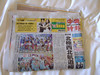
The hotel breakfast was pretty bad, and by that, I mean 5-star awful! But equally bad was the China Times (中國時報) hanging on the door handle when we first went out. Perhaps that was the bad taste that lingered within me until noon.

5-star Times

To our surprise, when we picked up the Liberty Times (自由時報) (a "green" paper) from the nearest convenience store, the story wasn't on its front page. (It was on page A3 while the KMT's was on page A2.) However, its "sister paper," the Taipei Times reported it in the front page headline story which, in my opinion, was where it should have been.

The numbers game
First, all the wrong ones, and I'll start with an explanation of what I was alluding to in my earlier remark about Bloomberg's Tim Culpan reporting from "another universe." Head firmly up someone's ass -- perhaps his own -- he says that there were a mere "60,000" in Kaohsiung -- supposedly quoting [DPP] "organizers" -- and "100,000" in Taichung, quoting the KMT. Ralph Jennings of Reuters tells readers that there were "150,000" in Kaohsiung and "100,000" in Taichung. Wally Santana says "more than 100,000" were in Kaohsiung. Even the BBC says, quoting "police," that "At least 100,000 people" took part in the rally in Kaohsiung, and a later BBC story says "250,000." But you know what? They're all wrong -- every last one of them.

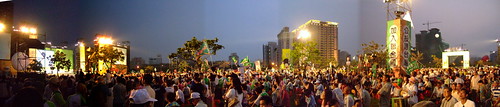
My own conservative estimate of at least 500,000 is based on: being there; walking through the whole site twice; actually counting large sections of people; and estimating how many such sections were present. Oh, and there are those photos and videos that I shot, in case you have doubts.

6:14 PM Crowd Panorama 1 (5 pieces)

6:18 PM Crowd Panorama 2 (7 pieces)

The usual BS
The above articles all contain the usual memes/errors/lies/distortions -- you know, the ones about Chen Shui-bian being "written off as an embarrassment" by his own party or of being "unnecessarily provocative" towards the US and/or China, the ones where the Chinese Nationalist Party (KMT) has the "Chinese" part left off, the ones where Taiwan "split" from China in 1949, the ones where the economy is "sluggish," and so on and so forth, ad nauseum.

Readers of Taiwan Matters should certainly know better than to believe any of that kind of nonsense.

UPDATE: Reuters' "The Good, the Bad, & the Ugly Editor" has issued a "correction," apparently a short time before I published this post (see also this) which reads:
China has seen self-ruled Taiwan as part of its territory rather than as a separate country since the island broke away from China in 1949 when Mao Zedong's Communists came to power.
Uh, not unless you equate both 1949 Taiwan and 1949 China with the KMT, eh? [/ END UPDATE]

The little surprises
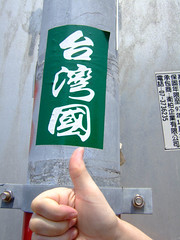
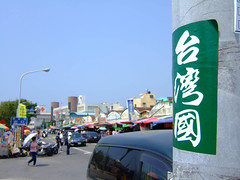
Heading over to Chichin Island (旗津) early Sunday afternoon where the crowds were totally unaware of a "sluggish" economy, my wife almost immediately spotted something exciting -- a green sticker on a light pole reading in white calligraphic script "台灣國" (Taiwan Nation). Thumbs up!

Thumbs up for the Taiwan Republic  This is the Taiwan Republic

But it felt hotter and more humid than the sauna in hell's kitchen, so after stopping at a juice stand across the road, and passing by several of what my wife and I both perceived as being practically identical seafood eateries (no obvious specialties, just the same 50 or so items at every place?), we opted instead to head straight to La Mambo café, where the jingji (經濟, economy) seemed actually rather jingqi (景氣, or bustling).

Every table was occupied at La Mambo

Chichin Island Panorama

We were volunteer "lab rats" on the "choo-choo of (potential) death"

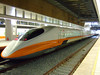
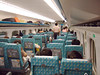
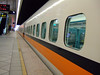
HSR at rest at the Zuoying StationLotsa leg room on the HSRGood bilingual info on the HSRHSR was nearly at full capacityHSR at Zuoying Station

Yep, that's right! We returned to Taichung on Taiwan's relatively new High Speed Rail. It was our "first time," and in contrast with what the Consumers' Foundation (Chinese Taipei) would have had us believe, nearly everything about the HSR was easy-breezy.

Volunteer lab rats?  These people aren't afraid of the HSR

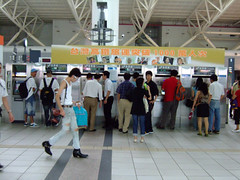
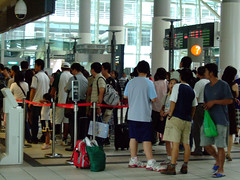
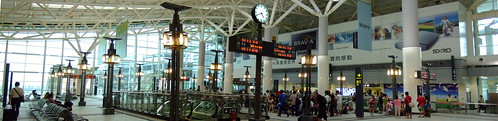
In contrast with what the pan-blue media had been telling me, there were lots of people buying tickets. We got to the station so early (as a precaution) that our wait was actually longer than the trip itself! We walked around the station and checked out the shops, the signage, etc.

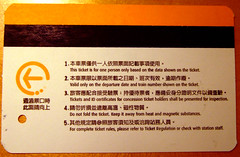
Back of the HSR ticket
Read number 4, and tell me if the TVBS reporter who blowdried their ticket was just a dumbass or was trying to create a story where there was none.

The trip home was fast. It was smooth. I was oblivious to just how much danger I was supposed to be in.

Zuoying HSR Station panorama
Zuoying HSR Station

Home, sweet potato home
Back in Taichung, I started putting all the photos and videos onto the hard drive, writing this post, editing videos, uploading and tagging photos, looking for others' experiences with the rallies. It took way too long, but I hope I've given you a view that you wouldn't have otherwise seen.

Even more RELATED INFO:
* A guest post from October 11, 2005 by Jerome F. Keating, PhD, on The Peking Duck blog: Should Taiwan have a seat on the United Nations? Most of the important details related to Taiwan's bid to join the UN can be found within that single post.
* Shieh Jhy-wey in New York with more of his "rap."
* A rockin' slideshow from Canberra and Sydney, Australia accompanied by a song called "相信台灣出英雄" (Here are the lyrics) performed by 水龍頭樂團.
* Strangely, a Hong Kong news report gives one of the highest crowd estimates I've seen ("400,000") and has a great image of the parade participants (14 seconds in).
* A musical interlude with video of the twinkling Taipei 101 Tower "UN for Taiwan" display
* Video from the Taiwanese Association in Belgium (Bruxelles/Brussels) in Taiwanese, French, and English
* A video called "UN for Taiwan--Voices from UK" has a couple of members of the UK Parliament speaking out on Taiwan's behalf.
* EuroNews (who seems to have deleted all their online articles) says "Hundred thousand rally in Taiwan over UN bid
." Never mind the inaccurate number in the title -- see for yourself.
* More from EuroNews: "Hundred thousand rally in Taiwan over UN bid, Part 2." This one shows the climax of the evening rally.
* A slideshow of scenes from Vancouver with the song "She [Taiwan] is our baby." Contains some of the same photos linked near the top of this post.
* People from Berkeley to San Francisco "Represent!" their support for "UN Membership for Taiwan."
* Plenty more pictures from New York and Kaohsiung
* A supporter of UN for Taiwan takes a subversive approach to spreading the message.
* More photos from Kaohsiung
* Yushan TV has lots of video (WATCH THE VOLUME!!!!!!!!!!!!!!!) including this one from the Kaohsiung rally (which contains many of the same scenes visible in Feiren's pictures) which shows that DPP supporters are not only 「一高二低」 ("old, uneducated, and low income"):

Online Videos by Veoh.com

* Here's a video from Taiwan Nathan ("Taiwan Nation" with a lisp?) (WATCH THE VOLUME!!!!!!!!!!!!!!!)

Fast tracks: , , , , , , , , , , , , , , ,

Cross-posted at It's Not Democracy, It's A Conspiracy!

Labels: , , , , , , , , , , , , , , , ,

__________________________________________________
Friday, September 14, 2007

permalink

915 UN for Taiwan

Get your maps, info, and reasons for going to Kaohsiung

915 UN for Taiwan Rally
Two rallies will be held tomorrow in support of 2 separate referenda. The DPP's, which supports joining the United Nations (UN) under the name "Taiwan," is important in that it will let the world know some very important things:
1) Taiwan is a democratic nation.

2) Taiwan is not part of China.

3) Taiwan's citizens do not want to be part of China.

4) Taiwan's citizens want their nation to be recognized as a a participant on level ground with the international community.

5) Taiwan wants freedom from the perpetual pressure from the US and China to bow to their whimsies.
Here's the content of the DPP's petition:
全國性公民投票案連署人名冊格式

主文:1971年中華人民共和國進入聯合國,取代中華民國,台灣成為國際孤兒。為強烈表達台灣人民的意志,提升台灣的國際地位及參與,您是否同意政府以「台灣」名義加入聯合國?

[Tim Maddog translation:]
Primary text: In 1971 the People's Republic of China joined the United Nations, replacing the Republic of China, and leaving Taiwan as an "international orphan." To strongly convey the will of the citizens of Taiwan and promote Taiwan's international standing and participation, do you agree or disagree that the government should use the name "Taiwan" to join the United Nations?
[More info here.]

Background
Neither the PRC, which now holds the "China" seat at the UN, nor the ROC, which once held the same seat, have ever done anything to give real representation to the people of Taiwan. The PRC flag has never flown over Taiwan. While the ROC flag has done so, the makers of that flag lost their "China" (of which Taiwan was not a part) to the Chinese Communist Party (CCP); hence, the ROC claim that Taiwan is a province of "China" is about as slippery a drop of mercury on a Teflon™ cliff. Nevertheless, the Chinese Nationalist Party (KMT) still clings to the fantasy that the country from which Mongolia became independent in the early 20th century and which they lost entirely in 1949 still exists. For the ROC to "rejoin" the UN would mean that the PRC doesn't exist.

Foreign backing
The KMT is desperately seeking foreigners to use as campaign props in their own "anti-referendum" rally in Taichung.

I would recommend, instead, that you head to Kaohsiung for the DPP's forward-thinking rally and show your heartfelt support for a democratic Taiwan with a brighter future than the KMT and CCP combined could (and would) impose upon it. If you've never been to such an event, I can't tell you how much the locals will appreciate your participation. If you have, then see you there!

The details
Here's the parade route, via the web site of the DPP:

Click thumbnail to enlarge


Here's a Google map where you can see the rally location -- the big grassy area at center right.

Here's a map I built on Wayfaring.com which shows the route, etc. (Hover on the yellow "bubbles" for notes.):

Click once on the map to change to "satellite" or "hybrid" view, zoom, etc.

I've been seeing contradictory information about times and parade routes, but the latest, most reliable info I have says that people should meet at 3 PM at the intersection of Chungshan 1st Road (中山一路) and Minsheng 2nd Road (民生二路), and the parade will start moving toward "Nong 16" (農16, a large grassy area) at around 4:15 PM. According to my Wayfaring map, the route is 2.44 miles (3.93 kilometers) long. Whatever happens, it shouldn't be too hard to find. There's sure to be a big crowd.

Come together, right now, on the green!
So, get on the ball! Many hotels are already booked to capacity for Saturday night. And if you're watching it on TV from either side of the globe, the climax should be happening at 9 PM Saturday Taiwan time (9 AM Saturday, US east coast time).

UPDATE: Info on the New York rally


Roots and routes: , , , , , , , , , , , , , , , , , ,

Cross-posted at It's Not Democracy, It's A Conspiracy!

Labels: , , , , , , , , , , , , , , , ,

__________________________________________________
Monday, July 16, 2007

permalink

Hsieh vs. Ma: A virtual presidential debate

Reason vs. mere rhetoric

In the post I wrote yesterday marking the 20th anniversary of the end of martial law in Taiwan, I quoted DPP presidential candidate Frank Hsieh (謝長廷) explaining that forgiveness of the Chinese Nationalist Party's (KMT) past offenses against Taiwan (which -- be honest -- continue to this very day) shouldn't include giving them another chance to be Taiwan's stewards. Here's the quote once more:
"We can forgive a 'caretaker' who harmed our people, raped our daughters and stole our property, but we can never allow him to be the caretaker again."
The quote is back in the news today, having started a debate of sorts (in which the participants were in different locations at different times). Reporters who had heard tell of each quote then asked the relevant candidate's opponent for his response. Or something along those lines.

Hong Kong-born KMT candidate Ma "There's-a-seriously-decomposed-corpse-on-the-balcony-of-my-City-Hall" Ying-jeou (馬英九) -- who announced his candidacy just hours after being indicted for misusing his "personal allowance" while he was mayor of Taipei -- responded to Hsieh's comment with the same kind of logic one would expect from a man who rode a bicycle around Taiwan for ten days and informed the world via his personal blog about not wearing underwear while doing so. (Could he be a "Britney Spears" fan?)

The article -- in which Ma wishes people would just forget all about martial law in Taiwan -- relates it like this:
Ma slammed Hsieh for his remarks, saying he "was surprised to hear Hsieh speak ill of others, because Hsieh is religious."

Ma also challenged Hsieh's idea of "reconciliation and coexistence," calling it "hollow words."
Speaking truth to authoritarianism (whether one is religious, agnostic, or atheist) doesn't count as "speak[ing] ill of others" (造口業) -- a phrase which implies unjust criticism. In the case of Hsieh's description of the KMT, it's simply truth that must be told because of the vast media conspiracy that would prefer for the public to ignore the dark past (and present) and focus on such hollow words (如空話) as "handsome" instead. Hey, Ma "Informed-on-his-Taidu-classmates-during-a-time-when-that-could-get-them-killed" Ying-jeou, people called Ted Bundy "handsome," too.

But the KMT's double-standard-bearer (Ma) didn't stop there. Continuing to avoid logic at all costs, he actually buttressed the validity of Hsieh's criticism with this next bit:
"The fact that the KMT was bad in the past doesn't prove the DPP is good now," Ma said.
First things first: "[T]he KMT was bad," and that's a fact, Jack!

But just in case your head is spinning from Ma's non sequitur, let's break down the "logic":
The fact that noun A was adjective B in the past doesn't prove that the opposite of noun A is the opposite of adjective B now.
Replacing those with some words chosen off the top of my head, I come up with this: "The fact that the dog was furry in the past doesn't prove that the cat is hairless now." Or, "The fact that Hitler was evil in the past doesn't prove that [choose your own contemporary opposite] is benevolent now."

As you can see, the statement is utter nonsense.

Ma "Foolishness-doesn't-prove-anything" Ying-jeou, therefore, can't even prove his own assertion (that the DPP is not good) -- but he does bolster my assumption above that the DPP -- despite all its faults -- is pretty much the polar opposite of the KMT. No wonder he never passed the bar exam.

The beleaguered former Taipei mayor (Ma) stumbles onward while gazing at himself in the rearview mirror:
"The KMT has stepped down [following the 2000 presidential election] and has reflected on its conduct during the martial law period," he said.
They love to claim that they "reflect" (反省) -- in a genteel and inscrutable Confucian manner -- on the errors of their murderous ways, but we still have Ma "Singapore-is-a-good-model-to-follow" Ying-jeou spewing nonsense. If any such "reflection" had actually occurred, the die-hard KMT members would have returned their stolen assets to the people of Taiwan, donated whatever was left to the victims of the "228 Massacre" and subsequent White Terror, and perhaps even gone home to the "motherland" to be with the ones they love. Whatever! Hsieh says to stay here and enjoy the democracy earned on the backs of the Taiwanese if you want -- just don't expect the people who call Taiwan their motherland to want you to be their president.

Hsieh puts the final nail in the conversation with this alliterative verse:
Hsieh said the victims [of political persecution during the martial law era] should forgive their persectors but never forget.

"Those who forget history will be forgotten by history. Those who abandon history will be abandoned by history," Hsieh said.

"Those who have harmed others are in no position to ask their victims to forget."
I can't wait to see these two go head-to-head in a real debate on live television.

FURTHER READING: For Hanzi versions of what was said by the two candidates, try here, here, here, here, or here.

Pros and cons: , , , , , , , , , , , , , , , , , , , , , , ,

Cross-posted at It's Not Democracy, It's A Conspiracy!

Labels: , , , , , , , , , , , , , , , ,

__________________________________________________
Sunday, July 15, 2007

permalink

Links of the day, July 15, 2007

Down with martial law

Today is the 20th anniversary of the lifting of martial law in Taiwan. That 38-year-long era was like a knife plunged into the hearts of the Taiwanese. And current members of the Chinese Nationalist Party (KMT) have the nerve to call the removal of this knife a "gift to the Taiwanese."

WTF? That's almost like saying that their own raping of Taiwan prevented China from doing so. Oh, wait...

Today's Taipei Times brings us a bunch of good info. Here are the links along with some samples:

* A brief history of the martial law era
1980

Kaohsiung Incident leader Lin I-hsiung's mother and his twin daughters were brutally murdered on Feb. 28, while the elder daughter was seriously injured. The identity of the murderer remains unknown. [Maddog: Unknown to anyone outside of the KMT (whose secret police had the house under 24-hour surveillance), that is.]

1981

Carnegie University professor and supporter of Taiwan's democracy movement Chen Wen-cheng (陳文成) was found dead a day after he returned to Taiwan for a visit and was taken from his residence by agents from the Taiwan Garrison Command, a secret police and state security body.

1984

Chiang Nan (江南), a Taiwanese author writing a biography on Chiang Ching-kuo, was killed on Oct. 16 at his house in San Francisco by a Taiwanese gangster commissioned by the Military Intelligence Bureau. Chiang Ching-kuo started the second term of his presidency.
* Taiwanese society under martial law remembered
While celebrating the anniversary of the lifting of martial law in 1987, it is easy to forget what life was like at a time when many aspects of society -- including books, music and TV and radio programs -- were heavily censored and under the tight control of the Chinese Nationalist Party (KMT) regime.

Dictator Chiang Kai-shek (蔣介石) declared martial law on May 19, 1949, after his KMT troops lost the Chinese civil war to Mao Zedong's (毛澤東) Communist Party and withdrew to Taiwan.

Martial law was not lifted until July 15, 1987.

[...]

President Chen Shui-bian (陳水扁) has attributed the lifting of martial law to the social forces that came into effect following the Kaohsiung Incident, with the immediate cause being the founding of the DPP.

The December 1979 Kaohsiung Incident occurred when the KMT authorities broke up an anti-government rally organized by Formosa magazine.

Ten days after the DPP was founded, then president Chiang Ching-kuo (蔣經國) announced he would lift martial law and allow the formation of opposition parties.
* Chen, DPP re-enact martial law rally
"We can forgive a 'caretaker' who harmed our people, raped our daughters and stole our property, but we can never allow him to be the caretaker again," he [DPP presidential candidate Frank Hsieh (謝長廷)] said. "It is not a matter of right and wrong. It is a matter of defending the character of Taiwanese people."
* Nation vulnerable to 'three wars' plan: panel
The "three wars" strategy refers to Beijing's plan to threaten Taiwanese psychologically, block Taiwan's participation in international organizations and "brainwash" Taiwan and its allies through "united front" (統戰) propaganda aimed at extending its influence in Taiwan.

prevention

"The end goal of the Chinese government's 'three wars' is to make Taiwanese believe that Taiwan is part of China," said Chen Lung-chu (陳隆志), president of the Taiwan New Century Foundation think tank, which hosted the forum.

"Strengthening Taiwanese people's sense of national identification is the best defense against the threats post by China's 'three wars,'" Chen said.
Despite all the informative articles above, the same edition of the same paper sows seeds of fear, uncertainty, and doubt when they should be promoting bravery, dedication, and clarity instead. There's a really bad editorial today (Could Antonio Chiang [江春男, AKA 司馬文武] be the "concern troll" writing this garbage?) equating two things which are actually quite different:

* Editorial: Two fumbling political parties
With the public spotlight on the end of the martial law era, the Chinese Nationalist Party (KMT) finds itself in an awkward position, being the sole political party responsible for subjecting Taiwan to 38 years of martial law that brought the violence of the White Terror and other tragedies.

The KMT's quandry [sic] lies partly in the fact that the victims of the dictatorship are still around to recount their stories. This is exacerbated by the fact that many of the party's heavyweights today also played important party roles during the latter part of the martial law era. They were part of and upheld an oppressive system. They were silent on the issue of oppression then, but present themselves as champions of democracy now.

[...]

But the Democratic Progressive Party (DPP) may not be in a position to boast either. Although it deserves praise for the actions of its members at crucial points in the past -- the Kaohsiung Incident and the struggle for democracy, for example -- the DPP should not, twenty years after martial law has ended, still be relying on Taiwan's collective memory of dark and painful days to win votes.

The DPP should be concerned that it's [sic] biggest contribution continues to be achievements from two decades ago. During the seven years of its administration, the DPP has made little progress in switching from an opposition party mentality to that of a governing party. Unfortunately, the DPP has far fewer laurels to show for its time in the presidential office than it gathered on the road to democracy.
I guess the writer of that piece forgot that the KMT controls a big chunk of the legislature to this very day. There's nothing at all disingenuous or unseemly about the DPP's use of the topic to gain the votes it needs in order to get things done. The editorial's comparison about "laurels" earned by the DPP now versus the leaps made 20 years ago reminds me of the inaccurate comparison made between the steady progress of Taiwan's well-developed economy and China's burgeoning economy. The Frank Hsieh quote from above bears repeating: "We can forgive a 'caretaker' who harmed our people, raped our daughters and stole our property, but we can never allow him to be the caretaker again."

Fellow Taiwan Matters blogger Michael Turton was up early on this Sunday morning publishing some goodies of his own over at The View from Taiwan -- including something which may further elucidate my comment about the economy just above:

* Taiwan's Economy: What's Going On?
Taiwan's "problems" are the problems of any advanced economy, complicated by the political threats from China, and perceived through the strong cultural belief here that life is a zero-sum game and if you're not at the top of the heap, you must be at the bottom. Most nations would take joy in Taiwan's 4% annual growth rate and strong electronics sector. Instead, we have angst. Some of it is justified, given the decline in purchasing power faced by the middle and working classes, but it is also true that the public in Taiwan could stand a little education in the problems of growth when your economy is already quite wealthy.
* Revolting Story of EU Kow-tow to China
So what is Beijing up to? They know from their pals in the KMT that the UN referendum is an election year ploy that will have no real effect on anything. So this isn't about "Taiwan independence" really. It's about stopping or defusing an election year ploy, on behalf of its allies, the KMT. It is also part of its long-term policy of making Chen Shui-bian look like a "radical."
A Maddog or a stray dog?
"And where have you been for the past couple of months, Maddog?" you may ask. Some of that time has been taken up tracking some of the anti-Taiwan memes in the Western media which fly in the face of reality. Here are the pages I've posted so far:

* Memes: Taiwan provoke China
* Memes: Taiwan "renegade province"
* Memes: [Taiwan and China] "split in 1949"

Due to the sheer volume of these memes, it's difficult for me to keep those pages completely up-to-date, but I'll do my best. Referring to them from time to time should be a real eye-opener, and I hope you will pass the information on to others in order to counter the effect of the memes.

During my time away from this blog, I've been active in other prominent places. At Jerome Keating's request, I did some graphics to accompany his piece called The KMT and Their Flag: Is Puyi Power Better than None? Fellow Taiwan Matters bloggers Michael Turton and Feiren joined me in smacking down Beijing correspondent Richard Spencer of Telegraph.co.uk for publishing a big, stinking pile of lies about Taiwan. Last weekend, I wrote to the people at LiveEarth.org to demand that they change their listing of Taiwan on their pledge page as being a "Province Of China." (Some of you should write to them, too.) And I have been going over lots of declassified documents from the CIA's archives.

I hope all you readers have been active, too, even if it's behind the scenes.

Bullet points: , , , , , , , , , , , ,

Cross-posted at It's Not Democracy, It's A Conspiracy!

Labels: , , , , , , , , , , , , ,

__________________________________________________
Saturday, April 14, 2007

permalink

The End of History: Taiwan and China

Francis Fukuyama has some interesting propositions about the desire for modernity, market economies, and liberal democracies on Project Syndicate. He's mainly concerned about the mess in Iraq, but let's see how they would work with Taiwan and China.

Fifteen years ago in my book The End of History and the Last Man I argued that, if a society wanted to be modern, there was no alternative to a market economy and a democratic political system. Not everyone wanted to be modern, of course, and not everyone could put in place the institutions and policies necessary to make democracy and capitalism work, but no alternative system would yield better results.
Unlike the Arab world where the project of modernity is still questioned, both Taiwan and China want to be modern. But let's turn Fukuyama's propositions around in the second sentence and consider them one by one.

There is a broad intellectual consensus among Taiwan's elites that democracy and capitalism yield the best results in the pursuit of modernity. Now I think it is possible to argue that one can find a substantial number of voters among Taiwan's increasingly disaffected traditional middle class (teachers, civil servants, and soldiers) who long for the good old days under Chiang Ching-kuo when Taiwan had (statist) capitalism but not democracy. But I submit that the KMT leadership, and even the PFP leadership, however reluctantly, accepts the efficacy of democracy and capitalism even when they pander to undemocratic sentiments among some members of the middle class.

But the situation in China is very different. While a brand of state-directed capitalism that would look familiar to Chiang Ching-kuo is accepted as being more efficient than socialism, outside of a few intellectuals, few accept that democracy has a role to play in China's rise to modernity. Indeed many argue that democracy would in fact hinder that rise by unleashing political instability.

Perhaps the more significant question is whether Taiwan and China are capable of putting the policies and institutions in place that underpin democracy and capitalism. In Taiwan, of course, the answer is broadly yes. Taiwan has a functioning private property system, free elections, an independent judiciary, and securities markets that work as they should to raise capital for private enterprise.

China, however, is engaged in an epic struggle. It does not have secure private property rights, not does it have functioning securities markets. Much as the kleptocrats who govern China see democracy as a hindrance to modernity, they correctly see private property as a potential obstacle to the orgy of development that is probably the main force driving China's incredible boom. Securities markets, which barely functioned until recently, are mainly just a method by which the Chinese people are divested of their savings by the state. An independent judiciary--the linchpin of both democracy and capitalism--is in its infancy. As for democratic institutions, there is not much point discussing them since there is no agreement in China that they are necessary or desirable.


To be sure, the desire to live in a modern society and to be free of tyranny is universal, or nearly so. This is demonstrated by the efforts of millions of people each year to move from the developing to the developed world, where they hope to find the political stability, job opportunities, health care, and education that they lack at home.
And it has been demonstrated in Taiwan by the democracy movement, and by immigration from and within China. Both the Taiwanese and the Chinese want live in modern societies and be free of tyranny.

But this is different from saying that there is a universal desire to live in a liberal society – that is, a political order characterized by a sphere of individual rights and the rule of law. The desire to live in a liberal democracy is, indeed, something acquired over time, often as a byproduct of successful modernization.

Here Fukuyama hits the heart of the matter. The Chinese do not want to live in a liberal society (yet) while the Taiwanese increasingly do. And as Fukuyama argues, the increasing Taiwanese desire to live in a liberal democracy is something that the Taiwanese have acquired over time as a byproduct of successful modernization.

It is a truism in discussions of Taiwanese politics to say that other than identity there is little that divides the greens and the blues. While this is certainly true in terms of say, economic policy, there is also a real divide in terms of commitment to living in a liberal democracy. The DPP is unquestionable committed to liberal democracy while the KMT is a bizarre hybrid between those who espouse a version of Chinese nationalism that is incompatible with liberal democracy and an illiberal wing of the Taiwanese elite (think Wang Jin-pyng) who want to live in a state committed to full scale development, not a liberal democracy.

Moreover, the desire to live in a modern liberal democracy does not translate necessarily into an ability to actually do so.
I see this as the last hurdle for the Taiwanese to get over before they can finally reach their ultimate goal of becoming a modern liberal democracy--that is, if China doesn't rain missiles down on Taiwan first. I am certainly not saying that the Taiwanese innately lack this ability, just that not everyone in Taiwan has learned these skills and become habituated to this culture.

Outside powers like the US can often help in this process by the example they set as politically and economically successful societies. They can also provide funding, advice, technical assistance, and yes, occasionally military force to help the process along.
One example of using military force legitimately 'to help the process along' would be to defend to Taiwan in the event of a Chinese attack.

Labels: , , , , , ,

__________________________________________________
Sunday, March 18, 2007

permalink

Chiang Kai-shek's Legacy: Small-minded Minions Struggling to Maintain His Image

A guest post by Jerome F. Keating, Ph.D.

Taiwan's Strawberry Generation (草莓族) is often blind and/or oblivious to the oppressive past that their parents endured. The then Chinese Nationalist Party (KMT) government regularly suppressed information and forbade certain discourse under penalty of jail, torture and even death. It even tried to deny the history of the world. Remnants of that controlling past remain and can easily be found for those who have eyes to see.

Given this past, it is all the more ironic that many members of the KMT and its lesser spin off parties try to downplay past reality, pretend that it never happened and even complain at the removal of their hero-like statues of Chiang Kai-shek (CKS, 蔣介石).

Most would agree that encyclopedias have a certain level of objectivity. The facts presented in them reflect the researched world at the time of their publication. Historians can challenge these facts and sometimes cause them to be changed. Only the smallest-minded dictators would try to deny them, alter them, and even censor them. Only the smallest-minded minions would carry out such directions. Yet in many university and public libraries around Taiwan, one can still find remaining instances of Chiang Kai-shek's legacy.

When one discovers such examples, the natural question arises. What kind of threatened egoist would issue orders to expunge or alter the past? Further, what kind of minions would carry out those orders?

The pictures attached to this post are true examples of such hypocrisy and deceit practiced by the KMT minions in trying to preserve their entitlement under the CKS legacy. These photos were taken in March 2007 from four separate censored encyclopedias published between 1977 and 1985; these encyclopedias are still on the shelves of university libraries:

Hosted by ImageShack

Click the above image to go to page one of Jerome's album


Hosted by ImageShack

Click the above image to go to page two of Jerome's album


Look first at the dates of this censorship. These are not examples of what was done in the 1950s when one might try to excuse it with the rationale that CKS was still in the throes of fighting for survival against Mao Zedong's (毛澤東) Communist Party. These come much later. If one grants that these western encyclopedias would take a year or so to reach Taiwan after publication, they almost all came and were censored when James Soong was Director of the Government Information Office and responsible for all censorship (1979-84).

Examine the publication dates (1977 to 1985) further. The Republic of China under CKS had lost its UN seat to Mao's China (1971). CKS and Mao were now both dead (1975-76). The United States would transfer its embassy to Beijing (1979) and the Kaohsiung Incident would demonstrate the KMT government's attempted suppression of the democracy movement (December 1979). Three high profile murders of those opposing the KMT would be carried out in Taiwan and the United States (1980 to 1984). The Democratic Progressive Party (DPP) would be formed in 1986. Martial law would finally be lifted in 1987 and Chiang Ching-kuo would die in 1988.

This was the Taiwan when the Strawberry Generation was being born (1979 onward); this was the Taiwan where so many were still being sent to Green Island (綠島). This was the time the KMT still refers to as the good old days. Look, therefore, at the censorship and see who is facing reality and who is not.

First to be noticed is the refusal to still admit that Mao, then dead, ever existed or defeated the KMT in China [Photos 1, 2, 3, 4, 5, and 6]. Zhou Enlai (周恩來) and others also get the axe [Photo 11]. The false dream was still fostered that the KMT would liberate China; only under this dream could the KMT attempt to claim legitimacy for its government and justify its refusal to allow democratic elections at any serious level of government.

Next is the alteration of history. According to the censors, China still belongs to the KMT [Photos 7, 8]. Mongolia is still part of the KMT's China even though it already had a seat in the United Nations [Photo 9]. Tibet's history is altered to deny its history as a nation [Photo 10] and facts about CKS are both sanitized and changed [photo 13]. Note in particular in photo #13 that a censor crossed out the 'not' in a sentence. The sentence originally said "He (Chiang Kai-shek) was not concerned with the social and economic transformation of Chinese society. . ." The censor changed this sentence to read the opposite, "He was concerned with the social and economic transformation of Chinese society." Many similar alterations were made.

Some of this censorship was done by Formosa Magazine Press which imported western magazines to Taiwan. This was the same press that the government regularly ordered to censor information coming into the country. It censored Mao as TIME's man of the year in 1967. A shocked TIME editor then responded with the following to distance TIME from the censorship:
"TIME has been tampered with by censors and other officials in many countries, but never to our knowledge has anyone stamped a rub-out X on the cover. Last week we learned that in Taiwan authorities had ordered the Formosa Magazine Press, TIME's distributor, to stamp a three-inch blue cross upon the puffy features of Mao Tse-tung on the Jan. 13 cover. The distributor hand-stamped the thousand or more copies (exclusive of those for the U.S. military) that circulate in Taiwan."
To those in the Strawberry Generation, I suggest that you be a detective; go into the libraries and examine books and encyclopedias from that period and see for yourselves if there remnants of the censorship are still there. Try to imagine living in such an age of censorship as your parents.

Then you will see why people look askance at those who seek to soft peddle this censored past. There can be no sense of democracy, where denial of history is maintained. The sick privileged mentality remains in some. Many of the minions who supported or carried out the policies of the Chiangs are still in government or positions of power.

When the DPP removes the statues of CKS, it is not trying to deny that he existed in history. At least 120 of the statues have been placed in a park in Tashi, a grim reminder of the megalomania of a despot who preached Sun Yat-sen's government of the people, by the people, and for the people but never instituted it in China or in Taiwan. No, the DPP is not trying to say CKS did not exist; the pain caused by his existence still affects the island. What the DPP is saying is that these statues of intended adulation have no place in the public places of Taiwan.

As you, the Strawberry Generation, begin to grasp the censorship of the past, realize who still defends it and finally whose sacrifice, blood and sufferings bought the freedoms that you all have. Look further and ask why the state assets of the country still remain in the control of the KMT and why transitional justice has not yet been carried out. Then you can better grasp the emotions of today.

__________

This was originally posted on Jerome's personal web site, where you can read more of his essays.

If any of you have seen similar instances of Chinese Nationalist Party (KMT) censorship, tell us about them in the comments or via e-mail. (The address is in the sidebar.)

Legacies: , , , , , , , , , , , , , , ,

Labels: , , , , , , , , , , , , , , ,

__________________________________________________