Taiwan Matters! The PRC flag has never flown over Taiwan, and don't you forget it!

"Taiwan is not a province of China. The PRC flag has never flown over Taiwan."

Stick that in your clipboards and paste it, you so-called "lazy journalists"!

Thanks to all those who voted for Taiwan Matters!
in the Taiwanderful Best Taiwan Blog Awards 2010!
You've got great taste in blogs!

Wednesday, March 02, 2011

permalink

Crossroads

The DPP is currently at a crossroads.  Ahead are critical intra-party primaries for the party's candidates for the 2012 Presidential Election. How each candidate addresses the issue of the party's position on relations to China will likely heavily impact their appeal to the public.  The leading candidates in this race are Chairwoman  Tsai Ing-wen (蔡英文) and Su Tseng-chang (蘇貞昌).  Former Vice-President Annette Lu and Hsieh Chang-ting (謝長廷) have also announced their interest in, or intentions to, run.  Today, two articles in the Taipei Times examined each of the candidates positions and came to two different conclusions:

Editorial: The Meaning of Tsai's Formula
Chen Wen-hsien (陳文賢)(Professor at National Chengchi University’s Graduate Institute of History): DPP must make its sovereignty stance clear

The editorial nicely summarises the positions of the leading contenders on China:
Tsai Ing-wen (蔡英文) 
She used the Chinese phrases he er butong (和而不同) and he er qiu tong (和而求同).  Tsai’s phrasing is inspired by the Confucian Analects. To be precise, Book 13, verse 23, in which Confucius says: “The true gentleman seeks harmony, but reserves the right to disagree (he er butong, 和而不同); the base person agrees without necessarily seeking harmony (tong er buhe, 同而不和).”  When Tsai talks about seeking harmony, she is referring to the status quo, arguing that the discussion should start with recognizing Taiwan and its values, and from there seek to maintain and nurture relations with China. In this, she does not diverge from the DPP’s consistent position.  The second phrase, he er qiu tong, means “seeking agreement in a spirit of conciliation,” which is basically an extension of the first idea. It is a recognition that Taiwan and China have shared responsibilities and interests and should be seeking peaceful and stable relations and fostering development, not focusing on unification or independence. Not only is this consistent with the DPP’s 1999 Resolution on Taiwan’s Future, it also leaves room for cross-strait relations to develop. 
Su Tseng-chang (蘇貞昌) 
Former premier Su Tseng-chang’s (蘇貞昌) “Taiwan consensus” (台灣共識) holds that, after four direct presidential elections, Taiwan should be considered a sovereign, independent country, does not belong to the People’s Republic of China, and, according to the Constitution, is currently called the Republic of China. Any change to that would require the consent of the entire country, although such a change already enjoys a majority consensus. Su’s formulation benefits from its clarity and is in line with the “status quo” and the spirit of the DPP platform. The phrase is clear, compared with the opacity of Tsai’s concepts, but it won’t find many advocates in Beijing. 
Former Vice-President Annette Lu 
Lu’s “1996 consensus” says Taiwan became a sovereign nation when it held its first direct presidential election in 1996. Uncompromising in its stance, it appeals to the pro-independence faction, but has little chance of building a consensus outside the DPP. 
Hsieh Chang-ting (謝長廷) 
Former premier Frank Hsieh’s (謝長廷) “constitutional consensus” (憲法共識) emphasizes the differences that exist between the respective political and legal systems. The pan-green camp has its issues with this idea, however, as the Constitution still seeks unification.
Chen's article more broadly covers what he thinks the DPP should do in the next few months if it wishes to appeal to a public he claims are ready for a broadly pro-Taiwan or 'proud of Taiwan' message:
The DPP should clearly state its support for Lee’s formula as representing Taiwan’s core interests. In so doing, it would be upholding the direction mapped out for Taiwan by these past Taiwan-oriented national leaders. 
It is only to be expected that China would react with threats and saber rattling. However, in this age of globalization, countries and economies are interdependent. If China resorted to force just because the DPP said Taiwan is a country, it would only harm its own interests and its belligerence would find no international support. 
So the key question is not what the DPP says about Taiwan’s national status; what matters is that the DPP should show greater wisdom and patience in communicating with countries that support Taiwan and in engaging with Beijing. 
The right way for the DPP to respond to these developments would be to stress its willingness to cooperate with Chinese people and government, on the basis of equality, to maintain peace and prosperity and to support China’s development into a democratic state.
If the DPP keeps avoiding the issue of Taiwan’s national status, it will neither gain the support of the international community nor the support of local voters. 
Apart from demanding that all DPP members and government officials should work and perform even better, the party needs to stick to its position that Taiwan is a democratic and just country that deserves to be respected by the international community. Such steadfastness would surely win the hearts of the public, so it can be voted back into office and ensure Taiwan’s survival.
Lu's 1996 Consensus could potentially chime with the public as it places an emphasis on Presidential elections as evidence of an practiced independent statehood that everyone actively shares.  The only problem is the person advocating it and her unpopularity both with the swing voters and light blues necessary for the DPP to win.  It is more concrete than Su's Taiwan Consensus and is far more accessible as an idea to the public than Hsieh's Constitutional Consensus.  However, Tsai's new approach, whilst vague, cautiously (and sensibly?) seeks a moderate ground for moderate voters - Tsai has chosen to play it safe and not bang the drum too loud.  This is perhaps because she fears that if her campaign alienates too many big power players along the way to an election victory then she might also find herself, like President Chen, effectively unable to implement her policies, especially if voters return a strongly KMT controlled Legislative Yuan.

Chen's article illustrates desire amongst some in the pan-green camp for maximising on the belittlement of Taiwan by the PRC and tapping into the latent Taiwan national identity balking at President Ma's fawning over China and his ideological fixation with all things Chinese.  It does not however come over as practical strategic advice for the party at this stage.  Reiterating that Taiwan is a democratic and just country is not a meme that would hurt Ma's campaign as he too has run on that platform before each of his elections.  Ma can also claim to wish for democracy in China and "willingness to cooperate with Chinese people and government, on the basis of equality, to maintain peace and prosperity".  That's exactly the smokescreen Ma and the KMT have used to mask their willingness to be subservient to the Chinese people and government, on the basis of the fictional '1992 Consensus' and equalities of political parties in negotiations to maintain peace (between parties) and prosperity (for the parties and sycophants that follow them).

This leaves me with the conclusion that for now, I still find Tsai's approach and leadership to be trustworthy and intelligent.  It's not perfect, may not even be excellent but it is the best the DPP have.  The DPP above all need to have a clean and fair contest in the primaries and then complete party solidarity behind the winner, whoever that may be.

Labels: , , , ,

__________________________________________________

Friday, December 31, 2010

permalink

Frank Hsieh’s campaign genius, starting with the 2010 Taichung mayoral election campaign

After the Mayoral and city council election on 27th November, many have noticed and commented on the impressive performance by Su Jia-chyuan (e.g. Michael Turton and Nathan Batto) in the Taichung race, battling from polling 30% behind incumbent Jason Hu to losing by 3% of the votes. This was the closest the DPP ever got in mayoral election in Taichung. What has not been mentioned much was who turned Su's campaign around. The answer is Frank Hsieh (謝長廷).

Before Hsieh put his weight behind Su's campaign, Su had managed to close the gap between himself and Hu to about 13% by making frequent visits to all the boroughs and villages. However, he was struggling to get much further. In late September, Hsieh, as DPP Chairperson of the Campaign Committee for the election, moved to Taichung and formally took over the campaign strategies. (There should have been prior meetings before this point to kick-start the process). From then on, Su's campaign became much more creative and certainly more visible to the press and to the public. Because Hu had been in office for nine years, Hsieh emphasised the need for Taichung to 'change' and started a series of press conferences/events called the 'Discovery' series (探索台中) to publicly question Hu's actions (or lack thereof) in office over the past nine years. This series contains 16 'episodes', examining what Hu campaign promises had broken and when Hu had been vague or untruthful. There was an illustration of how Hu usually responded to difficult questions by saying 'I don't know', 'I will not respond to this', 'Ask my campaign office' or 'It's very strange that anyone would ask the mayor about this'. This cast doubt in a lot of people's minds as to how involved and hardworking he really was as the mayor. Apart from those press conferences, Hsieh also held approximately 45 public events for Su, leaving Su a free hand to continue meeting with the local residents in Taichung.

This was not the only campaign Hsieh successfully ran, and every win he achieved or helped others achieve has been an important political milestone for Taiwan and for the DPP.

The 1994 Taipei City mayoral election

Hsieh immediately started serving as Chen Shui-bian's campaign chief for the Taipei mayoral election after losing narrowly in the first stage of the primary (i.e. party member votes). The main reason for this was the New Tide faction shifted their support to Chen the last minute. This hardly seemed fair to Hsieh because he had done more ground work (e.g. visiting places and meeting residents to see what they need and what the city needs) than Chen. Chen's strategies were more to do with getting media attention and gunning for faction support within the party. Hsieh might not have lost in the second stage (i.e. polling) but decided not to continue to save the party time and resources so that the DPP would have a better chance of winning. As soon as he started, he put all the support behind Chen and incorporated his people into the team. He did not hold back or secretly sabotage Chen's campaign. This is remembered by many as 'the Chang-Bian collaboration'. Many remember Hsieh as being really decent and sporting and see him as someone who embodies such spirit. Whenever someone in the DPP takes their defeat badly, supporters often urge them to 'be Frank Hsieh'.

As Nathan Batto commented on his blog:
'The 1994 Taipei City mayoral campaign is important not just because it brought about a change in political power and gave the DPP its first real chance to control resources, it also defined the New Party and brought about a realignment in the voting patterns of the capital city that persisted through the 1995 LY and 1996 NA elections.'
There were also other significant points. That was the first major DPP campaign that placed emphasis on hope for the future rather than the traditional victim perspective. The campaign slogan was 'Happiness, Hope, Chen Shui-bian' and the highlight was Hsieh's 'Daily Question' (每日一問) to Jaw Shaw-kong, the New Party candidate. As it was a three way race (i.e. DPP, KMT and the New Party) and Jaw seemed the strongest of the three to begin with, Hsieh's sharp and highly publicised questioning to Jaw quickly put Jaw in the defensive. This left Chen more time and energy to focus on the KMT candidate and sitting mayor, Huang Ta-chou (AKA Thomas Huang).

Some believe that even though Hsieh worked hard and was sincere, the campaign was actually dominated by Chen's most trusted aides rather than Hsieh. However, even if that was the case, years later, most Taiwanese may have now forgotten about other aspects of the campaign but still talk about Hsieh's 'Daily Question'. It's a bit like that most tennis fans remember McEnroe winning that classic tiebreak in the Wimbledon final but don't necessarily remember that Borg actually won that final.

The 1998 Kaohsiung City mayoral election

Hsieh has been one of the very few politicians willing to run in the most difficult (if not impossible) areas even when there is no apparent political upside. The 1998 Kaohsiung mayoral election was a classic example. Most people now remember Hsiao Bi-khim running for the Hualien chief recently. The difference is that Hsiao stepped up after the party started the search and no one else came forward whereas Hsieh, without prompting or much encouragement, took the initiative and ran with it.

At the time Hsieh announced his decision in 1996, he had encountered two major setbacks; one being the Taipei City mayoral election primary and the other being the 1996 presidential election as the vice-presidential candidate. Not many people in the DPP thought this was a good idea because Kaohsiung was dominated by the KMT and Hsieh had to take on a sitting KMT Mayor (Wu Den-yih). Because he resigned as a legislator to show his resolve for the 1996 presidential election, he was practically out of the political stage when losing the election. Most of his aides had taken other positions as a result. But he still went to Kaohsiung with a couple of assistants and started from scratch. At the time, the number of people he knew in Kaohsiung was less than 50.

A fatal blow came later that year when Taipei City Councillor, Chu Mei-feng, accused Sung Chi-li (the leader of a local religious group who claimed to have supernatural powers) of fraud in a press conference. As Hsieh was a legal consultant to the group, Chu implied that Hsieh was responsible in some way. Hsieh was later alleged to have received improper donations from this religious group for the 1996 campaign and his wife was also accused of fraud. The blue-friendly media went to town with this case and ridiculed Hsieh and his wife for being superstitious and dishonest. Years later, Sung has been found not guilty and those witnesses who implicated Hsieh and his wife have been convicted of perjury after it was found that the whole thing was orchestrated to destroy Hsieh. Hsieh also sued Chu for defamation and won. However, Hsieh's reputation was tarnished and life was upside down when it first happened. During a TV interview, his wife, in tears, said that she was willing to end their marriage to save his career. He immediately replied that he would rather give up his political career than leave her. In fact, he represented his wife in the court as her legal counsel for the charge brought against her.

Most people were convinced that this was the end of his political career. The press did not show much interest in him and very few people in the DPP showed any support. In fact, most people were trying to stay as far away from Hsieh as possible. He still worked hard for his campaign and took a rather hands-on approach. A young student blogged about some anecdotes. She was a high school student when she got to know Hsieh's assistants after they borrowed a venue in her school for a public event. She would often drop by their office for a chat afterwards. She commented that Hsieh not only listened to what the local residents had to say like a new neighbour but took them seriously. She said that she was amazed when she heard that Hsieh actually spent a couple of days going on buses in Kaohsiung himself (no entourage, no press following) just to see how bad the public transport was after she complained about it to him.

His career was only turned around by chance after he responded to the demand to see him in person from the serial killer holding a South African military attaché's family hostage in Taipei in 1997. Even though the killer was known to be volatile (not the calm and calculating type) and was clearly agitated at the time, Hsieh went in without a bulletproof vest to earn his trust and diffused this highly dangerous situation. As the killer had been on the run for a long time, breaking and entering, raping, and killing at the same time, Hsieh persuaded him to release the hostages and surrender without doing more harm, bringing an end to the terror for everyone who worried every night about when the killer might pop up. (See 'Hostage in Taipei: A True Story of Forgiveness and Hope' written by McGill Alexander, the military attaché.) After this, many saw Hsieh as being brave and reassessed their views about him. The public was gradually won over and he defeated Wu in that election.

As he proved himself to be a good mayor for Kaohsiung, he got re-elected in 2002. His vision for Kaohsiung was to play up its strength by highlighting it as a city of the ocean and he actively applied the idea of urban aesthetics when renovating the city.

The 2000 and the 2004 presidential elections

Hsien's impossible win in 1998 saved the DPP from being set back years as Chen Shui-bian lost in seeking his second term as the Taipei mayor. His good work in Kaohsiung paid off in many respects. Speaking of elections only, when Chen was running for President in 2000 and 2004, Hsieh successfully coordinated campaign efforts and resources in southern cities and counties so that the votes won in the south were enough to balance out those lost in the north and helped Chen get elected.

He was probably under more pressure from within the party than the outside, especially during the 2004 presidential election. As it was a head-to-head election and the DPP had more support in the south, his strategy was to stay low-key to the mainstream media but actively hold a lot of talks and forums locally so that the opponent could not easily see/work out what they were up to while the local residents were engaged. He was concerned that if it got 'overheated', the voters would be polarised and middle voters would be driven away from the DPP. However, many people in the DPP did not understand his concern and strategy and started accusing him of holding back. Someone went as far as predicting that Chen would lose by 30,000 votes in Kaohsiung city. Hsieh remained calm and simply told them to trust him. It was not until 20th March 2004, the election day, that those who doubted or accused him were convinced. Under his direction, Chen won by over 700,000 votes in the south. In Kaohsiung city alone, Chen won by over 100,000 votes. This was the first time in history that the green camp won by over 500,000 votes in the south.

The 2001 parliamentary election

Hsieh was the DPP chairperson between 2000 and 2002. He managed to bring all the factions together and worked with the Taiwan Solidarity Union (TSU) rather than competing with them. At the time, Hsieh moved the DPP towards the middle and the TSU went for the 'dark green'. He was careful and wise in the nomination process and with Chen being the president and giving support, it was the first time the DPP had more seats (n=87) than other parties in history. If the TSU seats were also considered (n=13), the pan-green coalition reached its peak then.

The 2006 Taipei and Kaohsiung City mayoral elections

After Chen had been panned a lot in the media and his family were implicated in corruption cases, it was a very difficult time for the DPP in 2006. No one popular enough in the DPP wanted to run for Taipei mayor because the DPP had no chance. After Hsieh was pushed out as the premier in 2005, it was clear that his successor, Su Tseng-chang had Chen's support for the 2008 presidential race. All of sudden, someone in the DPP came up with the 'bright idea' of asking Hsieh to run for Taipei mayor. It was practically persuading him to commit political suicide, as the loss would take him out of quite possibly any future race and a win would lock him in Taipei for 4 years at least, leaving him no chance for the 2008 presidential election. Hsieh was initially reluctant because he had been Kaohsiung mayor for two terms but then agreed after supporters expressed their worry about the DPP's future if no heavyweight came forward. So while the other heavyweights were ducking for cover, Hsieh stepped up. For many, it made little sense when those who had never been a mayor for a major city could have had a go.

Due to the polarisation of the society, he emphasised the need for everyone to 'reconcile and coexist' (和解共生) in 2005, which he later elaborated as 'mutualism'. Before the 2006 campaign, the Red Shirt Army protested for weeks, demanding former President Chen to step down. The country was almost torn apart and there was a clear blue/green divide. There was a high level of mistrust. He therefore highlighted 'Love and Trust' as the theme as he felt that those needed to be rebuilt in order to stabilise the society.

His own campaign in Taipei got more attention than expected and he was also helping all the DPP city councillor candidates. He had a vision for the city – bidding for the 2020 Olympics and came up with a detailed plan to reinvent the city. The KMT had a lot of resources tied up in Taipei as a result of Hsieh's good campaign. He successfully prevented the KMT from pouring everything into Kaohsiung City, and at the same time, he campaigned for Chen Chu and mobilised his people to in the south to put all the support behind her. He was in effect carrying both campaigns. The result was that Chen Chu won; he lost but managed to win 41% of the votes, which was surprisingly good under the circumstances. The DPP only got 36% in the 2002 election. In addition, all the candidates he campaigned for got elected as councillors and against expectation, the number of DPP seats actually went up. These results saved the DPP from falling apart then. The respect he gained for those good results and the appreciation of his sacrifice (i.e. taking one for the party when no one else would) turned into real support for him in the primary for the 2008 presidential election. Against the odds and against Chen's wishes, Hsieh won the primary and got nominated.

What makes him great?

Hsieh's campaign abilities rested on several personal characteristics and factors. One was his creativity. His strategies often surprise people and are refreshing. The opponent usually doesn't know what to expect from him one minute to the next. This may also have something to do with his abilities to naturally interact with young people and learn from them. He seems the least 'set in his ways' compared to other politicians.

He has this rare confidence and willingness to challenge the most difficult, if not impossible, tasks. It seems that a part of him is adventurous or courageous while the other part being measured and realistic. Another quality was his 'nonzero' mindset, demonstrated in the way he chose to work with rather than antagonise the TSU. This approach maximised the influence of the pan-green coalition. He is also one of the few who would put their full support behind someone who seems rather unlikely to win. He was the most proactive in lending support to the 2010 Taichung mayoral candidate and those who did not receive a lot of party support in the 2009 3-in-1 election.

The more fundamental element in his success is always thinking the long term and beyond election success. If one compares what he has done in Kaohsiung to what Chen Shui-bian/Su Tseng-chang left for Taipei City/County, one can see that Hsieh left a lasting effect on the culture and turned Kaohsiung from a definite 'blue' area in 1998 to the most solid 'green' base now whereas Chen and Su, while creating a lot of visible changes, did not manage to penetrate the existing culture among the residents and cause significant changes in their political views/values. Such a difference, again, I believe is derived from Hsieh's more profound philosophy, which I hope to post about in the near future.

Now, some of you may want to ask why he didn't do so well in the 2008 presidential election. Well, I'll talk about this in the future. I am aware that I promised the same a year ago but haven't delivered. I haven't forgotten but I haven't really had the time to deal with the complexity of this question nor have I found the right time. Let's leave it for the moment. I'll come back with a short bio of Hsieh and his philosophy first.

Further references

'A Youngster from the Blacksmith Street: The Story of Frank Hsieh (打鐵街少年: 謝長廷的故事)'written by Kuo Chiung Li, published in 2005.

'Seeking Success in Adversity (逆中求勝)' written by Kuo Chiung Li, published in 2007.

(Many thanks to Jay who shared his views and observations)

(Also cross posted on In Claudia Jean's Eyes)

(Some editing by Tim Maddog.)

Labels: , ,

__________________________________________________

Sunday, January 10, 2010

permalink

Big win for Taiwan's DPP

Sweeping those dirty counties clean!

All three of yesterday's by-elections to choose new legislators in Taoyuan (桃園), Taichung (台中), and Taitung (台東) Counties -- all Chinese Nationalist Party (KMT) strongholds -- were won by pro-Taiwan opposition Democratic Progressive Party (DPP) candidates, and won by surprising margins.

While the Taitung by-election was held to replace Justin Huang (黃健庭), who resigned his legislative position before being elected as Taitung County commissioner, the Taichung and Taoyuan elections were held to replace Chinese KMT politicians whose elections were annulled due to vote-buying convictions: Liao Cheng-ching (廖正井) in Taoyuan and Chiang Lien-fu (江連福) in Taichung.

Here are the numbers for the two major parties extracted from a press release (MS Word .doc file) available on the Central Election Commission (CEC) web site (percentage calculations mine, "non-partisan" candidates' votes included in calculating totals):

Taoyuan: DPP = 53,633 (58.05%) / KMT = 36,989 (40.01%)
Taichung: DPP = 63,335 (55.02%) / KMT = 51,776 (44.98%)
Taitung: DPP = 23,190 (49.46%) / KMT = 21,215 (45.25%)

The Sunday Taipei Times has an English-language chart (in image format) of the same numbers I show above, but including the other candidates.

Implications
The DPP now holds 30 legislative seats (compared to the Chinese KMT's 74 seats), giving them the power to initiate recall proceedings against President Ma Ying-jeou (馬英九) or propose amendments to the constitution.

Considering the gains made by the DPP in last month's election and this one, I'm looking forward to the February 27, 2010 by-election (to replace more legislators who were elected as county commissioners in the December 5, 2009 3-in-1 election) to demonstrate a real trend.

FURTHER READING:
* Taipei Times: "DPP wins all three seats in by-elections"

* Taiwan News: "Sweep shows voice of Taiwan people, says DPP leader"

* Taiwan News: "DPP will not launch presidential recall at legislature"

* Radio Taiwan International: "DPP takes all three legislative by-election seats "

* Straits Times (Singapore): "Taiwan opposition scores win"

* Reuters' Kelvin Soh and Ralph Jennings "report," Nick Macfie edits: "Taiwan anti-China opposition gains legislative seats" (Note the use of "anti-China" instead of "pro-Taiwan" -- putting the onus for the antipathy on the wrong side -- and so much more anti-Taiwan BS within.)

* AFP: "Taiwan opposition scores fresh election win" (Note the big zombie lie within the piece which says: "The self-ruled island and China split in 1949 after a civil war.")

Participants: , , , , , , , , , , , , , ,

Cross-posted at It's Not Democracy, It's A Conspiracy!

Labels: , , , , , , , , , , , , , ,

__________________________________________________

Sunday, December 06, 2009

permalink

A quick analysis of Taiwan's 3-in-1 election

DPP makes gains, but they aren't enough

Today's Taipei Times had a good visual analysis of the election result in PDF form [link updated] comparing the results with the turnout of the last Township/City/County election in 2005 and showing that out of the locales that were involved (Kaohsiung, Tainan, Taichung, and Taipei [Cities and Counties]) weren't), the Democratic Progressive Party (DPP) held onto all their seats plus gained Yilan County. The Chinese Nationalist Party (KMT), on the other hand lost not only Yilan (to the DPP) but Hualien County, too, to Fu Kun-chi (傅昆萁), who had left the party to run against the KMT's Du Li-hua (杜麗華).

The election in Penghu County was close, with KMT candidate Wang Chien-fa (王乾發) beating his DPP opponent Tsai Chien-hsing (蔡見興) by just 595 votes. A recount will take place automatically.

Michael Turton notes how close the overall vote count was, though I should point out that he's only looking at the numbers for the city mayors and county magistrates.

Much more info on the election is available on today's front page and in the Taiwan News section.

Chinese KMT violence to the fore
In other election-related news, Chen Chen-hui (陳振輝), the KMT's losing candidate in the Yunlin County town of Huwei (虎尾鎮) did something incredibly stupid.

A couple of hours after votes had been counted, Chen showed up at rival Lin Wen-pin's (林文彬, DPP) campaign headquarters. Chen was drunk and had a gun, and he started shooting. The DPP candidate's son, a policeman, happened to be on the scene and quickly captured the shooter, but not before a woman had been shot in the leg. Her injuries are said not to be life-threatening.

Here's a Liberty Times (自由時報) report on the shooting from late last night, and another article in today's Liberty Times mentions that Chen has a serious criminal record for having shot two investigators 24 years ago. That article tells us:
根據警方資料,陳振輝在二十四年前曾因槍擊兩名雲林縣調查員入獄。

[Maddog translation:]
According to police sources, Chen Chen-hui was sent to prison 24 years ago for shooting two Yunlin County investigators.
Chinese KMT chairman Ma Ying-jeou (馬英九), who happens to be Taiwan's current President, said he'd run a "clean" campaign with "clean" candidates, yet this violent criminal -- who probably had the gun already -- was one of his picks.

Ah, the things that some people will call "clean."

Here's a report on the shooting from SETN (三立新聞台) that I uploaded to YouTube:


2:27 YouTube video: "Shooting in Huwei, Yunlin by loser Chinese KMT candidate"

Is anybody surprised?

UPDATE: More analyses:
* Michael Turton compares the DPP's numbers from the 2008 presidential election with those from the December 5 election. The result shows an increase in DPP support in every area but one (Chiayi City, -1.9%).

* The Monday, December 7, 2009 edition of the Taipei Times takes a magnifying glass to the local election results, showing that the DPP made were bigger than they may seem at first glance. [/update]

Bullets in the chamber: , , , , , , , , , , , , , , , ,

Cross-posted at It's Not Democracy, It's A Conspiracy!

Labels: , , , , , , , , , , , , ,

__________________________________________________

Wednesday, June 24, 2009

permalink

DPP ECFA referendum ad

With free English translation by Tim Maddog

Taiwan's DPP has a great ad to enlighten the public about the lies being told by President Ma Ying-jeou (馬英九) about an Economic Cooperation Framework Agreement (ECFA) which his government insists will be signed with China. See what Ma says about "sovereignty," and compare it to the direct words of Chinese Premier Wen Jiabao (溫家寶) about "complete unification" [sic -- the correct word is "annexation" (併吞)]. Cringe in horror as you hear Taiwan's Premier Liu Chao-shiuan (劉兆玄) "explain" why he can't talk about the details of this ECFA.

Here it is with English titles (original version below):


0:35 YouTube video: "DPP ECFA referendum ad - with English titles"

Here's the original version in Mandarin:


0:35 YouTube video: "DPP ECFA referendum ad"

For a more complete description (in English) and more links, go to the YouTube pages for either video (links below each video).

A peck of pixeled peppers for Peter Piper to pick: , , , , , , , , , , , , , , , , , , ,

Cross-posted at It's Not Democracy, It's A Conspiracy!

Labels: , , , , , , , , , , , , , , , , ,

__________________________________________________

Saturday, June 28, 2008

permalink

Tsai Ing-wen on the DPP's Path to the Future

I have been greatly cheered by what I've so far from new DPP Chairman Tsai Ing-wen, whom I always thought would make a great chairman. Today the Taipei Times reported on her talk at the foreign correspondents club....

Tsai — talking to members of the Taiwan Foreign Correspondents Club in Taipei — reiterated the message she has been delivering since taking over as party chair last month, saying the next four years were vitally important as the party needs to start again following its defeat in January’s legislative and March’s presidential elections.

Party unity was the most important aspect of the rebuilding, Tsai said, adding that a recent opinion poll had shown public perception of the DPP’s unity had increased dramatically.

Asked about how the party would reconnect with grassroots voters and compete with the Chinese Nationalist Party’s (KMT) traditionally strong local organization networks, Tsai said the DPP would strive to increase direct contact with voters and would use former government officials to extend its grassroots movements.

Tsai said that although the party was strapped for cash, one thing it did have was a lot of time and it would use that time to re-energize its disappointed supporters.

On the issue of sovereignty, Tsai said that while it was important, it would not be the main focus for the party under her tenure. She said the DPP would remain firm but practical on the issue and accused the KMT government of giving away “too much, too fast” in the recent cross-strait talks with China, adding that a balance needed to be obtained.

Quizzed on whether she would lead opposition supporters to the streets if the new government failed to live up to expectations, she said that it was not her “style.”

She said that while the DPP wouldn’t tell people to protest, it would help organize things if that were the case.

Talking about the lack of stability and continuity in the DPP and the high turnover of party leaders in the past, Tsai said it was important for the DPP to experience a period of stability and emphasized she would not resign if the party performed poorly in next year’s local county commissioner and mayoral elections.
Good news all around, though I think the DPP needs to keep the tactic of street demonstrations as a threat if the situation turns really bad. I especially like her commitment to stay on even if the party does not do well in next cycle -- the habit of empty resignations to 'take responsibility' in local government is destructive and instability-inducing.

Labels:

__________________________________________________

Tuesday, December 11, 2007

permalink

Legislative Analyses

Max Hirsch of Kyodo News has a nice article on the upcoming legislative election in January, which in many ways is the more important of the two elections. The whole thing is here:

++++++++++
As eyes turn to Taiwan's presidential race, the outcome of which will impact on key security interests for Japan and the United States, another electoral showdown with arguably more important consequences draws near.

Wednesday marks one month before Taiwan's general elections in which the island's ruling and opposition camps lock horns in races whose implications are reaching past parliament to reshape the overall political landscape.

For starters, the general elections Jan. 12 will serve as a litmus test for the presidential election on March 22, observers say. Whichever party beats its rival in parliamentary elections will pass on to its presidential candidate ''decisive momentum.'''

'A victory in general elections typically works out to be a big advantage going into the presidential election -- it enables a party to be seen as a winner, and voters like a winner,'' says Michael Boyden, director of Taiwan Asia Strategy Consulting.

That message is not lost on the opposition Nationalist Party amid speculation that a ''pendulum effect'' could turn a parliamentary win into a black mark for the presidential election.

That is, Taiwan -- which in 2000 emerged from nearly 60 years of sometimes brutal, one-party rule by the Nationalist Party (KMT) -- may not be ready to see one party dominate both the legislative and executive branches.

Hence, voters might swing back to whichever party that lost the parliamentary elections when casting their presidential ballots -- a scenario that KMT heavyweights dismiss.

''We need a victory in parliamentary elections in order to win the presidency,'' says KMT Secretary General Wu Dun-yi. ''Keeping our majority in parliament will give us the momentum we need before the presidential election.''

The KMT has enjoyed majority status in parliament since the lifting of martial law in 1987.[Nit: Actually, the pan-Blues had a majority; the largest single party was the DPP until last year when several members quit.]

In 2000, the Democratic Progressive Party pushed the KMT from the Presidential Office after the DPP's Chen Shui-bian won the presidential race that year -- a victory he repeated in 2004.
Next month, the DPP hopes to clinch parliament with at least 50 seats for itself and seven for allied parliamentarians in the unicameral, 113-seat body, says Chen, who also serves as DPP chairman.

The KMT seeks ''65 to 70 seats,'' says a KMT insider.

''Street cred'' and ''stature,'' Boyden says, will go to the presidential candidate whose party wins majority status in parliament.

Beyond implications for the presidential race, however, the general elections' outcome could radically alter Taiwan's relations with Japan and the United States, the island's chief security benefactor.

A halving of the parliament from its current 225 seats to 113 in the next session, for example, will see key legislative committees merge.

And among the committees to merge, Wu says, are the National Defense and Foreign and Overseas Chinese Affairs committees.

Combining those committees will put one group of parliamentarians in charge of both defense and diplomacy bills, by far the most important legislation in terms of relations with Tokyo and Washington, says Kharis Templeman of think tank Taiwan Foundation for Democracy.

Hence, how that committee is stacked as a result of the parliamentary elections will play a key role in foreign relations.

The sheer power of parliamentarians on such a committee, Templeman says, ''isn't necessarily a bad thing. Having a few powerful committee members could make it easier to negotiate across party lines. We could see quicker responses to foreign policy issues put to the legislature, like weapons systems offered by the U.S.''

Parliamentary gridlock led to Taiwan's stalling on a huge U.S. arms package, offered to the island in 2001.

The DPP blames the opposition for killing some 65 bids to consider the package in parliament, while the KMT slams the DPP for poorly budgeting the proposed weapons.

The parliament finally passed a reduced package earlier this year, allotting funds to buy a defensive missile system and antisubmarine warfare aircraft from Washington.

But Taipei's dawdling seriously damaged ties with Washington amid concerns there and in Tokyo that Taipei does not take its defense seriously.

China, which vows to unify Taiwan with the mainland, threatens to attack the island if it formalizes its de facto statehood.

Those threats concern Tokyo because any conflict in the Taiwan Strait could result in U.S. military intervention, which in turn could drag Japan's Self-Defense forces into the fight via a joint defense pact.

With both the DPP and KMT vowing to pass future arms bills, however, a streamlined parliament boasting more powerful incumbents promises to ease gridlock.

Thus, while the presidential race looms large in gauging Taiwan's future ties with key partners, it is the island's next parliament, and the impact of general elections on the presidential race, that pack the most political wallop, both at home and abroad.

+++++++++++++

A-gu has been putting together a wonderful tool for assessing the election, an interactive map on the Google Map platform. It's right on his blog; have a look.

Labels: , , ,

__________________________________________________

Friday, October 12, 2007

permalink

Does Either Party Want to Win the 2008 Elections?

A few weeks back I wrote a post on why Hsieh will win the 2008 Presidential Election. Hahaha. What a sense of humor I have! I slay myself, really. Just ignore everything I said, because President Chen has decided after consideration -- as if there were any doubt -- to take up the invitation offered to him by the DPP's central standing committee and become the Chairman of the DPP.

Taiwan President Chen Shui-bian Thursday agreed to return as head of the ruling Democratic Progressive Party, pledging to safeguard the island's sovereignty and lead the party to election victory.

"After days of deliberation and exchange of consultation with party elders, I decided to take the post of DPP chairman and assume the responsibility (of party chief)," Chen said at a press conference.

The DPP had asked Chen, who had served as its chairman from 2002-2005, to lead the party following the resignation of Yu Shyi-kun in September.


I can imagine the conversation at DPP party headquarters....
ANALYST 1: New Chairman....new chairman...who?
ANALYST 2: I've got an idea....why don't we make an unpopular President who already mishandled one set of legislative elections the first time around the party Chairman again!
ANALYST 3: God, that's brilliant! You're a genius!
ANALYST 4: Wish I'd thought of it.
ANALYST 1: You must be channeling Karl Rove.
ANALYST 3: Perfect! The KMT has Honorary Chairman for Life Lien Chan, so we definitely need one too.
SHIAO MING: But....but....Lien Chan lost two elections, and he's uglier than the hind end of a yak.
ANALYST 2: [ponders] Don't worry. I think we can reach that standard.
SHIAO MING: But...but...don't you think the DPP should promote some up and coming young person like Hsiao Bi-khim or Lin Jia-lung? Or maybe give an experienced person like Tsai Ing-wen the post as a profile raiser? I mean, party heavyweights will be making all the decisions anyway...so why not cultivate talent?
ANALYST 1: What a stupid idea! What are you, some kind of Chinese spy?
ANALYST 3: Yeah, who are you anyway?
SHIAO MING: Uh...I'm just here delivering the lunchboxes. Who's having the vegetarian?
Ma Ying-jeou, quick to criticize, as always, ignored his Party's past:

Ma blasted Chen's provisional selection as DPP chairman.

"A chairman should be elected by party members," he said. "And it should not be because one is the president that he can become his party's chairman."

Strange, but I can't recall Ma taking this line when the Chiang Sr. and Jr. appointed themselves KMT Party Chairman after killing, imprisoning, exiling, or buying off potential rivals. Good Old Ma -- he can always be relied upon to have the courage of some other guy's convictions.... this week Ma also accused the DPP of colluding with China -- yes, you read that right:

President Chen Shui-bian (陳水扁) called on Chinese Nationalist Party (KMT) presidential candidate Ma Ying-jeou (馬英九) to stop "deceiving" the public by saying that "Taiwan is the ROC" because the Republic of China was annihilated by the Chinese Communist Party (CCP) long ago.

Chen was referring to a statement released by Ma's campaign office on Sept. 15 that said: "We hope the DPP [Democratic Progressive Party] will not collude with China in attacking the Republic of China ... The Republic of China and Taiwan are inseparable. Taiwan is the Republic of China, harming the Republic of China means harming Taiwan."

Ma on Wednesday went on to say that the Presidential Office did not decorate the building or put up placards displaying the national title for this year's Double Ten National Day celebrations, calling the move similar to China's refusal to recognize the ROC.

Ma added that the administration's behavior showed that the DPP was singing Beijing's tune and had teamed up with Chinese authorities to attack the ROC.

Let's point it out again: the first thing newly-elected KMT Chairman Wu Po-hsiung did in April was to go visit China. Who is colluding with Beijing? Any time you want to know what nefarious activity the KMT is engaging in, just see what they accuse the DPP of doing.

Such attacks remind us, however, that Ma speaking of the "ROC" during an election cycle is once again doing exactly what the DPP wants him to do. Foreign representatives up in Taipei may gush over the charismatic former secretary to a dictator as they listen to Taipei residents hack on the DPP (but remember that 40% of them voted for Hsieh last year -- watch what they do, not what they say), but down here in The Real Taiwan every time Ma opens his mouth, he sounds like the mainlander colonialists that Taiwanese grew to hate during the martial law era. Is Ma an ideologue? If not, why the unnecessary public defense of that useful virtual state, the ROC? Ma has to propitiate his core voters, just like Chen....

Does either party want to win? I can't tell. I thought the KMT was doing a great job handing the election to the DPP with the selection of Vincent Siew for the Veep, the slow alienation of the southern (Taiwanese) legislators, and the panting after the DPP's referendum. But with the ascension of Chen to the top spot in the DPP, I think the democratic side has definitely evened the score. Moreover, Frank Hsieh, the DPP's Presidential candidate, has been in hiding for the last couple of weeks, suffering from stress and a sprained ankle, he said on his blog. The one good thing about this: it will keep the KMT locked in its obsessive focus on the meaningless rivalry between Chen and Ma -- another tactical error of the KMT is that they seem to have forgotten it is Frank Hsieh, not Chen Shui-bian, that Ma Ying-jeou is running against.

Ah, Taiwan elections. I think I need to go binge eat now...

Labels: , ,

__________________________________________________

Friday, October 05, 2007

permalink

Taiwan's Joe Lieberman quits DPP... finally!

What took you so long?!

Joe Lieberman and Taiwan counterpart Shen Fu-hsiung
Cut from the same mold?
Joe Lieberman (faux left) and Shen Fu-hsiung (沈富雄)
Was either one ever a real "Democrat"?

Thursday's Taipei Times does an excellent job of recapping the reasons why it's such a pleasure to see former Democratic Progressive Party (DPP) lawmaker Shen Fu-hsiung (沈富雄) exit the party. Here's a big chunk of the article which contains some great reminders:
Shen said there was no need for him to stay in the party now that "bad boys" within the DPP felt nothing about his outspokenness against them. He did not elaborate.

"I am a good DPP member. People [in the party] just don't like me," he said.

[...]

Shen had been a member since 1992 when he ran for legislator under the party flag.

However, he was long considered a "loner" because of his outspokenness about the party's policies or other members with whom he disagreed.

He created a stir before the 2004 presidential poll when he gave credence to claims by tycoon-turned-fugitive Chen Yu-hao (陳由豪) that the businessman had given a donation to first lady Wu Shu-chen (吳淑珍) 10 years earlier.

Chen Yu-hao said Shen had been a witness to the transaction.

Shen's unwillingness to contradict Chen Yu-hao's allegations threatened to derail President Chen Shui-bian's (陳水扁) re-election campaign in the week before the poll.

Shen has been sharply criticized ever since by pan-green supporters, who denounced him for being a DPP apostate and for making connections with pro-blue figures.

In April 2004, Shen urged pro-green politicians to stop using the phrase "love Taiwan" as an encapsulation of their pro-localization stance, saying the phrase was detrimental to ethnic harmony between the majority Hoklo (commonly known as Taiwanese) and Mainlanders who came to Taiwan after 1945.

In May this year, Shen suffered an embarrassing defeat in the party's legislative primary along with 10 other members of DPP's former New Tide faction.
Kudos to reporter Flora Wang for presenting us with all those juicy details!

As the last sentence of the article clearly indicates, the voters were the ones who didn't like Shen -- not just other DPP politicians. Note, too, that the party allowed him to run for a DPP seat instead of kicking him out. This probably hurt them in the short run, but letting him get out of his own accord, they'll hopefully have a bit more leverage in next January's legislative elections.

The last time I saw the Shen
I seem to remember Shen threatening not so long ago to (UPDATE: links down bottom) "say bad things about the DPP all across Taiwan" if they didn't give in to his demands -- as if he hadn't already been saying such things for a long time. The last time I recall seeing Shen (I took a screenshot at the time) was in the same place he'd been appearing for a good while already -- alongside Little Bo Peep cosplayer Sisy Chen (陳文茜) on her 「文茜小妹大」 ("Sisy Chen, Gangster Gal"), a veritable fiesta of feces-flinging.

Hail, hail, the gang's all here!
June 23, 2007
Left to right: Hsu Hsing-liang (許信良), Tang Hsiang-lung (唐湘龍), (unidentified), Shen Fu-hsiung (沈富雄), (unidentified), and Sisy Chen (陳文茜)

I'm lookin' for clues...
Notice the people with whom Shen yucks it up in the above image. He carries on with this bunch as if they were old Double-O colleagues in espionage.

Well, aren't they? Sisy Chen and Hsu Hsin-liang both left the DPP long ago and took up with the deep blues not so long thereafter. Tang Hsiang-lung is the creator of the 一高二低 ("DPP supporters are old, low-class, and uneducated") meme frequently used by enemy media and is one of the hosts of the ETTV smear-fest 新聞龍鳳配 ("Dragon and Phoenix").

Also notice the "poll" about the Chinese Nationalist Party (KMT) presidential ticket of Ma Ying-jeou (馬英九) and Vincent Siew (蕭萬長) in the lower portion of the screen. Did 18,791 people really call in, or are those just more faked numbers? Oh, and the station is CTiTV (中天新聞), where the "C" stands for "China."

RELATED LINKS:
* Try not to get dizzy as you watch how the China Post views Shen's statements about the first lady through some kind of "Alien Skin" filter.
* Here's a post I wrote in 2004 (shortly before the article linked above came out) which mentions a certain "traitor in [the DPP's] midst."
* Here's another post of mine -- this one from 2006 -- helping Shen answer "What have [I] done to deserve this?" (Go see who Shen was collaborating with and learn precisely why saying "love Taiwan" hurts him so.)
* Here's a post I wrote the day after the one above about Shen running to the mendacious China Times (中國時報) for help.
* Thursday's China Post interprets Shen's departure with their usual spin.
* As usual, there are many more links within each of my own posts linked above.

UPDATE: Shen's appearance on Sisy Chen's show was just a few days before his threat against the DPP. Here are some related links:
** 民进党大佬沈富雄警告:将走遍全台批判民进党 (My translation: "DPP elder Shen Fu-hsiung: I'll criticize the DPP all across Taiwan")
** Here's a news report (WMV file), via FTV and TaiwanUS.net.
** Here's a letter to the editor about Shen's statement (Mandarin) in the June 30, 2007 edition of the Liberty Times (自由時報) by a Tunghai University graduate student of political science. [/end update]

Which side was Shen supposedly on again? Feh! Good riddance to him!

Classifications: , , , , , , , , , , , , , ,

Cross-posted at It's Not Democracy, It's A Conspiracy!

Labels: , , , , , , , , , , , , , ,

__________________________________________________

Sunday, September 16, 2007

permalink

Protests with the Mostest

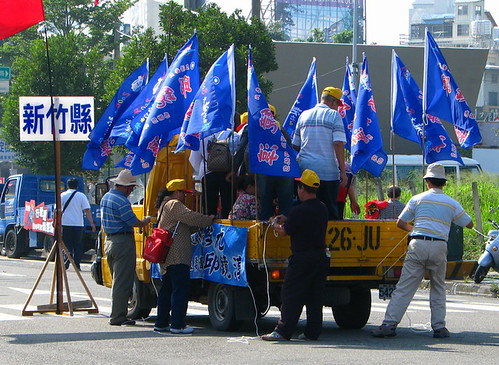
KMT supporters arrive for the big rally.

Massive rallies in Taiwan yesterday! I stopped by the KMT UN rally today for about an hour and a half during its opening moments, where I met the redoubtable Craig Ferguson of CFImages (Craig's beautiful images are up now on his blog), and watched my first rally from the Other Side.

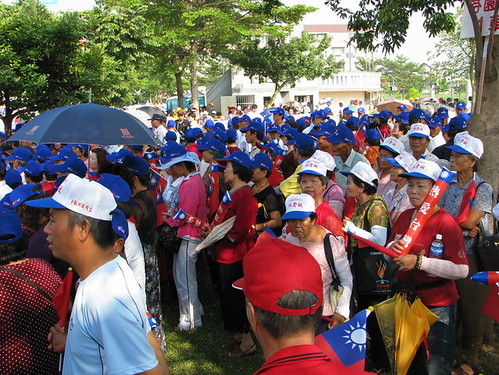
Waiting in the shade on a bitterly hot afternoon.

Step into the world of the Taiwanese KMT. Everyone at the rally was speaking Taiwanese, including the speakers on the stage, except for a few more formal remarks. The ralliers were asked to proclaim their love for Taiwan (ROC? What ROC?), and many led cheers calling for Chen to step down. Such remarks are so widespread, that one wonders whether the KMT realizes that it is running against Frank Hsieh, not Chen Shui-bian.

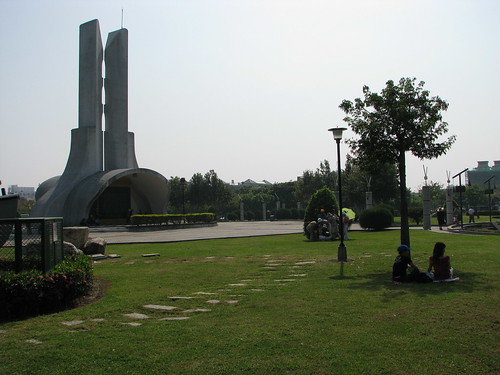
The Memorial at 823 Park.

The rally was held at the 8/23 Park in northern Taichung, which commemorates one of the great victories in the artillery war fought between ROC and PRC forces between the islands off the China coast in the 1950s.

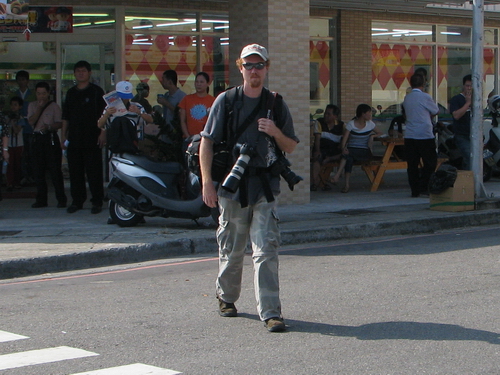
Craig Ferguson, loaded for bear.

Craig and I were the only white foreigners there, and we were just there to take pictures. I was approached by several media people, and left a verbal barb in the pro-KMT UDN reporter, telling him that I, like most foreigners here, was Green. I refused all requests to speak; God knows what I would have said with a microphone in my face.

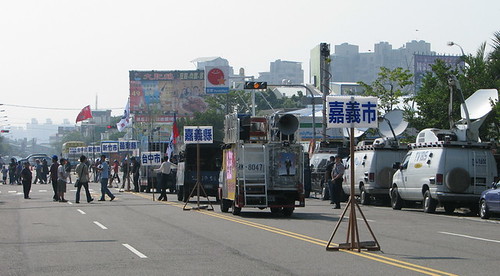
Media and sound trucks poised for action.

The rally was attended by people from all over the central part of the island. There were a large number of people dressed in aboriginal costume.

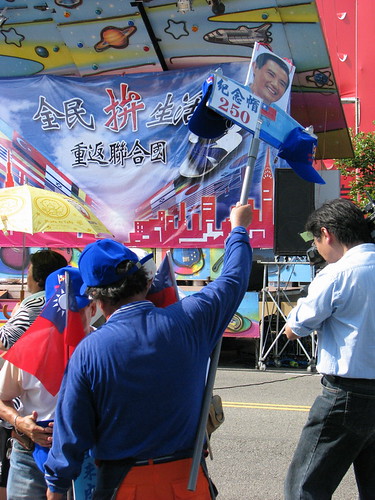
A souvenir vendor hoists Ma Ying-jeou paraphenalia.

None of the major politicians had arrived by the time I left at 4:30. The heat was oppressive, and most people were sensibly hiding out in the shade.

Brightly colored flags make for pretty pictures.

Ralph Jennings of Reuters on the UN Rallies:
About 250,000 people demonstrated in two Taiwan cities on Saturday to back the island's doomed efforts at securing United Nations membership, a move condemned by rival Beijing and rejected by ally Washington.

Some 150,000 people, including President Chen Shui-bian, marched through the southern port city of Kaohsiung in pro-U.N. green shirts and waving flags. Political opposition forces in Taichung meanwhile marshaled at least 100,000 people.

"The biggest thing is for the United Nations and the United States to notice that this U.N. effort is not just something Chen Shui-bian is doing," said Kaohsiung demonstrator Wang Chun-kai, 35, a businessman from the nearby city of Tainan.

Government officials say they know the U.N. bid will fail, prompting speculation that the ruling Democratic Progressive Party (DPP) has used it to solidify a long-term agenda of greater independence from China by stirring anger at home.

The United Nations is expected to reject the bid on Tuesday.

"The U.N. bid, of course, has absolutely nothing to do with getting into the U.N.," said Ralph Cossa, president of the U.S.-based think tank Pacific Forum CSIS.

"I think it is mostly tied into the Taiwan identity issue and the DPP's efforts to lock future administrations into this mindset."
The last sentence shows the latest wisdom that is rattling about the Establishment echo chamber: that the UN bid is really the "radical" Chen's bid to control the "moderate" Hsieh so that the latter has to follow the "radical" independence path. Never mind that Hsieh and Chen, whatever the personal rivalries, belong to the same party, and have been advocating independence and UN entry for the better part of two decades, nor that Chen was widely seen as a "moderate" upon assuming office. Once the Establishment decides on something, no evidence to the contrary will get it to change the CW. Note that this position is essentially a pro-KMT propaganda theme that has been picked up in some of the more conservative publications -- that the whole UN thing is simply Chen's bid to control the future of the DPP.

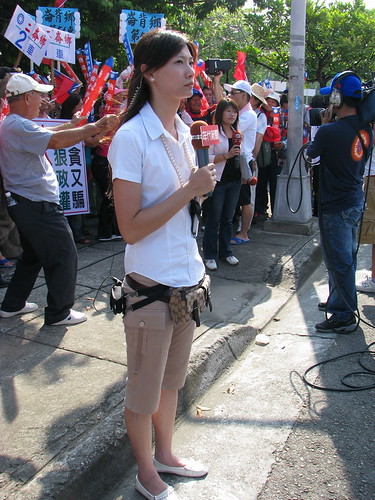
The first requirement for a TV reporter is babeness.

The Associated Press reported:
Surrounded by cheering supporters, Chen led marchers through the Kaohsiung streets amid colorful banners and rippling flags, looking poised and confident.

Addressing a rally ending event at a downtown plaza, Chen declared his love for Taiwan as the crowd applauded wildly: "I pay respect and appreciation to you all."

It was a remarkable comeback for a man who only a year ago was written off as an embarrassment by the ruling Democratic Progressive Party, which feared that a series of corruption sandals involving his family and inner circle would doom it to defeat in the upcoming presidential poll.

But now it is the main opposition Nationalist Party that seems to be caught off balance, torn between its support for eventual unification with the mainland, and its recognition that U.N. membership is a huge vote-getter with the Taiwanese public.

Reflecting the party's dilemma, Nationalist presidential candidate Ma Ying-jeou held his own pro-U.N. membership rally on Saturday, attracting about 50,000 supporters to the central city of Taichung. But unlike the DPP rally 125 miles to the south, this one pushed for Taiwan's U.N. re-entry under its official Republic of China name.
"Remarkable comeback?" Only if you believe pro-KMT polls.

Watching the speakers.

The Taipei Times reported that "several members of Congress" had expressed their support for Taiwan:

Several members of the US Congress expressed their support for Taiwan's bid to gain membership in the UN ahead of a rally promoting the bid scheduled for yesterday in New York.

In a letter to the Formosan Association for Public Affairs (FAPA), one of the rally's main organizers, US Representative Anthony Weiner said he deeply regretted that the UN continues to disregard the sovereignty of Taiwan and deny the right of self-determination to its people.

"There is no question that the United States must stand strong and advocate Taiwan's independence from China and inclusion as a United Nations member state," Weiner said.

Releasing a statement on the issue, Representative Dana Rohrabacher said it was incongruous that a world body founded on the principles of universality and self-determination would exclude a free, democratic and independent nation whose population is larger than three-quarters of the UN' member states.

Rohrabacher said that with Taiwan possessing all the qualifications to become a UN member and ample resources to contribute to the work and funding of the UN, the country's accession to the world body is long overdue.

"Let's tell the world how unfair it has been to deny the 23 million people of Taiwan their voice and representation in the United Nations and especially their willingness to [help] other nations in need," he said.
Good to see a Dem, Weiner, in there pitching for Taiwan. Weiner represents Brooklyn and Queens in NY.

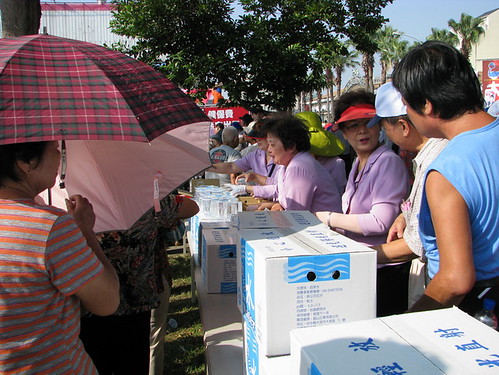
Volunteer grandmothers make the world go round.

The Taipei Times reported on the rally in Taichung:
Putting their 14-month-old boy on the father's shoulder, a Taichung resident surnamed Chang and her husband called on the DPP to reflect on its poor policies and urged the government to pay more attention to social problems.

"I closed my betel nut stand today to join the rally. We don't care about the UN referendum. What we want is a better life," said Chang, who declined to give her full name.

Dressed in traditional Amis clothing, Wang Chun-mei (王春梅) and dozens of her friends echoed Chang's demand for higher living standards.

"The people should stand up and fight for our economy. We want the government to take care of disadvantaged groups and develop the tourism industry," she said.

Legislative Speaker Wang Jin-pyng (王金平) did not attend the march, but showed up at the evening party afterwards.

Former KMT chairman Lien Chan (連戰) and People First Party Chairman James Soong (宋楚瑜) declined to attend the event.

Addressing the party, Ma condemned the DPP version of the referendum as an election gimmick designed to stir up emotions.

Ma said that the KMT version would not harm Taiwan's relationship with Washington.

Among the other KMT heavyweights NOT in attendance was Jason Hu, the mayor of Taichung, who had the excuse of being abroad.

Traditional music performers are an important part of any election activity.

The Beeb has pictures of the rallies up on its website here. Guess what: the whole world is talking about the UN bid. Go Grand Fenwick!

A KMT candidate exhorts her supporters.

AFP reported:

In contrast to the carnival atmosphere in central and southern Taiwan, dozens of people scuffled with police outside the Presidential Office in Taipei, where they were gathered to oppose the planned referendum.

Protestors sprayed red paint on photographs of the president and on government banners promoting the UN bid in a show of anger.

Some 15 of Taiwan's 24 allies have proposed the island's membership application to the General Assembly, which will decide whether to discuss it when the annual session opens on September 18.

Sounds like Shih's Red Ants were busy too....

Young performers ham it up for the camera.

These rallies announce the beginning of the serious election season here in Taiwan, which means that this issue will decline in importance as the DPP moves on to other activities -- meaning that This Too Shall Blow Over. Observe that all the KMT can do now is borrow ideas from the DPP and react to its thrusts, because -- as I've repeatedly noted -- the KMT has no platform of its own. Running on the economy is a dangerous idea, since Hsieh can co-opt its economic platform of opening to China very easily, and with greater credibility (and at present the economy is doing OK). The KMT has been totally defeated on the identity issue. If Ma loses or the legislative elections are a surprise, a profound identity crisis may grip the KMT. The Taiwanese KMT legislators have grumbled as ideologue Ma tightens his grip on the party, marginalizing their unofficial leader, Wang Jyn-ping, currently speaker of the legislature. They may be ripe for Wang to use as a base to form his own localized KMT party, or even to flip to the DPP.

And waiting out there somewhere is PFP Chairman James Soong, who may retain some shreds of popularity out there in the hinterlands somewhere......

The opening speakers. Everyone was pretty listless in the late afternoon heat at this point.

The Blue Sandal Babes.

The KMT symbol for this rally was the ubiquitous blue sandal, worn by Taiwanese everywhere, supposedly to symbolize the party's identification with the working classes (who, not by coincidence, form the core of the DPP's base). The Sandal Babes were followed everywhere by the media, and showed up in shots in the local newspapers. Smart marketing -- if you want something viewed, put a babe in it -- but the reality is that almost everyone at the rally came wearing ordinary shoes (sensibly too, since no one can walk any distance in flip-flops), at least when I was there.

Hope to see some great pics of the Kaohsiung rally from local bloggers. It may not reflect actual voting patterns, but it was nice to see the DPP rally crush the KMT rally. On to the elections!

Labels: , , ,

__________________________________________________

Monday, September 10, 2007

permalink

Red Ants Return

AFP reports that the Red Ant Army of Shih Ming-te is back in action.

Thousands of people rallied in the Taiwanese capital Sunday to mark the one-year anniversary of a campaign to oust President Chen Shui-bian over alleged corruption.

At least 1,000 riot police were deployed, but no clashes were reported in the candle-lit vigil, held on a square outside the presidential office.

Protesters donned red T-shirts and protest headbands, in a repeat of the huge demonstrations held a year ago when Chen refused to step down over allegations he misused funds intended for national affairs.

"The same place, the same old friends. As the same corrupt president is still there, your anger is totally understandable," democracy campaigner Shih Ming-teh, a former head of Chen's Democratic Progressive Party (DPP), told the crowd.

But he assured his supporters that their persistence would pay off.

"Because of you, whoever is elected as the president in the future will not dare to be corrupt," said Shih, who kicked off the A-bian (Chen's nickname) Out drive last year with round-the-clock protests in front of the presidential office.


AFP, like most who have reported on the anti-Chen protests, appears disinclined to do any real digging on this event, so I suggest you read my backgrounder over at DailyKos on the sad decline of Shih Ming-te. None of the foreign media have reported that Shih switched to the pro-China side in 2001, going to work for a pro-Blue "think tank" and running in elections against the DPP. AFP also leaves out the inconvenient fact that Shih's followers are all Blues, as Shih himself admitted last year, that there are credible allegations that Shih is getting money from China (Shih is close friends with alleged Taiwan embezzler Chen Yu-hao, who has links to the PRC government), and so on. These reports make Shih appear saner than he is, since no foreign media report has included any of his wilder remarks, such as claiming that bags on his HQ doorstep were bombs sent by the DPP, or saying that his followers were unemployed pigs. They have also failed to report that his own followers sued him for financial irregularities. In other words, the foreign media, in presenting Shih's protest, have left out everything that might enable the reader to actually understand what's going on: the whole thing is a faux protest, a pan-Blue put up job. Instead, what is created is essentially a pro-Blue political construction.

The first time the Red Ants appeared I mused on the odd connections between once-powerful local politician James Soong and Shih Ming-teh. Soong spoke at the protests many times last year, and was frequently pictured sitting next to Shih. Apparently Shih was not bothered by Soong's conviction for tax evasion (with the largest fine ever handed out to major Taiwan political figure) and the fact that he was fingered in a French Court for being the bagman on a US$400 million payoff in the Lafayette Frigate scandal. Last year, when Soong's party, the PFP, began putting pressure on the KMT about the stolen asset issue, suddenly, Shih began talking about the same thing.

Soong, a prominent pan Blue politician who once had a huge following and came just 3 points short of winning the Presidency in 2000, went into hiding after being shellacked in the Taipei mayoral elections in December of last year, where he got only 9% of the vote in the Bluest city in the country. With the Red Ants on the march again, think we'll be hearing from Soong soon?

Labels: , , , , ,

__________________________________________________

Thursday, September 06, 2007

permalink

Hsieh Attacks Ma for Colluding with China

International media reports on Taiwan's upcoming elections rarely mention, let alone analyze, the growing cooperation between the Chinese Communist Party and the KMT in Taiwan. Yet it is a major issue in the election here:

Democratic Progressive Party (DPP) presidential candidate Frank Hsieh (謝長廷) yesterday accused his Chinese Nationalist Party (KMT) counterpart, Ma Ying-jeou (馬英九), of colluding with Chinese leaders over the holding of a referendum on UN membership.

"Ma made promises to Chinese leaders when he was the KMT chairman," Hsieh said. "They most likely included carrying out the promises made by former KMT chairman Lien Chan [連戰]. Ma owes the public an explanation if he encounters any difficulties or contradictions in putting them into practice, because they could affect Taiwan's future."

Hsieh did not provide any evidence to substantiate his claims.

The remarks were occasioned by an article in the local Chinese-language China Times, the Xinhua of the KMT in the bad old days, that said the KMT had gotten a letter from Beijing:

A report in the Chinese-language China Times yesterday said Ting Yuan-chao (丁遠超), Lien's secretary, confirmed two weeks ago that Lien had received a letter from China and was asked to pass it on to the party's leaders.

The report said Chinese officials responsible for Taiwanese affairs had decided the referendum was "inappropriate."

Ting was unavailable for comment yesterday, while KMT leaders denied the letter existed.

KMT Secretary-General Wu Den-yih (吳敦義) said he didn't know anything about the letter, while KMT Spokesman Su Jun-pin (蘇俊賓) said the China Times report was "groundless."

"The KMT is pushing for the country's return to the UN. This will not change because of Chinese pressure," Wu said.

Wu said the party would go ahead with its plans to stage a rally in Taichung on Saturday to attract support for the party's referendum proposal.

The KMT can't be lying, because its senior members constantly go to China, obviating the need for a letter. For example, Lien Chan is on his way there right now:

Lien was accompanied by his wife, and will have to transfer airplanes in Hong Kong en route to China's Xinjiang province due to the lack of direct transport links between Taiwan and China.

Prior to his departure from the Taoyuan International Airport, Lien declined to answer reporters' questions regarding his role in a local newspaper report claiming that Chinese President Hu Jintao sent a letter to Ma Ying-jeou, the KMT's candidate in the March 2008 presidential election, voicing his objection to a KMT campaign aimed at holding a referendum on the country's U.N. bid.

According to the Taipei-based China Times, Hu sent a protest letter through Lien to Ma two weeks ago, but both Ma and the KMT central denied knowledge of receiving such a letter and said that they will not hold back in their efforts pushing for a U. N. referendum on the grounds that the issue has gained widespread public backing.

In April KMT Party Chairman Wu Po-hsiung announced that he would go to China immediately after being elected Chairman. Wu is widely reputed to be a Ma supporter.

In recent academic pieces on Ma, scholars have argued that Ma is a "moderate" because he has never gone to China. Why should he, when senior KMT officials go there for him? This "moderation" is typical of Ma -- while he has never gone there himself, neither has he criticized his fellows for kowtowing to Beijing.

Meanwhile, the closer the KMT gets to Beijing, the less well it will do in the polls here. Yeye, hurry home!

Labels: , , , ,

__________________________________________________