The short story is that because of the Chinese Nationalist Party''s (KMT) on-again, off-again boycott of both referendums, the threshold was not met for either one. Therefore, even though 94.01% of the ballots cast for the DPP said "yes" to their proposal to join the United Nations (UN) using the name "Taiwan," and more than 84% of those cast for the KMT-proposed/-boycotted referendum to "'rejoin' the international body using the name 'Republic of China' or any other 'practical' title that would uphold the country's dignity" also said "yes," both referendums failed. There's also the issue of the US government's "denunciation" of the referendums.
Much more info behind those links, including some partisan arrests for suspected vote buying which was nothing like the discussions in non-hushed tones that happened right in front of me yesterday.
The tautology of not throwing hissy fits Another article gets the headline "Foreign observers laud peaceful poll." Duh! The simple reason it was peaceful is because DPP supporters don't riot when their candidates lose elections, unlike the KMT, which has done so many times before. Be sure not to miss Lien Chan's (連戰) low-class hissy fit described within that very article. Ballots, not bullets: Taiwan, 台灣, United Nations, 聯合國, Taiwan 2008 Presidential Election, 2008年台灣總統大選, referendum, 公投
Chiang was the founding father of modern Taiwan, when his defeated army was driven from the Chinese mainland in 1949.
Many native Taiwanese resented this influx of mainlanders, and suffered human rights abuses during subsequent decades.
Mr Chen has sought to undo this legacy, and the re-dedication of the hall is the latest in a series of symbolic changes, the BBC's Chris Xia reports.
Most controversial is a plan to hold a referendum on joining the United Nations as the independent country of Taiwan.
This has provoked fury in Beijing, which still regards the island as a renegade province.
The name Chris Xia is mentioned within. S/He is the BBC's East Asia editor.
Get out your mediascopes Let's take a closer look at what I quoted above.
"[M]odern Taiwan" is often described as a "vibrant democracy." Chiang, on the other hand, was a dictator (ranked number four in the book Tyrants: History's 100 Most Evil Despots & Dictators), so he can hardly be described as "the founding father of modern Taiwan." The BBC's East Asia editor, however, somehow allowed that to appear in the article. Oh, wait. Xia is the East Asia editor.
UPDATE: The first paragraph from the section quoted above now reads:
Chiang Kai-shek, who once governed all of China, fled with his Nationalist troops to Taiwan in 1949 after losing the civil war to the Communists.
The rest remains as is. Note that the update could still be considered a pro-PRC position.
Screenshot from the Google cache of the page (Click thumbnail to enlarge)
[/END UPDATE]
"Mr Chen" happens to be President Chen Shui-bian (陳水扁) (the article does call him "President" in its first line), but he's not seeking to "undo" [Chiang's] legacy." What the Taiwanese resented wasn't merely the "influx," but rather the treatment they got. The resentment that remains is directed specifically at the people who still "hate Taiwan" and treat it as if it were part of China (which it isn't) -- not at the immigrants who have made Taiwan their home and who identify with the people here.
As for the editorial comment about the referendum being "controversial," that sounds a whole lot like a line that could have been fed to Xia by a deep-blue supporter or politician. No wonder Xia doesn't quote a source.
According to a poll conducted by the Executive Yuan's Mainland Affairs Council in April 2007, more than 77% of respondents support using the name Taiwan to apply for membership in international organizations, the United Nations included. In the face of such clear-cut public opinion, democratically-elected government of Taiwan must respond accordingly. As such, we have decided to apply for UN membership under the name Taiwan.
Xia considers 77% support to be "controversial"? Feh! Have a look at a sampling of the BBC's own controversial reporting on Taiwan:
A hissy fit a day keeps democracy at bay Just yesterday I compared the tendency of the opposition in Taiwan to throw hissy fits with the same tendency in the Republicans in the US. Both take constant advantage of the media to "catapult the propaganda" and avoid real discourse.
This silly image from the front page of Saturday's Taipei Times beautifully illustrates the hissy fits of Taiwan's opposition:
Somebody call the waaaaambulance! (Click image to view full size.)
The large text across the middle of the picture reads "Referendum kidnaps the election." The pan-blues think that people are too stupid to know how to vote if they pick up all their ballots at once -- or at least that's what they say. I think the truth is that they're afraid that if the election is held in a fully democratic way -- that is, where thugs who are outside of the polling station watching who picks up their ballots can't see what voters are doing -- they'll certainly lose. The referendum to allow the public to show their approval for applying for UN membership using the name "Taiwan" will win, and any remaining credibility the pan-blues' grip on the media has allowed them to maintain will vanish like vapors do when fresh air is allowed to pass through a previously-stagnant space.
The above photo, by the way, accompanied an article informing readers that the Central Election Commission (CEC) delayed their announcement as to whether ballots will be distributed all at once or with separate steps for the referendum ballots and presidential ballots. Hidden by all the squealing going on are the DPP's "stolen assets" referendum and the Chinese Nationalist Party's (KMT) "anti-corruption" one which the article tells us "aims to give the legislature the power to investigate allegations of corruption against the president and subordinates." Mixing the legislative and judicial branches of government contradicts what I learned in Civics class about "separation of powers" in a democracy.
Quiet riot? Don't deny it! Chao Shu-chien (趙叔鍵), a CEC member recommended by the People First Party, is paraphrased in the article as saying that "distributing the ballots together could spark a riot." He is directly quoted as saying that "If no serious problems occurred last time when the ballots were issued separately, why should we change it?" The piece of the puzzle without which we can't see the truth of the matter is that the opponents of the method used in the previous referendum (that would be the pan-greens) are generally non-violent, while the opponents of the proposed method of giving ballots all at once (that would be the violent pan-blues) threaten violence at just about every turn. (Please follow that link if you have any doubts.)
Vote these bastards out of office soon, please, so we can get beyond this medieval madness!
The correspondents This past Saturday, Michael Turton and Craig Ferguson were together in Taichung scoping out the old fogeys and hired babes at the Chinese Nationalist Party's (KMT) rally. Feiren and I were (separately) in Kaohsiung, as was Wally Santana of AP. The dateline on a Reuterspiece o'crap by Ralph Jennings (a veritable king of loaded language) says he was in Taipei (345 kilometers away from Kaohsiung), and while Bloomberg's Tim Culpan wrote about it, too, he may as well have been phoning it in from an alternate universe beneath KMT headquarters. (Read on, and you'll see why I say so.)
Many participants in the SocialForce.tw discussion took part in overseas rallies, including ones at the Dag Hammarskjold Plaza in New York, the Federal Building in Los Angeles, the TECO office in El Monte, CA, Vancouver, British Columbia, Canada, and many other places.
I can only wonder how many people around the globe took part in the day's events supporting Taiwan's entry into the UN.
From here to there First, some details gathered on my personal adventure to Kaohsiung.
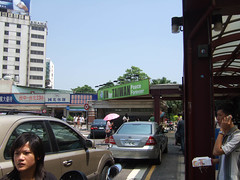
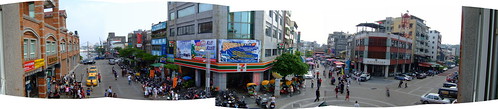
My wife and I boarded a Taiwan Railways train at the station in downtown Taichung, where there was a nice big "UN for Taiwan" banner hanging out front. (Be sure to also check out Michael Turton's impressive panorama of the same scene taken 2 days later when there were far fewer people.)
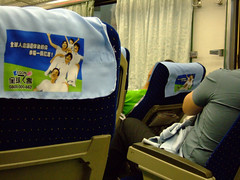
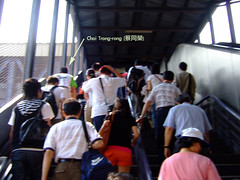
I didn't know if I'd see or be able to notice anybody aboard who might be headed to the Kaohsiung rally. Imagine my surprise when DPP heavyweight Chai Trong-rong (蔡同榮) got on my car in Chiayi (嘉義) wearing a green-sleeved "UN for Taiwan" jersey and sat a couple rows in front of me. He reclined in his seat and snoozed through most of the journey there, but before disembarking, a smiling supporter had grabbed his attention, so I didn't get the chance to say hello.
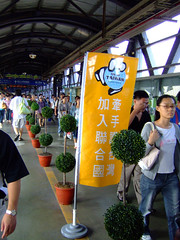
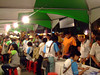
At the station in Kaohsiung, it was more crowded than Wal-Mart the day after Thanksgiving. I photographed a couple of the same kind of banners that Feiren saw there.
So that's why they call 'em "5-star" hotels! Leaving the train station by taxi, my wife and I headed to our hotel -- a high-class joint a short distance from the start of the parade route. But we were both tired and hungry. I had hardly slept at all on Friday night because I was so excited about the upcoming rally. We looked for food, but of the two nearby places on the map the hotel provided, one was already closed for their afternoon break, and the other apparently no longer existed at that location. So, we went back to the hotel and ordered room service.
By the time we had eaten, the parade had already gotten underway, so we were trying to see how the media was covering it. When I turned on the tube, it was tuned to TVBS where Lee Tao was busy spouting his usual nonsense and looking like his head was about to explode. SET was missing in action. FTV was present and accounted for, so we stuck mostly with that channel.
The TV images showed huge crowds, and we were in an air-conditioned room sitting on a comfortable bed. But I didn't come all that way just to sit there!
Inertializing... Since the parade was well on its way, we hailed a taxi and headed for Nong 16 (農16), which was the end of the parade route and the site of the evening rally. The ride was not short (costing NT$150), so I didn't regret skipping the long walk in that heat. We were able to get out just a short distance behind the big stage.
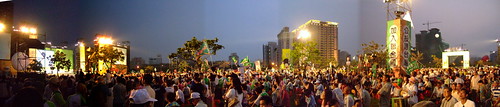
Pure energy There was so much happening, I have to refer to my photos and videos to get everything in order. Also, even though I was trying to not to fill my memory cards with images, I filled 3 of them.
Miscellaneous observations Kaohsiung mayor Chen Chu (陳菊) had lots of energy with which to fire up the crowd. An aboriginal singer-rapper let the rhythms flow in an exciting rapid-fire manner, yet he carried a wonderful melody at the same time. There were many different kinds of T-shirts for sale. I got myself a special one with a design which I'll keep secret. ;-)
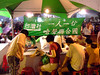
The crowd was composed of people of all ages. I saw a guy walking with an upside-down ROC flag hanging from a ragged broom. A man in front of me had flags from earlier pro-democracy rallies I'd attended (228 Hand-in-Hand, 326 Democracy/Peace/Protect Taiwan). There were people as far as the eye could see (with more and more arriving in droves). An Elvis impersonator sang "Heartbreak Hotel," "Hound Dog," and other tunes. DPP Legislator Kuan Bi-ling (管碧玲) led the crowd with inspiring cheers. I saw Robin Hood (AKA Robin Dale of "Formosa Lily" fame [see the original video]) in the crowd nearby, Vice-President Annette Lu (呂秀蓮) implored the US government in English to understand Taiwan's dilemma. Cabinet spokesman Shieh Jhy-wey (謝志偉) via satellite, live from New York kicked out something like a rap -- in Taiwanese:
And how could I forget Frank Hsieh's (謝長廷) chiding of Ma "Don't Paint Me Red" Ying-jeou:
你為什麼不給台灣一個機會?!
[Maddog translation] Why can't you give Taiwan a chance?!
Coming up to the end of the event, when Cabinet Secretary-General Chen Chin-jun (陳景峻) and Kuan Bi-ling introduced President Chen Shui-bian (陳水扁), the crowd went abso-friggin-lutely wild. See for yourselves:
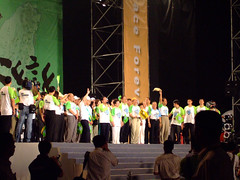
At the end of the evening, there were lots of fireworks, the sound system played Beethoven's "Ode to Joy" at high volume, lifting spirits even higher, people were enthusiastically chanting "Taiwan! Go, go, go!" and the evening, despite some small glitches, was one for the history books. The people of Taiwan, both at home and abroad, along with friends from nations around the world, had stood up and made their voices heard with a peaceful, positive message: "UN for Taiwan! Peace forever!"
A short while later when it was time to go, without necessitating any external pressure, the crowd dispersed in quite an orderly fashion, as they have at every single DPP event I've attended. It was a great end to an awesome evening.
Appreciation During the rally, I got many smiles, thumbs up, expressions of gratitude, handshakes, and arms around the shoulder for my presence and support. As memorable as it already was just to be there, those things gave the experience an even more powerful flavor which I will forever carry with me.
The soreness On the downside, my legs were killing me, so after grabbing some nourishment at a nearby bakery, we headed back to the hotel. The TV was strangely not saying a whole lot about the event, so it was time for a little more food, a shower, and sleep.
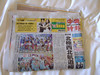
Rude awakening The hotel breakfast was pretty bad, and by that, I mean 5-star awful! But equally bad was the China Times (中國時報) hanging on the door handle when we first went out. Perhaps that was the bad taste that lingered within me until noon.
To our surprise, when we picked up the Liberty Times (自由時報) (a "green" paper) from the nearest convenience store, the story wasn't on its front page. (It was on page A3 while the KMT's was on page A2.) However, its "sister paper," the Taipei Timesreported it in the front page headline story which, in my opinion, was where it should have been.
The numbers game First, all the wrong ones, and I'll start with an explanation of what I was alluding to in my earlier remark about Bloomberg's Tim Culpan reporting from "another universe." Head firmly up someone's ass -- perhaps his own -- he says that there were a mere "60,000" in Kaohsiung -- supposedly quoting [DPP] "organizers" -- and "100,000" in Taichung, quoting the KMT. Ralph Jennings of Reuters tells readers that there were "150,000" in Kaohsiung and "100,000" in Taichung. Wally Santana says "more than 100,000" were in Kaohsiung. Even the BBC says, quoting "police," that "At least 100,000 people" took part in the rally in Kaohsiung, and a later BBC story says "250,000." But you know what? They're all wrong -- every last one of them.
My own conservative estimate of at least 500,000 is based on: being there; walking through the whole site twice; actually counting large sections of people; and estimating how many such sections were present. Oh, and there are those photos and videos that I shot, in case you have doubts.
The usual BS The above articles all contain the usual memes/errors/lies/distortions -- you know, the ones about Chen Shui-bian being "written off as an embarrassment" by his own party or of being "unnecessarily provocative" towards the US and/or China, the ones where the Chinese Nationalist Party (KMT) has the "Chinese" part left off, the ones where Taiwan "split" from China in 1949, the ones where the economy is "sluggish," and so on and so forth, ad nauseum.
Readers of Taiwan Matters should certainly know better than to believe any of that kind of nonsense.
China has seen self-ruled Taiwan as part of its territory rather than as a separate country since the island broke away from China in 1949 when Mao Zedong's Communists came to power.
Uh, not unless you equate both 1949 Taiwan and 1949 China with the KMT, eh? [/ END UPDATE]
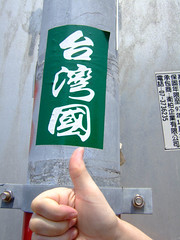
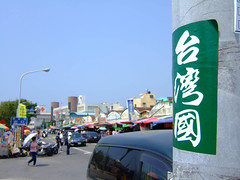
The little surprises Heading over to Chichin Island (旗津) early Sunday afternoon where the crowds were totally unaware of a "sluggish" economy, my wife almost immediately spotted something exciting -- a green sticker on a light pole reading in white calligraphic script "台灣國" (Taiwan Nation). Thumbs up!
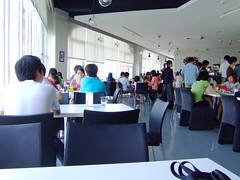
But it felt hotter and more humid than the sauna in hell's kitchen, so after stopping at a juice stand across the road, and passing by several of what my wife and I both perceived as being practically identical seafood eateries (no obvious specialties, just the same 50 or so items at every place?), we opted instead to head straight to La Mambo café, where the jingji (經濟, economy) seemed actually rather jingqi (景氣, or bustling).
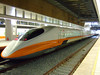
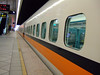
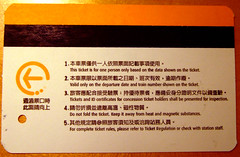
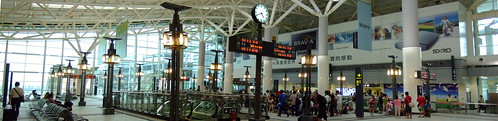
Yep, that's right! We returned to Taichung on Taiwan's relatively new High Speed Rail. It was our "first time," and in contrast with what the Consumers' Foundation (Chinese Taipei) would have had us believe, nearly everything about the HSR was easy-breezy.
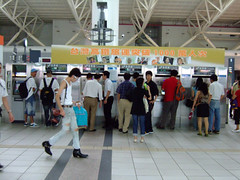
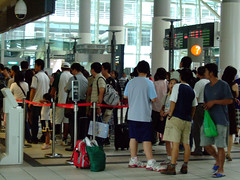
In contrast with what the pan-blue media had been telling me, there were lots of people buying tickets. We got to the station so early (as a precaution) that our wait was actually longer than the trip itself! We walked around the station and checked out the shops, the signage, etc.
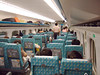
The trip home was fast. It was smooth. I was oblivious to just how much danger I was supposed to be in.
Zuoying HSR Station
Home, sweet potato home Back in Taichung, I started putting all the photos and videos onto the hard drive, writing this post, editing videos, uploading and tagging photos, looking for others' experiences with the rallies. It took way too long, but I hope I've given you a view that you wouldn't have otherwise seen.
Get your maps, info, and reasons for going to Kaohsiung
Two rallies will be held tomorrow in support of 2 separate referenda. The DPP's, which supports joining the United Nations (UN) under the name "Taiwan," is important in that it will let the world know some very important things:
1) Taiwan is a democratic nation.
2) Taiwan is not part of China.
3) Taiwan's citizens do not want to be part of China.
4) Taiwan's citizens want their nation to be recognized as a a participant on level ground with the international community.
5) Taiwan wants freedom from the perpetual pressure from the US and China to bow to their whimsies.
[Tim Maddog translation:] Primary text: In 1971 the People's Republic of China joined the United Nations, replacing the Republic of China, and leaving Taiwan as an "international orphan." To strongly convey the will of the citizens of Taiwan and promote Taiwan's international standing and participation, do you agree or disagree that the government should use the name "Taiwan" to join the United Nations?
Background Neither the PRC, which now holds the "China" seat at the UN, nor the ROC, which once held the same seat, have ever done anything to give real representation to the people of Taiwan. The PRC flag has never flown over Taiwan. While the ROC flag has done so, the makers of that flag lost their "China" (of which Taiwan was not a part) to the Chinese Communist Party (CCP); hence, the ROC claim that Taiwan is a province of "China" is about as slippery a drop of mercury on a Teflon™ cliff. Nevertheless, the Chinese Nationalist Party (KMT) still clings to the fantasy that the country from which Mongolia became independent in the early 20th century and which they lost entirely in 1949 still exists. For the ROC to "rejoin" the UN would mean that the PRC doesn't exist.
Foreign backing The KMT is desperately seeking foreigners to use as campaign props in their own "anti-referendum" rally in Taichung.
I would recommend, instead, that you head to Kaohsiung for the DPP's forward-thinking rally and show your heartfelt support for a democratic Taiwan with a brighter future than the KMT and CCP combined could (and would) impose upon it. If you've never been to such an event, I can't tell you how much the locals will appreciate your participation. If you have, then see you there!
The details Here's the parade route, via the web site of the DPP:
Click thumbnail to enlarge
Here's a Google map where you can see the rally location -- the big grassy area at center right.
Here's a map I built on Wayfaring.com which shows the route, etc. (Hover on the yellow "bubbles" for notes.):
Click once on the map to change to "satellite" or "hybrid" view, zoom, etc.
I've been seeing contradictory information about times and parade routes, but the latest, most reliable info I have says that people should meet at 3 PM at the intersection of Chungshan 1st Road (中山一路) and Minsheng 2nd Road (民生二路), and the parade will start moving toward "Nong 16" (農16, a large grassy area) at around 4:15 PM. According to my Wayfaring map, the route is 2.44 miles (3.93 kilometers) long. Whatever happens, it shouldn't be too hard to find. There's sure to be a big crowd.
Come together, right now, on the green! So, get on the ball! Many hotels are already booked to capacity for Saturday night. And if you're watching it on TV from either side of the globe, the climax should be happening at 9 PM Saturday Taiwan time (9 AM Saturday, US east coast time).
What we at this blog have been saying all along has supposedly been said by US officials in a letter to the United Nations, quoted here in an FTV article via Sina.com:
[Tim Maddog translation:] US doesn't accept that Taiwan is part of the PRC
The United States spoke out just last week to say that neither Taiwan nor the Republic of China are countries. News reports on September 5 said that the United States wrote a letter to the United Nations saying that it "does not accept that Taiwan is a part of the People's Republic of China." The blue and green camps both confirmed the news. The DPP said it will exert even more effort to promote its planned referendum on joining the UN.
The China Times, in a dispatch from Washington DC, said China has canceled the plan for the UN vote. China now says that it is UN members' consensus that Taiwan is part of China, so there is no need for a vote.
In a nine-point clarification, the US told the UN that 'Taiwan is part of the People's Republic of China' is not the consensus of the majority UN members, and is not the consistent policy of the US.
Washington has conveyed this stance to both the UN and Taipei, the mass-circulation Chinese-language paper said.
China originally planned to ask UN members to vote on 'Taiwan is part of China' to block Taiwan's bid to join the UN. Taiwan has been seeking to join the UN since 1993 but stepped up its campaign this year by applying to join the UN as a new country, called 'Taiwan,' with President Chen Shui-bian signing the application which was delivered to UN Secretary-General Ban Ki-moon.
Ban rejected Taipei's application, saying the Taiwan issue was solved when the UN passed Resolution 2758 in 1971 to expel the Republic of China (ROC) and accept the People's Republic of China (PRC).
The ROC government lost China to the Chinese Communists in 1949 - when it fled to Taiwan to set up its government-in-exile, still called the ROC - but continued to hold China's UN seat until 1971.
Note the complete rectification of the old false meme about "Taiwan and China" having "split in 1949." Now that's Journalism with a capital J! Whoever is responsible for that deserves some heavy-duty kudos.
Ma Ying-jeou seriously misrepresents Taiwan Relations Act
Equine waste matter for the masses [UPDATED WITH IMAGE AND VIDEO LINKS]
In an article about the competing versions of a referendum regarding Taiwan's bid to join the United Nations, the Sunday edition of the Taipei Times gives us a direct quote from Chinese Nationalist Party (KMT) presidential candidate Ma Ying-jeou (馬英九) in all its fly-infested glory:
KMT presidential candidate Ma Ying-jeou (馬英九) yesterday blamed the strong US reaction on the DPP's attempt to push for the bid to enter the UN under the name "Taiwan," arguing that it was still possible for the country to be recognized in the international community under the name "Republic of China (ROC).
"The US treats the ROC as a foreign government in the Taiwan Relation Act (台灣關係法). In other words, it is still feasible to rejoin the UN under the name `ROC,"' Ma said during a trip to Kaohsiung.
What a mess of lies mixed with fantasy! And the resulting stench is overwhelming! Somebody... help!
Maddog's Cleaning Machine™ to the rescue I just linked to the Taiwan Relations Act on Saturday night. Let's refer to that link once again to see exactly what it says about the "ROC":
SEC. 2. (a) The President- having terminated governmental relations between the United States and the governing authorities on Taiwan recognized by the United States as the Republic of China prior to January 1, 1979 [Maddog note: that would refer to the, um, KMT], the Congress finds that the enactment of this Act is necessary--
[...]
(c) For all purposes, including actions in any court in the United States, the Congress approves the continuation in force of all treaties and other international agreements, including multilateral conventions, entered into by the United States and the governing authorities on Taiwan recognized by the United States as the Republic of China prior to January 1, 1979, and in force between them on December 31, 1978, unless and until terminated in accordance with law.
[...]
(b) The President is requested to extend to the instrumentality established by Taiwan the same number of offices and complement of personnel as were previously operated in the United States by the governing authorities on Taiwan recognized as the Republic of China prior to January 1, 1979.
[...]
(2) the term "Taiwan" includes, as the context may require, the islands of Taiwan and the Pescadores, the people on those islands, corporations and other entities and associations created or organized under the laws applied on those islands, and the governing authorities on Taiwan recognized by the United States as the Republic of China prior to January 1, 1979, and any successor governing authorities (including political subdivisions, agencies, and instrumentalities thereof).
There you have 'em -- each and every mention of the "Republic of China" (excluding "People's Republic of China") within the Taiwan Relations Act. Search that page for yourself if you don't believe me.
But just in case anybody riding Ma's wavelength still doesn't get it (or pretends not to), the Act states with very precise phrasing that as of January 1, 1979, what was formerly (therefore, no longer) recognized by the US as the "ROC" would from that point onward be referred to as "Taiwan." Note, too, that the Act defines Taiwan clearly as:
[...] the islands of Taiwan and the Pescadores, the people on those islands, corporations and other entities and associations created or organized under the laws applied on those islands, and the governing authorities on Taiwan.
There's nothing there about any of Mongolia, Tibet, or any of the provinces currently under China's (PRC) rule and which Ma's ROC would most likely include in its territory. And nowhere within does the US "treat[] the ROC as a foreign government," as Ma claims. It treats the ROC as a formerly recognized government.
Lastly, but not least, read the name of the Act -- out loud. It's called the "Taiwan Relations Act."
What, Ma worry? In addition to the reasoning implicit and explicit above, applying for UN membership as the "ROC" has been tried over a dozen times, and it has met with failure each and every time. Is Ma actually afraid that even if it fails, using Taiwan will gain a bit of ground for the people of this nation in their quest for international recognition of their existing independence?
The law of repetition To repeat Ma's lie: "The US treats the ROC as a foreign government in the Taiwan Relation Act." Read the Act for yourself to see that this is a lie. It's Taiwan which the Act says is to be treated by the US in the same manner as "foreign countries, nations, states, governments, or similar entities." [See Section 4 (b) (1) & (2).]
To restate the facts: That "treat[ment]" ended on January 1, 1979, and the "foreign government" has from that date onward been referred to as "Taiwan." Read the Act for yourself to see that this is the truth.
To remind readers of more facts: UN Resolution 2758 brought an end to the legitimacy of the ROC's representation of China at the UN, and the blame for the "strong US reaction" should be placed squarely on the shoulders of our unfriendly neighbor: China.
To repeat for the sake of absolute clarity, Taiwan is defined in the Taiwan Relations Act as:
[...] the islands of Taiwan and the Pescadores, the people on those islands, corporations and other entities and associations created or organized under the laws applied on those islands, and the governing authorities on Taiwan recognized by the United States as the Republic of China prior to January 1, 1979, and any successor governing authorities (including political subdivisions, agencies, and instrumentalities thereof).
It's a question of dust So, former-Chairman Ma, why did you say what you said in Kaohsiung, and -- to paraphrase President Chen Shui-bian (陳水扁) -- 「ROC是啥碗糕?」 ("WTF is this 'ROC' of which you speak?") [UPDATE LINK: Hear President Chen say it with the context just past the halfway mark in Part 4 of the show.]
In other words, would you please be so bold as to draw a map of it for us as you explain -- out loud -- how on Earth that dusty historical relic could get a seat at the UN? Then tell us this -- if, by some remote chance (or devious trickery) you are elected president, who would you claim to represent, and on whose behalf? If the answer to either part of that question is "Beijing," then I know you dare not say it out loud the way Chen Shui-bian has clearly spoken of Taiwan's existing independence many times over.







 RSS Feed