Taiwan Matters! The PRC flag has never flown over Taiwan, and don't you forget it!

"Taiwan is not a province of China. The PRC flag has never flown over Taiwan."

Stick that in your clipboards and paste it, you so-called "lazy journalists"!

Thanks to all those who voted for Taiwan Matters!
in the Taiwanderful Best Taiwan Blog Awards 2010!
You've got great taste in blogs!

Saturday, May 30, 2009

permalink

The Chinese Nationalist Party hates Taiwan's democracy

Goodbye democracy, hello dead-dictator worship

In the days of freedom, it was known as the Taiwan Democracy Memorial Hall. We should have known what was coming.
Taiwan Democracy Memorial Hall (臺灣民主紀念館)
Photographed in December 2007 by Tim Maddog
(Click to enlarge)

The Saturday, May 30, 2009 edition of the Taipei Times brings us the details of the Chinese Nationalist Party's (KMT) plans to reverse Taiwan's democracy all the way back to how things were when they were the only party that was legal and memorializing dictators was de rigueur:
Old CKS plaque to be reinstated at Memorial Hall

[...]

The [KMT] government has decided to remove a plaque bearing the name "National Taiwan Democracy Memorial Hall" from the main building of the hall and would reinstate the "Chiang Kai-shek Memorial Hall" plaque in July, Minister Without Portfolio Ovid Tseng (曾志朗) said on Thursday.

The decision was made after coordination meetings between different government branches, Tseng said.

As for the inscription on the memorial hall's entry arch, the Ministry of Education said yesterday it would hold three public forums next month to discuss whether to reinstate the four-character inscription, dazhong zhizheng (大中至正), which means "great neutrality and perfect uprightness."*

Participants at the forums will include academics and experts, while elected representatives and government officials will be excluded from the meetings, the ministry said.

Tseng said the government would not replace the "Liberty Square" inscription at the hall entrance until after gauging public opinion on the matter during the ministry-sponsored forums.

[...]

During the review of the central government's budget request for the current fiscal year in January, the KMT-controlled legislature passed a resolution stating that "the name of National Taiwan Democracy Memorial Hall shall be changed to Chiang Kai-shek Memorial Hall."
Note carefully how they say they won't replace the "Liberty Square" sign "until after they gauge public opinion." According to experience, that means that no matter what the public has to say about it, they will do it, perhaps after pretending to do a survey.

A closer shot of the plaque which reads ''Taiwan Democracy Memorial Hall''
A closer shot of the plaque which reads
"Taiwan Democracy Memorial Hall"
Photographed in December 2007 by Tim Maddog
(Click to enlarge)

* NOTE: The second and fourth characters in "dazhong zhizheng" form two-thirds of one of Chiang Kai-shek's (蔣介石/蔣中正) names. Every city in Taiwan has a Zhongzheng/Jhongjheng/Chungcheng Road (中正路).

A Taipei gate displaying the words ''Liberty Square''
The gate at Liberty Square
Photographed in December 2007 by Tim Maddog
(Click to enlarge)

Directional indicators: , , , , , , , , , , , , , ,

Cross-posted at It's Not Democracy, It's A Conspiracy!

Labels: , , , , , , , , , , , ,

__________________________________________________

Wednesday, January 02, 2008

permalink

Another distortion piece from the BBC

Down with Xia!

A piece with no byline on the web site of BBC News tells of the "recycl[ing]" of the former National Chiang Kai-shek Memorial Hall (國立中正紀念堂). Then it tacks on some nonsense which the BBC seems to require by policy:
Chiang was the founding father of modern Taiwan, when his defeated army was driven from the Chinese mainland in 1949.

Many native Taiwanese resented this influx of mainlanders, and suffered human rights abuses during subsequent decades.

Mr Chen has sought to undo this legacy, and the re-dedication of the hall is the latest in a series of symbolic changes, the BBC's Chris Xia reports.

Most controversial is a plan to hold a referendum on joining the United Nations as the independent country of Taiwan.

This has provoked fury in Beijing, which still regards the island as a renegade province.
The name Chris Xia is mentioned within. S/He is the BBC's East Asia editor.

Get out your mediascopes
Let's take a closer look at what I quoted above.

"[M]odern Taiwan" is often described as a "vibrant democracy." Chiang, on the other hand, was a dictator (ranked number four in the book Tyrants: History's 100 Most Evil Despots & Dictators), so he can hardly be described as "the founding father of modern Taiwan." The BBC's East Asia editor, however, somehow allowed that to appear in the article. Oh, wait. Xia is the East Asia editor.

UPDATE: The first paragraph from the section quoted above now reads:
Chiang Kai-shek, who once governed all of China, fled with his Nationalist troops to Taiwan in 1949 after losing the civil war to the Communists.
The rest remains as is. Note that the update could still be considered a pro-PRC position.

Hosted by ImageShack.us
Screenshot from the Google cache of the page
(Click thumbnail to enlarge)

[/END UPDATE]

"Mr Chen" happens to be President Chen Shui-bian (陳水扁) (the article does call him "President" in its first line), but he's not seeking to "undo" [Chiang's] legacy." What the Taiwanese resented wasn't merely the "influx," but rather the treatment they got. The resentment that remains is directed specifically at the people who still "hate Taiwan" and treat it as if it were part of China (which it isn't) -- not at the immigrants who have made Taiwan their home and who identify with the people here.

As for the editorial comment about the referendum being "controversial," that sounds a whole lot like a line that could have been fed to Xia by a deep-blue supporter or politician. No wonder Xia doesn't quote a source.

On the web site of Taiwan's Ministry of Foreign Affairs, one can easily dig up the information that will shine some light on Xia's distortion:
According to a poll conducted by the Executive Yuan's Mainland Affairs Council in April 2007, more than 77% of respondents support using the name Taiwan to apply for membership in international organizations, the United Nations included. In the face of such clear-cut public opinion, democratically-elected government of Taiwan must respond accordingly. As such, we have decided to apply for UN membership under the name Taiwan.
Xia considers 77% support to be "controversial"? Feh! Have a look at a sampling of the BBC's own controversial reporting on Taiwan:
1) BBC gets Taiwan all wrong
2) BBC angers all who care about Taiwan
3) BBC still not getting Taiwan right
4) BBC continues Taiwan deception
5) BBC strikes again
6) BBC Taiwan Coverage: Pathetically Biased
7) BBC cooks up more nonsense about Chen recall bid
8) Who will observe the Taiwan observers?
9) BBC has news about Taiwan totally backwards
Finally, as for Beijing being "provoked," remember that it is a policy choice for them, and since the PRC flag has never flown over Taiwan, it couldn't possibly be a "renegade province," so stop saying that.

Controversy generators: , , , , , , , , , , , , , ,

Cross-posted at It's Not Democracy, It's A Conspiracy!

Labels: , , , , , , , , , , , , , , ,

__________________________________________________

Monday, December 10, 2007

permalink

How AFP tailored a report to mislead readers

The hot news in Taiwan these two days is the violent resistance to the government's removal of the final symbol of authoritarian regime -- the "dazhong zhizheng"『大中至正』 plaque referring to dictator Chiang Kai-shek (蔣介石) at the gateway to Taiwan Democracy Memorial Hall. A bloody crime was committed by a pro-China supporter during the confrontation.

As the foreign media often report biased news of Taiwan following the propaganda put forward by the local pro-KMT media, I am curious for how they are gonna cover this.

It won't take much time before one is spotted. AFP, Agence Frence-Press, claimed to be "the world's oldest established news agency", can't wait to lead the world on manipulating news to serve the particular political agenda of some particular party.

Go see Michael's AFP Again *Sigh* for details on how AFP uses carefully chosen words in their recent report "Taiwan leader defends move to downplay Chiang legacy" to make the story one-sided. What I am going to point out here is how AFP uses selected photos and legends to further achieve that goal.

AFP displayed 3 photos on the same page of that article Michael mentioned.

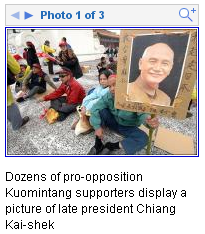
The first photo shows Chiang Kai-shek supporters sitting on the ground, holding a big photo of Chiang's. The legend says:

"Dozens of pro-opposition Kuomintang supporters display a picture of late president Chiang Kai-shek"

Note what this photo and the legend tramsmit:

  1. Peaceful demonstration of the pro-Chiang supporters, which is not the whole story;

  2. No mention of the fact that Chiang is considered a dictator in the eyes of many Taiwanese;

  3. No mention that there are many people showed up to support the removal of the『大中至正』 plaque, creating a wrong impression that Taiwanese are against this removal.

(Screen shot of photo and legend #1)


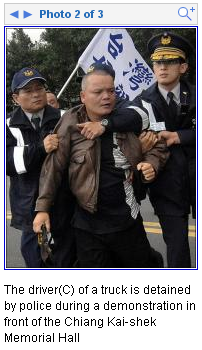
By itself this photo probably won't cause too much misleading. But AFP didn't stop here. The second photo is an arrest of a truck driver by police, with legend:

"The driver(C) of a truck is detained by police during a demonstration in front of the Chiang Kai-shek Memorial Hall"

(Screen shot of photo and legend #2)
Without informing the readers the cause of arrest, this photo and legend might give the readers a wrong impression that Taiwan police arrest demonstrators for no reason.

The fact is, the truck driver, Peng Sheng-lu (彭盛露), drove his truck at high speed into a group of people, dragging a journalist underneath the truck, and kept going for 10 meters despite that surrounding people shouting that a guy was under the truck.

His violent behavior resulted in serious injuries of several journalists. The one who was dragged underneath, ETTV cameraman Wang Jui-chang (王瑞璋), had to be taken care in an intensive unit of a hospital overnight before it was confirmed that the injury was not life threatening.

Peng denied being intentional, but many witness and police said otherwise, judging from the fact that Peng stopped and charged several times before he was finally stopped:

彭盛露否認故意撞人,供稱為閃避民眾圍毆開車逃離,誤踩油門才撞上媒體記者。不過,警方以他駕車連續三度衝撞媒體記者,有殺人故意;另查出他是某立委參選人的助選員,涉及選舉暴力,訊後將他依殺人未遂、傷害及違反選罷法、妨害公務、毀損等五罪嫌送辦。

Peng committed total of 5 crimes, including one felony of attempted murder. That's why he got arrested. The news was all over local media, yet AFP reporter skillfully hides the crucial criminal fact from her readers but revealed only that a demonstrator was arrested.

Together with the impression presented from the first photo, that the demonstration is peaceful, this photo of "arrest for no reason" misled readers into believing, or at least suspecting, that Taiwan police arrest peaceful pro-Chiang demonstrators for no reason.

It is for obvious reasons that this AFP reporter, whose name is not shown, doesn't want his/her readers to know that the arrested criminal, Peng, is a registered campaign assitant of a pro-China legislative candidate Mei Feng (梅峰), who claims on his website to be a "China Legislative Candidate." (in Taiwan?)


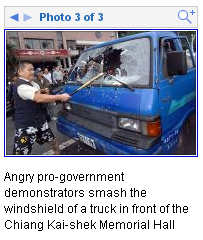
AFP continues her news distorting trick onto the 3rd photo, which gets even dirtier. It shows that one guy is smashing the windshield of a truck, with legend:

"Angry pro-government demonstrators smash the windshield of a truck in front of the Chiang Kai-shek Memorial Hall"

Note what I highlight above. What AFP hid from the readers in this single photo are:

  1. The crime committed by the driver of this truck prior to this windshield smashing act (在眾人驚慌尖叫下,員警、媒體記者和民眾合力擋住小貨車,員警火速拔掉車鑰匙並將彭盛露拉下車。一名台建聯盟成員拿出棍棒猛砸車頭和擋風玻璃 [see here]);

  2. The truck was the crime tool of a violent act;

  3. The pro-government demonstrators were angry because of that criminal act committed by an anti-government demonstrator;

  4. The direct 'cause-and-response' relationship between the crime act in photo#2 and the behavior in photo#3.

(Screen shot of photo and legend #3)
Note that in photo#2, not only the attempted murder charge was hidden from the readers, but also the identity of the criminal, including name and which side he serves for, was not mentioned. But in photo#3, AFP didn't forget to remind readers that the angry windshield-smashing guy is a "pro-government" supporter.

It seems to me that not only the photos and legends are carefully selected, but the order of how those photos are presented is carefully arranged in such a way that readers will be led to have an impression that:

1. Pro-Chiang demonstrators are peaceful;
2. Taiwan police arrested peaceful demonstrators for no reason;
3. Pro-government demonstrators are violent.

Unfortunately none of these covers entirely what really happened there.

When a journalist is accused of being biased, we could think of that he or she is eitehr ignorant or having own agenda. In this case, the AFP reporter saw a confrontation between DPP government and anti-government pro-KMT supporters, but by using carefully selected words and skillfully arranged photos and legends in their report, they hid the negative part of pro-KMT side to make pro-KMT look good, and at the same time hid all the background and historical information to make DPP government and DPP supporters look bad. With AFP's professional effort, this entire event has been painted into a shape that's far away from the truth. This kind of truth distortion can't be explained away by simply being ignorant.

In their own website, AFP claims (highlight by me):

"Today, the agency continues to expand its operations worldwide,... All share the same goal: to guarantee top quality international service tailored to the specific needs of clients in each region."

AFP certainly leads the global media on the "service tailored" part.

------------

Update: I am attaching some other sources to let you see how much AFP has left behind. Comparing them, you would wonder if the writer of AFP is either drunk in some lala land, or is paid to write a propaganda note.

1. BBC Chinese "大中至正"牌匾完成拆除
(with my translation)
支持拆匾的民眾高喊"打倒威權",並且開紅酒慶祝,反對拆匾的民眾則咒罵陳水扁及民進黨政府,...
The people supporting the removal of the plague shouted "Down the authoritarity" and celebrated with red wine. Those who are against it blamed Chen Shui-Bian and DPP government, ...
在昨天的流血事件中,一名駕駛貨車的立委助選員,意圖沖撞主張拆匾的台獨人士,他在遭阻攔及記者包圍採訪後,駕車沖撞記者造成一名記者被撞倒拖行而身受重傷。
In that bloody incident yesterday, an assitant of a legislator candidate drove a truck, intended to ram those plague-removal supporting TIers (Taiwan Independent supporters). After he was blocked and was surrounded by a group of journalists, he drove his truck into journalists, causing serious injuries onto a journalist who was dragged underneath the truck.

該名主張兩岸統一的立委參選人未獲政黨提名而獨立參選...
The pro-unification legislator candidate was not nominated by his party so he joined the campaign of legislative election without nomination.
該名遭起訴的貨車駕駛雖辯稱是意外事件,但據許多在場記者表示其多次猛加油門,是蓄意沖撞。
The indicted truck driver claimed that the whole thing was an accident, but according to the journalists at the scene, the driver pushed hard on gas paddle several times, indicating that the ramming was intentional.

2. A-gu's Characters down!

A reporter friend called me live from the scene about 10-15 minutes ago to say all the characters are finally down at the gate and on the memorial building itself.

I heard the crowd, which was cheering and very happy.

He said that as the construction workers were removing each nail on the final character at the gate, they would turn around and held it up to show the crowd, which cheered. As they finished and were coming down from their raised platform, they also waved at the crowd which again cheered them.

3. Thanks to Tim Maddog for providing the following links of video clips. Watch what really happened in the scene, and ask yourself: what kind of news agency would pretend that it didn't happen?

-- CNN news clip. From the content, this clip shows what happened right after the ramming started. Police were trying to drag the driver out of the truck, but the truck kept going. You can hear the screaming and crying of bystanders, and frantic "Someone underneath the truck!!" shouting. (Link to the original clip):


-- News clip based on ftv.com.tw (Link to the clip on YouTube)


------------

4. A historical moment of the end of authoritarian regime. Video clip from Taipei Congressman Chuang Rui-Hsiung (莊瑞雄, Nickname Taiwan Bear)'s website. Click to see how Taiwanese cheered and celebrated the removal of Chiang's plague. You can see how far AFP misled the readers. (original link)


5. Tim Maddog sent me this: Taipei Times regrets citing information from AFP because AFP reported distorted news:

In yesterday's issue, an item in the "Quick Take" section said former president Lee Teng-hui urged voters not to support the Democratic Progressive Party in upcoming elections ("Lee Teng-hui turns on Chen," page 3). Lee only urged his audience to make good use of the party ticket vote in the legislative elections. The material was sourced from Agence France-Presse, and the Taipei Times regrets the error.


Labels: , , , , , , , , , , , ,

__________________________________________________

Sunday, July 15, 2007

permalink

Links of the day, July 15, 2007

Down with martial law

Today is the 20th anniversary of the lifting of martial law in Taiwan. That 38-year-long era was like a knife plunged into the hearts of the Taiwanese. And current members of the Chinese Nationalist Party (KMT) have the nerve to call the removal of this knife a "gift to the Taiwanese."

WTF? That's almost like saying that their own raping of Taiwan prevented China from doing so. Oh, wait...

Today's Taipei Times brings us a bunch of good info. Here are the links along with some samples:

* A brief history of the martial law era
1980

Kaohsiung Incident leader Lin I-hsiung's mother and his twin daughters were brutally murdered on Feb. 28, while the elder daughter was seriously injured. The identity of the murderer remains unknown. [Maddog: Unknown to anyone outside of the KMT (whose secret police had the house under 24-hour surveillance), that is.]

1981

Carnegie University professor and supporter of Taiwan's democracy movement Chen Wen-cheng (陳文成) was found dead a day after he returned to Taiwan for a visit and was taken from his residence by agents from the Taiwan Garrison Command, a secret police and state security body.

1984

Chiang Nan (江南), a Taiwanese author writing a biography on Chiang Ching-kuo, was killed on Oct. 16 at his house in San Francisco by a Taiwanese gangster commissioned by the Military Intelligence Bureau. Chiang Ching-kuo started the second term of his presidency.
* Taiwanese society under martial law remembered
While celebrating the anniversary of the lifting of martial law in 1987, it is easy to forget what life was like at a time when many aspects of society -- including books, music and TV and radio programs -- were heavily censored and under the tight control of the Chinese Nationalist Party (KMT) regime.

Dictator Chiang Kai-shek (蔣介石) declared martial law on May 19, 1949, after his KMT troops lost the Chinese civil war to Mao Zedong's (毛澤東) Communist Party and withdrew to Taiwan.

Martial law was not lifted until July 15, 1987.

[...]

President Chen Shui-bian (陳水扁) has attributed the lifting of martial law to the social forces that came into effect following the Kaohsiung Incident, with the immediate cause being the founding of the DPP.

The December 1979 Kaohsiung Incident occurred when the KMT authorities broke up an anti-government rally organized by Formosa magazine.

Ten days after the DPP was founded, then president Chiang Ching-kuo (蔣經國) announced he would lift martial law and allow the formation of opposition parties.
* Chen, DPP re-enact martial law rally
"We can forgive a 'caretaker' who harmed our people, raped our daughters and stole our property, but we can never allow him to be the caretaker again," he [DPP presidential candidate Frank Hsieh (謝長廷)] said. "It is not a matter of right and wrong. It is a matter of defending the character of Taiwanese people."
* Nation vulnerable to 'three wars' plan: panel
The "three wars" strategy refers to Beijing's plan to threaten Taiwanese psychologically, block Taiwan's participation in international organizations and "brainwash" Taiwan and its allies through "united front" (統戰) propaganda aimed at extending its influence in Taiwan.

prevention

"The end goal of the Chinese government's 'three wars' is to make Taiwanese believe that Taiwan is part of China," said Chen Lung-chu (陳隆志), president of the Taiwan New Century Foundation think tank, which hosted the forum.

"Strengthening Taiwanese people's sense of national identification is the best defense against the threats post by China's 'three wars,'" Chen said.
Despite all the informative articles above, the same edition of the same paper sows seeds of fear, uncertainty, and doubt when they should be promoting bravery, dedication, and clarity instead. There's a really bad editorial today (Could Antonio Chiang [江春男, AKA 司馬文武] be the "concern troll" writing this garbage?) equating two things which are actually quite different:

* Editorial: Two fumbling political parties
With the public spotlight on the end of the martial law era, the Chinese Nationalist Party (KMT) finds itself in an awkward position, being the sole political party responsible for subjecting Taiwan to 38 years of martial law that brought the violence of the White Terror and other tragedies.

The KMT's quandry [sic] lies partly in the fact that the victims of the dictatorship are still around to recount their stories. This is exacerbated by the fact that many of the party's heavyweights today also played important party roles during the latter part of the martial law era. They were part of and upheld an oppressive system. They were silent on the issue of oppression then, but present themselves as champions of democracy now.

[...]

But the Democratic Progressive Party (DPP) may not be in a position to boast either. Although it deserves praise for the actions of its members at crucial points in the past -- the Kaohsiung Incident and the struggle for democracy, for example -- the DPP should not, twenty years after martial law has ended, still be relying on Taiwan's collective memory of dark and painful days to win votes.

The DPP should be concerned that it's [sic] biggest contribution continues to be achievements from two decades ago. During the seven years of its administration, the DPP has made little progress in switching from an opposition party mentality to that of a governing party. Unfortunately, the DPP has far fewer laurels to show for its time in the presidential office than it gathered on the road to democracy.
I guess the writer of that piece forgot that the KMT controls a big chunk of the legislature to this very day. There's nothing at all disingenuous or unseemly about the DPP's use of the topic to gain the votes it needs in order to get things done. The editorial's comparison about "laurels" earned by the DPP now versus the leaps made 20 years ago reminds me of the inaccurate comparison made between the steady progress of Taiwan's well-developed economy and China's burgeoning economy. The Frank Hsieh quote from above bears repeating: "We can forgive a 'caretaker' who harmed our people, raped our daughters and stole our property, but we can never allow him to be the caretaker again."

Fellow Taiwan Matters blogger Michael Turton was up early on this Sunday morning publishing some goodies of his own over at The View from Taiwan -- including something which may further elucidate my comment about the economy just above:

* Taiwan's Economy: What's Going On?
Taiwan's "problems" are the problems of any advanced economy, complicated by the political threats from China, and perceived through the strong cultural belief here that life is a zero-sum game and if you're not at the top of the heap, you must be at the bottom. Most nations would take joy in Taiwan's 4% annual growth rate and strong electronics sector. Instead, we have angst. Some of it is justified, given the decline in purchasing power faced by the middle and working classes, but it is also true that the public in Taiwan could stand a little education in the problems of growth when your economy is already quite wealthy.
* Revolting Story of EU Kow-tow to China
So what is Beijing up to? They know from their pals in the KMT that the UN referendum is an election year ploy that will have no real effect on anything. So this isn't about "Taiwan independence" really. It's about stopping or defusing an election year ploy, on behalf of its allies, the KMT. It is also part of its long-term policy of making Chen Shui-bian look like a "radical."
A Maddog or a stray dog?
"And where have you been for the past couple of months, Maddog?" you may ask. Some of that time has been taken up tracking some of the anti-Taiwan memes in the Western media which fly in the face of reality. Here are the pages I've posted so far:

* Memes: Taiwan provoke China
* Memes: Taiwan "renegade province"
* Memes: [Taiwan and China] "split in 1949"

Due to the sheer volume of these memes, it's difficult for me to keep those pages completely up-to-date, but I'll do my best. Referring to them from time to time should be a real eye-opener, and I hope you will pass the information on to others in order to counter the effect of the memes.

During my time away from this blog, I've been active in other prominent places. At Jerome Keating's request, I did some graphics to accompany his piece called The KMT and Their Flag: Is Puyi Power Better than None? Fellow Taiwan Matters bloggers Michael Turton and Feiren joined me in smacking down Beijing correspondent Richard Spencer of Telegraph.co.uk for publishing a big, stinking pile of lies about Taiwan. Last weekend, I wrote to the people at LiveEarth.org to demand that they change their listing of Taiwan on their pledge page as being a "Province Of China." (Some of you should write to them, too.) And I have been going over lots of declassified documents from the CIA's archives.

I hope all you readers have been active, too, even if it's behind the scenes.

Bullet points: , , , , , , , , , , , ,

Cross-posted at It's Not Democracy, It's A Conspiracy!

Labels: , , , , , , , , , , , , ,

__________________________________________________

Sunday, March 18, 2007

permalink

Chiang Kai-shek's Legacy: Small-minded Minions Struggling to Maintain His Image

A guest post by Jerome F. Keating, Ph.D.

Taiwan's Strawberry Generation (草莓族) is often blind and/or oblivious to the oppressive past that their parents endured. The then Chinese Nationalist Party (KMT) government regularly suppressed information and forbade certain discourse under penalty of jail, torture and even death. It even tried to deny the history of the world. Remnants of that controlling past remain and can easily be found for those who have eyes to see.

Given this past, it is all the more ironic that many members of the KMT and its lesser spin off parties try to downplay past reality, pretend that it never happened and even complain at the removal of their hero-like statues of Chiang Kai-shek (CKS, 蔣介石).

Most would agree that encyclopedias have a certain level of objectivity. The facts presented in them reflect the researched world at the time of their publication. Historians can challenge these facts and sometimes cause them to be changed. Only the smallest-minded dictators would try to deny them, alter them, and even censor them. Only the smallest-minded minions would carry out such directions. Yet in many university and public libraries around Taiwan, one can still find remaining instances of Chiang Kai-shek's legacy.

When one discovers such examples, the natural question arises. What kind of threatened egoist would issue orders to expunge or alter the past? Further, what kind of minions would carry out those orders?

The pictures attached to this post are true examples of such hypocrisy and deceit practiced by the KMT minions in trying to preserve their entitlement under the CKS legacy. These photos were taken in March 2007 from four separate censored encyclopedias published between 1977 and 1985; these encyclopedias are still on the shelves of university libraries:

Hosted by ImageShack

Click the above image to go to page one of Jerome's album


Hosted by ImageShack

Click the above image to go to page two of Jerome's album


Look first at the dates of this censorship. These are not examples of what was done in the 1950s when one might try to excuse it with the rationale that CKS was still in the throes of fighting for survival against Mao Zedong's (毛澤東) Communist Party. These come much later. If one grants that these western encyclopedias would take a year or so to reach Taiwan after publication, they almost all came and were censored when James Soong was Director of the Government Information Office and responsible for all censorship (1979-84).

Examine the publication dates (1977 to 1985) further. The Republic of China under CKS had lost its UN seat to Mao's China (1971). CKS and Mao were now both dead (1975-76). The United States would transfer its embassy to Beijing (1979) and the Kaohsiung Incident would demonstrate the KMT government's attempted suppression of the democracy movement (December 1979). Three high profile murders of those opposing the KMT would be carried out in Taiwan and the United States (1980 to 1984). The Democratic Progressive Party (DPP) would be formed in 1986. Martial law would finally be lifted in 1987 and Chiang Ching-kuo would die in 1988.

This was the Taiwan when the Strawberry Generation was being born (1979 onward); this was the Taiwan where so many were still being sent to Green Island (綠島). This was the time the KMT still refers to as the good old days. Look, therefore, at the censorship and see who is facing reality and who is not.

First to be noticed is the refusal to still admit that Mao, then dead, ever existed or defeated the KMT in China [Photos 1, 2, 3, 4, 5, and 6]. Zhou Enlai (周恩來) and others also get the axe [Photo 11]. The false dream was still fostered that the KMT would liberate China; only under this dream could the KMT attempt to claim legitimacy for its government and justify its refusal to allow democratic elections at any serious level of government.

Next is the alteration of history. According to the censors, China still belongs to the KMT [Photos 7, 8]. Mongolia is still part of the KMT's China even though it already had a seat in the United Nations [Photo 9]. Tibet's history is altered to deny its history as a nation [Photo 10] and facts about CKS are both sanitized and changed [photo 13]. Note in particular in photo #13 that a censor crossed out the 'not' in a sentence. The sentence originally said "He (Chiang Kai-shek) was not concerned with the social and economic transformation of Chinese society. . ." The censor changed this sentence to read the opposite, "He was concerned with the social and economic transformation of Chinese society." Many similar alterations were made.

Some of this censorship was done by Formosa Magazine Press which imported western magazines to Taiwan. This was the same press that the government regularly ordered to censor information coming into the country. It censored Mao as TIME's man of the year in 1967. A shocked TIME editor then responded with the following to distance TIME from the censorship:
"TIME has been tampered with by censors and other officials in many countries, but never to our knowledge has anyone stamped a rub-out X on the cover. Last week we learned that in Taiwan authorities had ordered the Formosa Magazine Press, TIME's distributor, to stamp a three-inch blue cross upon the puffy features of Mao Tse-tung on the Jan. 13 cover. The distributor hand-stamped the thousand or more copies (exclusive of those for the U.S. military) that circulate in Taiwan."
To those in the Strawberry Generation, I suggest that you be a detective; go into the libraries and examine books and encyclopedias from that period and see for yourselves if there remnants of the censorship are still there. Try to imagine living in such an age of censorship as your parents.

Then you will see why people look askance at those who seek to soft peddle this censored past. There can be no sense of democracy, where denial of history is maintained. The sick privileged mentality remains in some. Many of the minions who supported or carried out the policies of the Chiangs are still in government or positions of power.

When the DPP removes the statues of CKS, it is not trying to deny that he existed in history. At least 120 of the statues have been placed in a park in Tashi, a grim reminder of the megalomania of a despot who preached Sun Yat-sen's government of the people, by the people, and for the people but never instituted it in China or in Taiwan. No, the DPP is not trying to say CKS did not exist; the pain caused by his existence still affects the island. What the DPP is saying is that these statues of intended adulation have no place in the public places of Taiwan.

As you, the Strawberry Generation, begin to grasp the censorship of the past, realize who still defends it and finally whose sacrifice, blood and sufferings bought the freedoms that you all have. Look further and ask why the state assets of the country still remain in the control of the KMT and why transitional justice has not yet been carried out. Then you can better grasp the emotions of today.

__________

This was originally posted on Jerome's personal web site, where you can read more of his essays.

If any of you have seen similar instances of Chinese Nationalist Party (KMT) censorship, tell us about them in the comments or via e-mail. (The address is in the sidebar.)

Legacies: , , , , , , , , , , , , , , ,

Labels: , , , , , , , , , , , , , , ,

__________________________________________________