Taiwan Matters! The PRC flag has never flown over Taiwan, and don't you forget it!

"Taiwan is not a province of China. The PRC flag has never flown over Taiwan."

Stick that in your clipboards and paste it, you so-called "lazy journalists"!

Thanks to all those who voted for Taiwan Matters!
in the Taiwanderful Best Taiwan Blog Awards 2010!
You've got great taste in blogs!

Sunday, September 20, 2009

permalink

The injustice of the verdict against Chen Shui-bian

It's no surprise Ma Ying-jeou never passed the bar exam

On September 11th, 2009, Taiwan's former president Chen Shui-bian (陳水扁) was convicted and sentenced to life imprisonment. This development will certainly divert people's attention from the poor performance of current president Ma Ying-jeou (馬英九) during the Typhoon Morakot rescue effort -- a performance which brought his approval rating down to a record low of 16 percent.

But Chen's case stinks not only because Taiwan does not have a set of healthy tax regulations but also because the testimony of criminal suspect Jeffrey Koo, Jr. (辜仲諒) was used to convict Chen in exchange for dropping charges against Koo.

The fact that Ma was able to ignore the overwhelming stench of this case while his Harvard Law School mentor felt sad about it leads me to conclude that it's not surprising to learn that Ma never passed the bar exam!

Ma's former mentor Jerome Cohen is certainly not proud of his former student. This is how Cohen reacted instead:
"It is a very sad day, it is also a very important day."
And how could Cohen not be sad? He had earlier given Ma a hint about Chen's human rights, but Ma didn't pay any attention.

Now the kangaroo court is going to lay more charges on Chen, and the Chinese Nationalist Party (KMT)-dominated Legislative Yuan is proposing yet another unfair law "decriminalizing" the use of the fund by government chiefs. This change will victimize only Chen while letting suspects in many previous corruption cases go free and will make things easier for future government officials to misuse their special allowances. If the new amendment is passed, pending corruption cases against KMT party members will be conveniently dismissed.

Because it could not stand the test of fair trial (presumed innocent until proven guilty), it is unlikely that the 1,415 pages of the judgment against Chen will ever be translated into English out of the fear that the content would be challenged by law experts around the world.

However, an English version of Chen's defense is available on a non-profit educational organization's site. and links are provided under "References" below.

I hope my analysis below will provide guidance to the people of Taiwan who may know very little about how political donations are dealt with elsewhere in the world and were blindly influenced by the pan-blue media in Taiwan into believing that Chen Shui-bian is guilty as charged. After all, a person is presumed innocent until proved guilty, and Chen should be treated with no exception.

Chen's unspent donations left over from previous election campaigns
First, I would like to introduce some forms which are readily available from the Internet, and which are common knowledge to tax practitioner in North America: "information returns" and "trust returns" like the ones below.

First is this:

CONTRIBUTIONS TO A REGISTERED PARTY OR TO A REGISTERED ASSOCIATION INFORMATION RETURN [PDF file]

This is the information return (T2092) which is filed annually by a registered party or a registered association to show the total contributions received, and all the slips detailing each contributor's amount of contribution and his name and address must be kept for 2 years for possible selective inspection by a government auditor.

But this type of information return does not exist in Taiwan because the KMT does not want to disclose their secret financial dealings and its total donations received.

There's also this:

IC75-2R7 Contributions to a Registered Party, a Registered Association or to a Candidate at a Federal Election

The information provided at the link above gives clear guidance to the subject discussed. Pay special attention to points 25, 26, 27, 28 (maximum deduction of $650 from tax payable so no one will benefit from a huge donation and consequently avoiding bribery), and 32 (no carry over of unused deductions to the following tax year).

In the US tax system
In the US, a political party can file an Income Tax Return for Certain Political Organizations [PDF file] (Form 1120-POL), and the rules are clear about what's exempt and what's not (investment income derived from political contributions are not exempt) see here.

There is other related tax info to be found here: "Trust income tax returns" like this form in Canada or like this one in the US.

But in Taiwan, the KMT does not want to pay taxes to the government on its investment income or business income or capital gains on sales of properties, nor do they want to return the assets to their rightful owners -- the people of Taiwan and to the now-defunct UNRRA -- so none of the aforementioned tax forms exist in Taiwan.

In other words, the KMT is like a criminal organization running some business enterprises while avoiding taxes along the way. And the transactions between the party and some key members of the party cannot be verified to be dealing at arm's length whereas the transactions between the party and the state were known to be indistinguishable during its terms in power.


In this respect, I find that the regulations in Taiwan needed serious overhaul.

In Chen's case, since no such filing requirements exist for political parties in Taiwan, it follows that the DPP wouldn't be able to file any returns similar to the ones mentioned above, nor would Chen be able to locate every last one of his supporters who donated to his election campaign and return the money to them (Which donors would get how much money back?) and ask them to donate again in future to other DPP candidates. So what could be done with the money left from Chen's election donations?

Chen couldn't report it under his personal income tax return -- nor should he have. Because the fund is for the purposes of his election or for other DPP functions, he knew that whenever there was a DPP event or whenever DPP candidates needed money for elections, he would be able to draw from these funds. In the meantime, moving the leftover donations abroad for investment was wise, and there was nothing wrong with that, otherwise he would have been subject to personal income taxes on this fund. That would have been an incorrect classification because this fund was not for his personal enjoyment. Moving money abroad did not constitute money laundering unless the prosecutors could establish that the money was obtained not from the donation leftovers but from a criminal act, e.g., money which belonged to the country.

There might have been disagreements between Chen and his wife as to how the money in this fund would be used, and perhaps his wife would have even liked to keep some (if not all) for their own family. While that would amount to selfishness, it wouldn't be a crime.

Additionally, people may have donated to Chen while not donating to other DPP candidates simply because people admired Chen so much for being a good Taiwanese role model who grew from a poor boy who almost had to drop out of school in order to work to help feed his family into a Taipei mayor with good record and, eventually, a national leader seeking reelection.

So, with the lack of Taiwan's tax regulations regarding political parties' information returns and/or tax returns, Chen couldn't be guilty on account of how the leftover donations were handled. While the KMT had all kinds of investment income and capital gains, they had never paid a cent of tax to the country -- this is tax avoidance.

The State Affairs Fund
This excerpt from "Former President Chen Shui-bian's Plea of Not Guilty Outside the Court (2)" provides some details:
The state affairs fund is similar in nature to the special allowances fund provided for administrative heads of government. The regulations governing both are loose and resemble guidelines more than strict laws. The application and reimbursement procedures of the state affairs fund have always been conducted in accordance with established practices. No one, from former President Chen and his aides to accountants in the Accounting Department of the Office of the President, has had any intention to commit crimes or corruption or to take money for their own pockets. They simply had inherited imperfect application and reimbursement procedures, which were the established practice left by the previous governments. This imperfect procedure can and should be reformed, but no one should be selectively charged with corruption simply because he or she had followed the previous governments' practice.

President Chen had, on his own initiative, cut his monthly salary by half, which means that his annual income was reduced by NT$5 million per year resulting in an NT$40 million reduction of his salary over his eight-year presidency. He had also, on his own discretion, terminated the Fongtian project and the Dangyang project, two secret National Security Bureau funds totaling NT$3.6 billion that used to be called "the President's private money." Moreover, he had donated all of his presidential election subsidies of more than NT$340 million. How then could such a president have any motive for embezzling a paltry NT$104 million from the state affairs fund? Further, in that fund, Chen has listed all fund expenses to prove that the total amount of expenditures from that fund had far exceeded the original amount allotted to it. For that reason, the accusation in the bill of indictment that "[Chen] had raised funds from other sources to pay for the expenses he listed, but he still put the state affairs fund into his private pocket" is more than absurd!
In addition to the above points, the unreliable testimony by Jeffrey Koo, Jr. -- who was cleared of any criminal charges by implicating Chen as being involved in a land deal -- also played a crucial role. However, throughout the indictment, the prosecutors assumed that Chen directed his wife (who didn't hold any public post) to act on behalf of him (who held a public post). We should all know that a person without an official post couldn't commit the crime of corruption; therefore, in order to convict Chen, the court had to assume -- without proof -- that Chen was the mastermind and that he directed his wife to commit the act of corruption.

It is widely believed that while Chen was so occupied with national affairs that he actually let his wife handle the family's financial affairs. If there's anything for Chen to regret, it would have been that he should have paid much more attention to what his wife was doing instead of being such a damn good Taiwanese nationalist leader, for it angered both China and the United States, causing him to be labeled as a troublemaker.

Chen's priority was always how to make Taiwan a normal nation, as he describes here in Block C of this interview on CNN's TalkAsia:


6:10 YouTube video: "Chen Shui-bian TalkAsia interview (01-2007) Part 3/3"

Chen Shui-bian TalkAsia Transcript
POSTED: 9:34 a.m. EST, February 2, 2007

[...]

[Q. by Anjali Rao:] President you're now in the last term of your presidency what are your priorities now?

A: As the leader of this nation, I want to make Taiwan into a normal country. Even though Taiwan is an independent, sovereign country, it is not yet a normal and complete country. Why do I say that Taiwan is not yet a normal country? Because if it were, it would be a member of the UN family and also be the member of the World Health Organization. Why do I say that Taiwan is not yet a complete country? Because our current Constitution has never been approved by our people. The 23 million people of Taiwan really need a new Taiwan constitution that is timely, relevant, and viable.

I want to put the emphasis on striking a good balance between prosperity and social justice and equity. Therefore, our main policy goals include increasing investment in Taiwan, continuing to create more job opportunities, bridging the gap between urban and rural areas, as well as decreasing the gap between the rich and poor. These are our major policy goals.
Holding Chen incommunicado without being charged, conducting a "trial by press" by leaking detrimental information to the media, and videotaping Chen's meetings with his lawyers (a practice which was declared unconstitutional by the Council of Grand Justices) had all violated Chen's right to build an effective defense. Topping it off was the unconstitutional switch of the presiding judge to Tsai Shou-hsun (蔡守訓) to take over Chen's case all pointed to the weakness of a fair trial.

The opinion from Chen's original lawyer about the unconstitutional change of the presiding judge to Tsai stated that the case should have been reverted back to the judge who was handling the case from the beginning, i.e. judge Chou Chan-chun (周占春) [Taiwan Matters translation]:
陳水扁原辯護律師鄭文龍表示,扁案從周占春合議庭被換到蔡守訓合議庭,違反法定法官原則,他認為全案違憲而且無效。

Chen Shui-bian's original lawyer Cheng Wen-lung said that since Chou Chan-chun was replaced with Tsai Shou-hsun by the procedural committee, this violates judicial principles, and he believed that this rendered the entire case unconstitutional and invalid.

陳水扁原辯護律師鄭文龍:「我們很有信心大法官應該會宣告這個案子違憲,既然是違憲的判決,當然是無效的判決,二審法院最好的方式是直接廢棄發回,再由一審重新審理,應該由當初的承審法官,周占春法官繼續審理這個案子,因為這個案子的序屬,我們認為還在周占春法官手上」

Cheng said, "We are confident that the Council of Grand Justices will declare this case unconstitutional. Since this is an unconstitutional ruling, it surely is an invalid ruling. The best way to deal with this in an appeals court (AKA "court of second instance") would be to dismiss and return the case to the first court proceeding ("court of first instance") for the original judge, Chou Chan-chun. Because of the order in which this trial has proceeded, we believe that the case is still under judge Chou's jurisdiction."
Here's what Ma's Harvard mentor, Jerome Cohen, had to say about the changing of judges:
Asked whether it was appropriate for the judge to have been changed half-way through Chen's trial, Cohen said it would have been reasonable if judge Tsai Shou-hsun (蔡守訓) had taken up and presided over the Taipei District Court's collegiate panel right from the start.

Because the judges were changed after the case had started, it was natural that there was public doubt over the matter, he said.
The chaos resulting from the recent erosion of justice in Taiwan reveals two key personnel who -- like cancer cells -- should have been removed immediately from the government's posts. A brief background check for them revealed some interesting details.

The first of these is Minister of Justice Wang Ching-feng (王清峰), who was the chairperson of the unconstitutional, pan-blue-dominated "319 Truth Commission" (319 槍擊事件真相調查特別委員會) (MORE: 1, 2, 3), a committee that tried to overturn Chen's 2004 presidential election victory by claiming that Chen staged the March 19, 2004 assassination attempt on himself in order to win sympathy votes.

Jerome Cohen's "Lesson in Integrity for All" contains a hidden message for Wang:
The case [which voided the criminal corruption conviction of former US senator Ted Stevens-R] also illustrates the importance of having a justice department chief courageous enough to repudiate his staff's misconduct, replace the offending prosecutors, initiate an investigation and drop the charges.
The second one is judge Tsai Shou-hsun, who just happens to be the judge who acquitted Ma Ying-Jeou for his involvement in his special allowance corruption case and jailed Ma's secretary, Yu Wen, instead.

Cohen's "Lesson in Integrity for All" also contains another hidden message for Tsai:
Several times during the trial, Judge Emmet Sullivan, prompted by dynamic defence counsel, reprimanded prosecutors for withholding evidence, and sought to remedy any damage to the defence.
Chen's case has caused outrage among the people in the English blogosphere. One example can be read here:
If you look at the evidence, it's actually fairly weak. One of the charges was to do with a land transaction for a science park. I don't believe testimony actually showed Chen's connection to it, just that of his wife. But, with almost all the charges, the prosecutor said "how could Chen not know". I'm not sure how why husbands are responsible for the crimes of their wives.

What Chen was guilty of was taking advantage of a big hole in Taiwanese law that allows politicians to deal with surplus campaign funds as they see fit. There were proposals to close this during Chen's presidencies, but the KMT-controlled legislature strangely cut them all down. So I'm not sure how that's a crime either, least of all money-laundering. To launder money it has to be obtained illegally, from criminal proceeds, etc. If the law doesn't say Chen wasn't entitled to keep it, moving it around can't possibly be money-laundering.
Here's another example by Jerome F. Keating Ph.D.: "The Real Source of Taiwan's Campaign Corruption," Tuesday September 15, 2009.

People say that Ma is keeping Chen in prison because Ma cannot continue to deceive the people of Taiwan without Chen being around to divert attention; in case you haven't noticed, the Mandarin word for "cheat" or "deceive" is piàn​ (騙), which is formed by combining two characters. Ironically, the left half is Ma's surname, which means "horse" (馬), and the right half is the latter half of the former president's given name: Bian (扁). Ma wishes to keep A-bian behind bars so A-bian's case can help Ma to continue deceiving the nation by drawing away attention from his poor performance.

Taiwanese people who divide themselves among pro-Chen or anti-Chen camps should view the whole situation from a broader scope. Since the Ma administration came into power in 2008, justice and rule of law in Taiwan are swiftly being eroded. Something has to be done quickly to stop this.

The KMT is not just a simple political party -- it is a criminal organization engaged in tax avoidance economic activities, and has never paid a cent of tax to the country on its investment and other business or capital gains income. They have illegally sold properties and assets misappropriated from the Taiwanese people and of international aid to private owners.

If the heavy fines imposed on the accused in Chen's case are paid, they will eventually wind up in the combined KMT government's coffers to assist the party in its subsequent criminal activities, e.g. tax avoidance economic activities and vote-buying schemes, resulting in a vicious cycle.

As Chen Shui-bian pointed out in the TalkAsia interview, the people of Taiwan have never approved the ROC constitution which has been used to govern Formosa since the arrival of the KMT per General Order no. 1. They never had a chance to conduct a fair election independent from the ROC constitution and were consequently deprived of the chance to have a normal functional legislative body to pass fair laws.

Taiwanese abroad should hold a demonstration in front of the UN, and the people of Taiwan should protest in front of the American Institute in Taiwan (AIT) to demand the confiscation of all the assets of the KMT criminal organization and evict that party from Taiwan. It is a Chinese party which should not participate in Taiwanese elections. Since there is no longer any hostility between the two Chinese parties (the KMT, and the CCP), the KMT's ROC government should terminate its exile status and return to its origins -- namely, any territory in China -- and let the de facto independent Taiwan become a normal nation.

References:
The English version of Chen's defense, in five parts:
http://www.wretch.cc/blog/ketagalan/12878262
http://www.wretch.cc/blog/ketagalan/12878271
http://www.wretch.cc/blog/ketagalan/12878272
http://www.wretch.cc/blog/ketagalan/12878274
http://www.wretch.cc/blog/ketagalan/12878276

Earlier on my personal blog:
* Tracking Taiwan's evaporating national assets - Ma is a suspected criminal on the loose

Previously on this blog:
* Tuesday, December 16, 2008, Taiwan Echo and Tim Maddog: "Seeing Chen Shui-bian's so-called "money laundering" case from another angle"

* Tuesday, August 14, 2007, Tim Maddog: "Ma Ying-jeou acquittal documentation online"

* Saturday, November 18, 2006, Tim Maddog: "The differences between the cases of Ma Ying-jeou and Chen Shui-bian"

The erosion of justice in Taiwan:
This has been a long-running series. Here, in chronological order, is a list of some recent letters on the subject and news about related events:
* November 6, 2008: Scholars and writers from around the world publish an "Open letter on erosion of justice in Taiwan." The same letter as an online petition has been signed by more than 2,000 people.

* November 25, 2008: Minister of Justice Wang Ching-feng (王清峰) calls the open letter "inaccurate."

* December 2, 2008: "Eroding justice: Open letter No. 2" counters Wang Ching-feng's claims.

* January 8, 2009: Over a month later, Wang Ching-feng comes up with "clarif[ications]" regarding the open-letter writers' so-called "misunderstandings."

* January 21, 2009: "Eroding justice: Open letter No. 3" is addressed to President Ma Ying-jeou.

* January 24, 2009: Two more "US-based Taiwan experts add [their] names to open letter [No. 3]."

* January 25, 2009: President Ma claims the public had gained confidence in the judiciary in 2008 -- the exact opposite of what this Taiwan News article tells us they actually felt:
According to recent surveys conducted by Academia Sinica and the Web site Yahoo! Kimo, over 50 percent of the people do not believe in Taiwan's judicial system and over 75 percent have no confidence that the Judicial Yuan will undertake judicial reform [...]
* May 22, 2009: An estimable group of scholars and writers -- 26 in all, and each one with a deep understanding of Taiwan and the surrounding facts -- has composed an open letter addressed directly to President Ma Ying-jeou (馬英九). The letter addresses the ever-increasing problems with judicial fairness, press freedom, the lack of transparency in the Chinese Nationalist Party's (KMT) rapprochement with China, the loss of Taiwan's sovereignty, and the loss of human rights. The argument the letter makes is rock solid. It is based on demonstrable facts.

* September 11, 2009: Chen Shui-bian gets life

* September 12, 2009: "Jerome Cohen, Ma's Law School Mentor, Again Speaks Out on the Ma Government Violation of Human Rights," by Jerome F. Keating Ph.D.
(Tim Maddog contributed to this post.)

Labels: , , , , , , ,

__________________________________________________
Monday, September 10, 2007

permalink

Red Ants Return

AFP reports that the Red Ant Army of Shih Ming-te is back in action.

Thousands of people rallied in the Taiwanese capital Sunday to mark the one-year anniversary of a campaign to oust President Chen Shui-bian over alleged corruption.

At least 1,000 riot police were deployed, but no clashes were reported in the candle-lit vigil, held on a square outside the presidential office.

Protesters donned red T-shirts and protest headbands, in a repeat of the huge demonstrations held a year ago when Chen refused to step down over allegations he misused funds intended for national affairs.

"The same place, the same old friends. As the same corrupt president is still there, your anger is totally understandable," democracy campaigner Shih Ming-teh, a former head of Chen's Democratic Progressive Party (DPP), told the crowd.

But he assured his supporters that their persistence would pay off.

"Because of you, whoever is elected as the president in the future will not dare to be corrupt," said Shih, who kicked off the A-bian (Chen's nickname) Out drive last year with round-the-clock protests in front of the presidential office.


AFP, like most who have reported on the anti-Chen protests, appears disinclined to do any real digging on this event, so I suggest you read my backgrounder over at DailyKos on the sad decline of Shih Ming-te. None of the foreign media have reported that Shih switched to the pro-China side in 2001, going to work for a pro-Blue "think tank" and running in elections against the DPP. AFP also leaves out the inconvenient fact that Shih's followers are all Blues, as Shih himself admitted last year, that there are credible allegations that Shih is getting money from China (Shih is close friends with alleged Taiwan embezzler Chen Yu-hao, who has links to the PRC government), and so on. These reports make Shih appear saner than he is, since no foreign media report has included any of his wilder remarks, such as claiming that bags on his HQ doorstep were bombs sent by the DPP, or saying that his followers were unemployed pigs. They have also failed to report that his own followers sued him for financial irregularities. In other words, the foreign media, in presenting Shih's protest, have left out everything that might enable the reader to actually understand what's going on: the whole thing is a faux protest, a pan-Blue put up job. Instead, what is created is essentially a pro-Blue political construction.

The first time the Red Ants appeared I mused on the odd connections between once-powerful local politician James Soong and Shih Ming-teh. Soong spoke at the protests many times last year, and was frequently pictured sitting next to Shih. Apparently Shih was not bothered by Soong's conviction for tax evasion (with the largest fine ever handed out to major Taiwan political figure) and the fact that he was fingered in a French Court for being the bagman on a US$400 million payoff in the Lafayette Frigate scandal. Last year, when Soong's party, the PFP, began putting pressure on the KMT about the stolen asset issue, suddenly, Shih began talking about the same thing.

Soong, a prominent pan Blue politician who once had a huge following and came just 3 points short of winning the Presidency in 2000, went into hiding after being shellacked in the Taipei mayoral elections in December of last year, where he got only 9% of the vote in the Bluest city in the country. With the Red Ants on the march again, think we'll be hearing from Soong soon?

Labels: , , , , ,

__________________________________________________
Sunday, August 19, 2007

permalink

Ma's Insider Problem

For the last year I've been noting how Ma Ying-jeou has faced opposition from within his own party, by insiders who dislike him. During the Chairmanship elections last year longtime political observer and commentator Lawrence Eyton noted:
Ma was widely touted by the media as the favorite, but he was certainly a very odd favorite. When the vote took place, three quarters of the party's legislators, many high-level party officials such as central executive committee head Chang Che-shen and more than 100 retired generals - the KMT is traditionally strong in the military - had thrown their support behind Wang.
Party insiders just plain don't like Ma, despite his being the right "ethnicity." His support comes overwhelmingly from the conservative rank and file who identify strongly with China and look down on Taiwanese. The insiders preferred Speaker of the Legislature Wang Jin-pyng, longtime foe of Ma Ying-jeou, and widely regarded as the unofficial leader of the Taiwanese KMT.

Today the Liberty Times ran a piece on the relationship between Wang Jin-pyng and Hou Kuan-jen, the prosecutor in the Ma case. Hou and his fellow prosecutors are currently appealing the verdict. This case has brought to light some of the innumerable connections that weld together the island's ruling elites. Not only was Ma the Witness at Hou's wedding, Hou is related to Wang:

王 金平對黨內高層在他拒絕的次日,就拿他與侯寬仁的親戚關係放話、作文章,甚至扭曲事實,感到相當憤怒。他說,侯寬仁是馬英九任法務部長的部屬,關係不是 更親密?讓他最生氣的是,那位高層既然要在他與侯的親戚關係上作文章,卻又找人來見他,要他勸請侯寬仁放棄上訴,「這到底是什麼意思?」

The second day that Wang Jin-pyng refused to use his family relationship with Hou, high-ranking KMT officials raised a stink, even twisting the facts. Wang was quite angry about it. Hou was under Ma when Ma was Justice Minister, Wang pointed out, and wasn't that an even closer relationship? What made him most angry was that on one hand, it was said he had a relationship with Hou, while on the other, people kept coming to talk to Wang about it and have Wang get Hou to not appeal the verdict in favor of Ma. Wang said: "What the hell is that shit?"*

KMT officials were trying to prevail on Wang to have Hou stop the appeals process and end the case. Wang, Ma's longtime rival and loser in the 2005 KMT Chairmanship election, was quoted later in the article as saying that putting he and Hou together is like confusing peanuts and pressed tofu (土豆仁與土豆干). The relationship that KMT officials are trying to leverage? Hou's wife is the sister of Wang's nephew's wife. That's farther than my family relationship to Chen Shui-bian. As Wang said, who doesn't have relatives somewhere?

Had Wang chosen, he might have found a way to make the relationship yield something. Yet, he chose not to do so. How much help will Ma have come election time from key members of his own party?


*I decided to translate the thought, not the words.

Labels: , , ,

__________________________________________________
Sunday, August 12, 2007

permalink

Picking over the bones of the past

Both sides are crawling over past statements that Ma Ying-jeou has made on the special funds, and the DPP has come up with a doozy. Over at That's Impossible! A-gu has posted on the upcoming propaganda wave ahead of the verdict expected Tuesday in the Ma Ying-jeou corruption case:

Taipei City councilor Yen Sheng-kuan (顏聖冠) and DPP Legislator Hsu Kuo-yung (徐國勇) a press conference today showing old footage from city hall where Ma clearly agrees the special allowance fund is only for public expenditures, that he's never used it for private purposes. and that he'd quit politics if he was ever found to have done so. Of course, Ma's current legal argument is that he thought the money was a subsidy he could use for private expenses. This is damning footage that will very likely be made into a DPP ad if Ma is judged guilty and still wants to run.

(Youtube video link)

Ma's lawyers expressed optimism for the coming verdict because, "it's clear Ma had no intention of breaking the law" when depositing the NT$11 million (US$333,000) into his personal bank account. Yeah.

Ma made the remarks in September of 2006, nearly a year ago. Seems like another age, back when Ma invited prosecutors to look into his accounts. The DPP also raised issues about his use of funds won in elections at that time as well. DPP lawmakers reminded Ma of his promises.....:

"Ma knew very well that the mayoral special allowance is a public fund and should be used only for work-related purposes," Hsu said. "But some media organizations, Ma's campaign team and his lawyers are defending Ma as `not having intended to embezzle' because he didn't know" the rules.

Hsu backed up his accusations with a video recording of a conversation between Ma and Yen during a Taipei City Council question-and-answer session when Ma was still mayor of Taipei.

In the video, Ma said "we do not use the special allowance for private expenditure," when asked by Yen if this was allowed.

When Yen asked if the special allowance fund could only be used for public purposes, Ma said "yes."

Ma states in the video that "the special allowance fund is clearly separate from my personal expenditure ... I never used the special allowance for private purposes, don't worry," and "my special allowance fund has only been used for official affairs or public welfare."

When Yen asked what Ma would do if he used the special allowance for private purposes, Ma answered: "I'll take whatever penalty if you can prove it."

"If we find out one day that you used the special allowance fund for private purposes, would you retire from politics?" Yen asked at the end of the video.

"Yes," Ma replied.

"Ma is lying to everyone," Yen told the press conference. "He should be ashamed of himself and retire from politics as promised."

Meanwhile Ma too was looking back into the past, but in a very different and more revealing way. Ma Ying-jeou finished his "long stay" in southern and central Taiwan at the end of last month. The very phrase is suggestive of how Ma views Taiwan outside of Taipei -- as a kind of hostile territory where his residence is a temporary foray necessitated by the exigencies of electoral politics, rather than a visit to a place in his own country.

In a piece I wrote a while back when Ma selected Vincent Siew as his running mate, Feiren and I both noted how Ma's economic thinking is oriented toward the glorious past, and how Siew's background is basically that of a developmentalist state technocrat. Neither seems to have a vision of the future that involves fundamental and progressive change. Or something more than large infrastructure projects.

On the new KMT news site there is a link to Ma's plan for 10 Well Being Projects for Central Taiwan (a bit of blog history: this is my first link to the new KMT English news site. Go KNN!). The news site is pretty much worthless as a news site, though that may well change, but it promises much value as a source of KMT thinking. Here are Ma's plans for 10 Well Being projects, policies aimed at getting votes in central Taiwan, a hotly contest though marginally KMT area. As you read them, keep in mind that they are "Well Being" projects:

1. Push forward with the merger of Taichung City and Taichung County.

2. Designate Taichung Ching Chuan Kang Airport as a hub for direct cross-Strait flights to expand air links between major cities in Northeast and Southeast Asia.

3. Complete the Green Line of Taichung’s Mass Rapid Transit System while planning a “Yellow” line between Feng-yuan and Ching-Shui Wu-Chih and an “Orange” line between Ching Chuan Kang Airport and the THSR (Taiwan High Speed Rail) Wurih Station to promote all-round development of local areas.

4. Rebuild Taichung and Changhua railway stations to promote the economic revival of the surrounding areas.

5. Speed up the completion of Taichung No. 2 and No. 4 roads; implement the extension of the No. 4 Expressway to Tungshih and the Wu-feng section of the No. 6 Expressway to improve local traffic; and build a cloverleaf interchange system for the existing expressways in the area

6. Add an interchange to the No. 3 Expressway linking Nantou city and Chushan in order to solve traffic congestion and promote local development.

7. Immediately repair the pavements along the Central Cross-Island Highway between Ku Kuan and Tehchi Reservoir for the convenience of local people and conveyance of agricultural products.

8. Set up a central branch of the Industrial Technology Research Institute.

9. Build a fishing port at Changhua

10. Formulate a new satellite park of the Central Taiwan Science Park to be located in Changhua.

Note first of all that each of the projects is an infrastructure project. There are no park, recreation, conservation, environmental, educational, cultural, health, or alternative energy projects -- projects many might think of when the words "well-being" are used. It's 2007, and Ma Ying-jeou is still touting the doken kokka, the construction state, of the 1970s and '80s, as the answer to Taiwan's growth questions. In Japan, as the sun set on manufacturing and the Bubble economy went ka-pow! in the early 1990s, the construction state became even more important. Here too, in Taiwan, where the local political economy is fueled by flows of cement and manufacturing is offshoring to China, it seems the KMT would have us following Japan downhill. There is nothing in any of this that says: here lies the future.

The very name "Ten ____ Projects," of course, recalls the Ten Great Construction Projects of the early 1970s, including the freeway and the Taoyuan airport. It is hard to overestimate how inflated a view the KMT still has of those projects. In 1989 I visited the National Palace Museum. At that time it had three walls covered with displays of images of the great achievements of human history -- the Great Wall, the Sistine Chapel, the Pyramids of the Sun and Moon, Stonehenge -- at the end of this list that covered three walls full of human history, right up there next to the Parthenon and the Taj Mahal, were the Ten Great Construction Projects. Yup. The KMT thought that the Sun Yat-sen Freeway deserved a place next to the Kailasa Temple at Ellora or the Inca ruins at Cuzco. The DPP has also harked back to those massive, highly successful, desperately needed infrastructure projects with its Ten New Major Construction Projects -- but while the infrastructure is there, the DPP also envisions things like upgraded universities and expanded fiber-optic systems. Observe too that on Ma's list no project seems aimed at any particular local industry or resource -- one could change the names and these projects would happily fly in Pingtung, Tainan, or Miaoli. They are just generic infrastructure projects, just more formulaic applications of concrete to the countryside.

But it is the KMT we're talking about, so we get it coming and going. Not only are these projects not very forward looking, they are not new either. For example, upgrading Taichung to the status of a municipality has been talked about for years. The central government has been extremely reluctant to create another power center on the island by elevating the city, however. Making the airport here an international airport has long been a dream of local activists like Douglas Haebecker, the former Taichung correspondent for the old China News, who has been pushing for the issue since the Ming Dynasty, I think. Several of the projects are already ongoing, while only a lack of money has prevented implementation of others, such as repairs to the cross-island road system. It's important that good, needed, ideas get a push, but at the same time, the future has to be envisioned through creativity and imagination as well. Nothing like that is evinced here.

I especially like the fishing port idea for Changhua -- ports are highly prized pork projects used to buy local loyalties -- similar programs of infrastructure development in the Penghu have given those islands more fishing ports than the main island of Taiwan! A fishing port? How about a ferry port? A water park? A marine ecological zone? A wind farm? In a political economy where local construction and land development fund local political factions that offer support to those who hand out large sums of cash, Ma Ying-jeou is simply making a bald statement to the local factions: follow me and I will keep the money flowing down to you. What that says about Ma's views of corruption is obvious.

To a mind oriented on the future, many things suggest themselves. To a mind like Ma's that is borne unceasingly back to the past, the only solution is what worked before. Whatever you may say about the many slips twixt the DPP cup and lip, the party's localization programs, alternative energy, open government, and other policies, all convey the idea that it is the party of the future. What Siew shows about Ma, and what Ma's idea of economic development show, is the mind of a man whose solutions for 21st century problems are three decades out of date.

crossposted from The View from Taiwan

Labels: ,

__________________________________________________
Sunday, May 20, 2007

permalink

Farmers Associations and Rural Politics

The past few days the Taipei Times has been running articles on the changes at one of the most important of the nation's rural institutions, the farmer's associations. According to this 2005 paper, Taiwan has 281 local farmers' associations, 21 city and county farmers' associations and one provincial farmers' association. "These local farmers' associations are the most important social and economic cooperative organizations in local areas of Taiwan." They are critical for understanding how Taiwan's politics function.

The farmers' associations were established in 1900 by local farmers during the Japanese colonial period. The colonial government took them over and operated them as an administrative arm of the government. They formed the core of the colonial government's agricultural extension program, which was involved in standardizing seed varieties, introducing new farming methods, and other developmentalist activities. Membership was required of all rural households. By the 1920s these were major institutions with 40,000 employees.

In 1949, when the KMT fled to Taiwan the existing agricultural cooperatives and farmers associations were merged. In 1950 the US AID team came in, and the associations were reorganized based on the recommendations of the Joint Commission for Rural Reconstruction (JCRR). Again developmentalist in orientation, the purpose of the associations shifted to providing better credit facilities for finance of new technology. During the Japanese period rural credit had been a major agricultural issue, and high interest rates were the norm.

The associations are organized in a hierarchy with the provincial farmers' association as the main management unit. Membership of the 300 such organizations includes anyone and everyone doing farm business in Taiwan, including owner-cultivators, tenants, hired hands, agricultural extension works, and employees of state-run firms. By the 1980s total membership consisted of over 85% of households, or 1.3 million people. Both full and associate memberships are available. Because these organizations are important sources of rural credit, small businessmen are often members, especially in urban and suburban areas. Another driver of membership in urban areas was land sales -- until the late 1990s, to buy and sell agricultural land, you had to be registered as a farmer. Many a white collar worker in a Taipei office was listed as a farmer somewhere so that he could engage in lucrative agricultural land deals on the city outskirts.

Under the system, the general managers of these cooperatives are not elected, and never have been. Instead, the farmers elect representatives who elect a board of directors who in turn select the general managers of the cooperatives. The candidates are then officially appointed by the Department of Agriculture and Forestry. As Hung Mao-tien noted in his excellent work on the transition to democracy in Taiwan, The Great Transition:

The general manager is the chief executive in charge of the daily operations of the association. As credit activities increased, the general manager assumed an additional role comparable to the president of a cooperative bank. The position is regarded as the most lucrative of all public offices in rural Taiwan, drawing a salary comparable to that of a cabinet minister in the national government. Furthermore, since the position offers a unique opportunity to help friends get jobs or win export quotas for agricultural products, it provides a bae that can lead to an exciting and lucrative political career."(p47)

Because the resources controlled by these associations are so vast, local factions compete furiously for the positions of board members, general manager, and director (this situation is also true of local irrigation associations, which even during the 1980s were considered so lucrative that candidates would spend a million US dollars to run for office). In addition to the vast opportunities for graft, corruption, insider deals, and outright embezzlement, the farmers associations also elected representatives to the provincial and national legislatures under the old political system. This made them politically powerful in their own right, and for years they kept unofficial spokesman in those institutions to look after their interests. Numerous KMT politicians began their career in these associations, including former KMT legislative speaker Liu Sung-pan, who ended up fleeing to China from corruption charges a decade ago.

During the martial law era the appointments were controlled by the KMT, and its influence remains strong at the rural level due to its grip on these organizations. Although the farmers themselves were less than 10% KMT members, virtually all association officials had to be in the Party.

Corruption is easy and widespread because of changes made to the system back in 1974. Prior to that time the funds collected from members were owned under a share system by the members themselves, but in 1974 these assets were placed under the direct control of the association's appointed officials. With oversight non-existent, the associations became notorious for corrupt financial practices. At present the system is burdened with enormous sums in non-performing loans. Their financial dominance at the rural level was so great that as late as 2003 there were almost 100 townships on the island that had no commercial bank presence (source). As this Taiwan ThinkTank White Paper observes:

Since [1974], the welfare and rights of farmers and fishermen have not been protected. After the system was abolished, the money from sale of shares in the association was used as a business fund. Although there was a rule that 70% had to be used for agricultural promotion, in fact it was raided by politicians and business people. Local political factions were able to empty out the credit units. Simply put, whoever won an election, and in those days the KMT allowed no real competition, would take charge of everything, including the huge sums of capital in the association credit units.

One article describes in detail how the farmer's associations were integrated into the KMT's local faction alliances:

In the organisation of Taiwan's local policy, local factions (difang paixi) are local-level clientelistic networks. Most of Taiwan's counties and municipalities have two, some three local factions, which compete for local economic and power resources. Factions usually are held together by ties of blood, kinship and marriage, but also by interpersonal relationships. The KMT made use of local factions basically by trading money for support via local-level elections. Getting elected at the local level was not very attractive in terms of political power, because local government was in the firm grip of the party state. Political office, however, granted access to local monopoly and oligopoly rights and "money machines" like the credit departments of the fishermen's associations (yuhui), the water conservancy associations (shuilihui), and the farmer's associations (nonghui). In addition, political protection of semi-legal or illegal projects such as brothels, gambling dens and karaoke bars guaranteed the local power-holders further resources.

The organisational capacity of the KMT, a tailor-made electoral system and its clientelistic relationship to the local factions made influence on electoral outcomes highly effective during authoritarianism. All that was required was the subdivision of an electoral district into as many parts as there were candidates, and ensure that each candidate received just the right number of votes. This was achieved with the help of vote-brokers (zhuangjiao). In order to be successful in these elections, one usually had to be nominated by the KMT, who had the organisational means to co-ordinate votes and candidates, the financial means to co-finance the costly electoral campaigns, and the coercive means to deter non-authorised candidates from running. As a consequence, candidates of the various local factions competed for nomination by the KMT, and local alliances against the KMT were highly unlikely unless the KMT disregarded the factions by filing its own candidates. This was backed up by the rigorous enforcement of a policy that forbade factions to conclude alliances beyond the county level.

These "local factions" continue to play a powerful role in Taiwan's politics, and the majority are still loyal to the KMT. They are integrated into the Party's Machine politics. In 1994 the KMT under Justice Minister Ma Ying-jeou, now the Party's Presidential candidate, launched a crackdown on vote buying at the local level whose effects still linger in the hatred of the Party's Machine politicians for Ma, and in disastrous results in the legislative elections. In 1996 Ma was removed from his post as justice minister, an event which many have claimed was due to his attacks on political corruption. Since then the local-level KMT has fought all attempts to reform the system.

Consequently, the political role of the farmer's associations remains the same, although the financial effectiveness of the organizations themselves is on the wane. A recent commentary in the Taipei Times noted:

Farmers' associations are no longer organizations for farmers. At best, they are companies trading in agricultural resources and materials as well as buying, distributing and marketing processed agricultural products. For example, Pai Tien-chih (白添枝), who became a legislator-at-large for the Chinese Nationalist Party (KMT) as an agricultural representative although he is chairman of a gravel company, said that farmers' associations were like privately owned companies, and their directors were like corporate chief executives.

Pai Tien-chih is actually the Chairman of the Board for the Taipei County Farmers' Association, a powerful institution. Note the interconnection -- he also runs a gravel company, another key rural industry rife with corruption.

In 2001 36 agricultural associations were taken over by State-run banks in a bid to clean up the tremendous non-performing loan problem. A 2002 Taiwan Journal article said:

While acknowledging the important role that these organizations have played in Taiwan's economic development, ministry officials said the credit unions are losing money fast, especially compared with what they were able to earn five years ago. Farmers' credit unions, for example, earned roughly US$317 million in 1996--77 times last year's figure.

Statistics also show that by the end of June, the average overdue loan ratio for farmers' and fishermen's cooperatives stood at 21.5 percent and 17.5 percent, respectively. This far surpasses the rate of 7.5 percent at local commercial banks and 14.3 percent of credit cooperatives.


In November 2002, local farmers' and fishermen's associations organized a massive rally to request that the government suspend risk-control measures for association loans, switch supervisory control from the Ministry of Finance to the Council of Agriculture (CoA), and establish a national agricultural bank to offer loans for agricultural development as well as general businesses to help increase the competitiveness of grassroots credit units. The importance of this issue can be gauged from the fact that in the Chen Administration budgets, the Council of Agriculture is consistently the second largest item after Defense. However, financial reform has been opposed by the KMT, many of whose politicians make their power bases in the associations. Reform thus impacts the KMT right where it hurts.

The Chen Administration has taken several shots are reforming the system, one that has provoked a backlash from the KMT, whose officials have long pillaged these institutions. In 2001 the Administration revised the laws on who can be a general manager, and in 2003 it clarified oversight. In a situation familiar to anyone who has interacted with the bureaucracy on Taiwan, accounting oversight for the agricultural cooperatives was completely unclear prior to 2003. Did the Ministry of Finance or the Council of Agriculture have oversight of the loan system? The Chen Administration assigned this to the CoA in 2004.

The Administration also established the Agricultural Bank of Taiwan in 2005 to take over the activities of three previous institutions. According to Taiwan ThinkTank, the "Chen administration has also increased the subsidy for elderly farmers from NT$3000 to NT$4000, offered academic grants and loans for farmers’ and fishermen’s children, provided a 50% increase in subsidies for natural disasters, increased the subsidy for fallow farmland from NT$37,000 to NT$45,000 per hectare, increased the fuel benefit for fishing boats, provided for special agricultural loans at an annual rate of 1.5% to 2%, offered to purchase all produce when prices fall below 95% of direct costs, and funded a NT$76.5 billion subsidy for farmers to offset the impact of imported farm produce." The farmers associations have also become key marketing associations for farm products during the Chen era.

The Chen Administration's fight to reform this system, which is an important source of financing and political coalition building for KMT politicos at the local level, has not gone unchallenged. The Taipei Times commentary chronicles the issues:

After the Democratic Progressive Party took power in 2000, it sought to add an anti-corruption clause to the farmers' and fishermen's association acts. After negotiations and interruptions, a compromise amendment passed in 2001.

Former Council of Agriculture chairman Chen Hsi-huang (陳希煌) said at the time that about one-third of the nation's more than 300 association directors had a history of corruption. Negotiations, however, watered down the law to the point that such people would lose their jobs only after they exhausted all appeals. That was still troublesome for these people, so legislators close to the associations have frequently tried to repeal the law.

In 2004, then People First Party (PFP) legislator Chen Chao-jung (陳朝容), who is now a member of the KMT, joined PFP Legislator Tsai Sheng-chia (蔡勝佳) and others in signing a motion to eliminate the anti-corruption clause.

Tsai recently raised the idea of voiding the anti-corruption clause again. At the time I strenuously objected, believing that one should not use farmers as an excuse to serve one's own ends.

I grew up in Changhua County's Fenyuan Township (芬園), where farmers mostly grow things like lychees and pineapples. About NT$900 million (US$27 million) of the money that farmers had saved in their associations' credit departments was repeatedly "lost" by their directors through high-risk loans.

Tsai's latest amendment, which was passed last week, removes the rule that members be stripped of their position upon losing their second appeal, and imposes the more lenient condition that their conviction must be finalized before they are discharged. It also removes any term limits.


Tsai Sheng-chia was one of the drivers of the campaign to market Taiwan's fruit in China. He led a group to China back in 2005, along with Pai Tieh-chih mentioned above.

The changes he proposed basically evisecerate any attempt to remove corrupt officials at key financial institutions at the rural level, making it possible for the KMT to continue to use the associations as gold mines. Originally the secretary-generals of the associations were limited to three terms, but the new legislation abolishes this. The new legislation also means that since officials aren't removed until their convictions are finalized, convicted officials can remain in key offices in provincial financial institutions. The DPP responded:

"The changes are an attempt by the pan-blue camp to consolidate their relationships with the associations," said Democratic Progressive Party (DPP) Legislator Wu Ming-ming (吳明敏).

Wu, who has taught agriculture in colleges for 30 years, said that he was sad that the welfare of farmers and fishermen had been "sacrificed" to party interests.

With the amendments, about 95 percent of current secretary-generals, whose loyalties traditionally lie with the KMT, will be able to dominate the organizations indefinitely despite the fact that many of them have criminal backgrounds, Wu told a press conference.

According to Wu, 24 executives or staffers in the associations across the nation were convicted of crimes such as corruption, drug trafficking, bribery and violence at their first trials as of this month.


Political blogger A-gu, commenting on this, observed:

The goal is to help those secretary-generals to wield significant long-term power, which makes them good friends and easier to buy off, and to help protect them from prosecution in the cases where they are involved in shady deals. And they often are: "In the 2001 farmers' association election, 555 cases of vote-buying, violence, and violation of the election laws, involving 951 people, were sent to the court, an increase of 157 cases (42 people) compared with the 1997 election."

One obvious solution to the ongoing crisis is a reform program that erects a national farmer's bank and eliminates the farmers' associations. This has been repeatedly proposed during the Chen Administration, but the KMT and its allies continue to fight reform of their lucrative power bases in Taiwan's Farmers' Associations.


Labels: , , , , ,

__________________________________________________
Monday, May 14, 2007

permalink

Chateau Fire Exposes More of Ma's Corruption

Grass Mountain Chateau
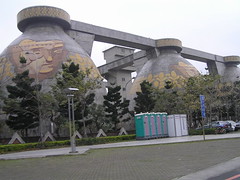
Grass Mountain Chateau (GMC, 草山行館), which was the first Presidential residence after the Chinese Nationalist Party (KMT) escaped to Taiwan in 1949, was burned to the ground in a fire of unknown origin on April 7 of this year. Although some materials found among the debris raises the suspecion of arson, the real cause of fire is still undetermined.

The current political environment in Taiwan is filled with the calls of "de-Chiang-ization" (去蔣化), which is a movement to eradicate the God-like figure of Chiang Kai-shek (蔣介石) that was painted by the authoritarian KMT government over the past 60 plus years. The movement includes renaming of many state-owned organizations, removal of numerous Chiang's status all over Taiwan, etc.

Naturally, elites of the old authoritarian KMT and their successors fought back furiously. Under this intense political spot light, up goes Chiang's first lodge in a blaze. In no time has it sparked a huge intensification of the current political conflict. Especially, pan-blue politicians are wasting no time looking for evidence to blame this fire on the anti-Chiang movement.

They conveniently forgot what the history should have taught them again and again: whatever conspiracy theories they cook up against the pan-greens, it always backfires and hurts them seriously. Rising from the ashes of the conspiracy theory about "burning GMC as part of anti-Chiang movement" is the discovery that Ma, during his term as Taipei Mayor, violated rules and ignored laws via a contract between GMC management contract winner and the Taipei City Government to benefit his Taipei City Government employee.

Grass Mountain Chateau


Map of northern Taiwan showing the location of Grass Mountain Chateau
An article in the Taipei Times describes the Chateau:
The chateau, located in Yangmingshan National Park, was built in 1920 as a vacation home for Japan's Prince Hirohito and later became a summer retreat for dictator Chiang Kai-shek (蔣介石) after he retreated with the Chinese Nationalist Party (KMT) to Taiwan in 1949.
Here is another description:
The Taipei City Government took over the administration of the chateau after Chiang died in 1975, registering the building as a monument because of its historical significance. In 2002, it was turned into an arts salon and a museum.

Ma's GMC-related corruption


Remember that Ma Ying-Jeou was elected as Taipei Mayor in 1998.

The Chateau, as a national monument, is protected by law. The local government in whose jurisdiction a national monument resides is responsible for contracting the maintenance and preservation of the national monument to an outside party.

The contract winner of GMC management was the Humanities and Social Sciences of Fo Guang College (佛光人文社會學院). Kung Peng-Cheng (龔鵬程), who represented Fo Guang to sign the contract with Taipei City Government, is a senior consultant employed by Taipei City Government. To state it more clearly, Ma's Taipei City Government gave the contract of managing GMC to his own employee. Legally, this might not be a problem, if no rules were bent.

According to the law, whoever gets the management contract of a national monument should pay monthly management fee to the local government --- in this case, Taipe City.

Taipei City Councilwoman Jian Yu-Yen 台北市議員簡余晏
But the law was completely distorted when it came to Ma's hand. Taipei City Councilwoman Jian Yu-yen (簡余晏) and Councilman Lee Ching-feng (李慶鋒) pointed out on April 16 that, not only did Ma not ask Fo Gong to pay the required monthly management fee, but also his city government even paid a subsidy to benifit Fo Guang. Fo Guang, as the main contractor of the management, subcontracted the management tasks to several downstream parties and took management fees from them. Fo Guang put these management fees into their own pockets without paying them back to the Taipei City Government.

Taipei City Councilman Lee Ching-feng 台北市議員李慶鋒
Therefore, as a result of Ma's corrupted administration, not only did Taipei City Government illegally paid Fo Guang but also provided Fo Guang the location of a national monument for free --- without charging Fo Guang the management fee, the rent, or even the utilities (all were paid by the citizens of Taipei with their tax money) --- for Fo Guang to run a business that earned profits from subcontractors and visitors.

The corruption of Ma's government doesn't stop here. Upon the expiration of the contract, the Taipei City Government allowed Fo Guang to continue receiving all the illegal benefits --- free land, free Chateau, free utilities, illegal subsidies, and all the illegal earnings --- without signing a new contract or even an extension of the old one.

It's hard to believe that the Taipei City Government - under the administration of Ma Ying-Jeou - can't even manage a simple historical monument legally. The entire process is marked by a series of steps revealing corruption. Like many other previous cases, Ma might, as usual, claim that it's all his subordinates' fault so he doesn't need to shoulder any of the responsibility for this.

The Red Army leader Shih Ming-Teh (施明德) wearing an "anti corruption" shirt
I recall that when Ma was accused earlier this year of putting the Mayor's special allowence fund into his private account, Shih Ming-Teh (施明德), the leader of the Red Army that called for President Chen to step down in the name of 'anti-corruption' last October, responded to the media in regard of Ma's campaign for the Presidency next year,
"We came out to protest the corruption of a President. Now you expect people to vote a corrupt politician into the Office? Should Taiwan be called 'State of Corruption'? "
That's the real question that all blue and red supporters need to ask and answer. As the Presidential election comes closer and closer, I am sure that more and more Ma's corrupt activities will be exposed.

-----
Note: Thanks to Tim Maddog for proofreading

Labels: , , , , , , , , , , ,

__________________________________________________

Wednesday, April 04, 2007

permalink

BBC on Ma: No Context

It's BBC reporting on the trial Ma Ying-jeou, once mayor of Taipei, once Chairman of the KMT, now an accused embezzler, which opened today. So we need not belabor the point that everything important to the context will be left out. The BBC reports:

Taiwan opposition leader and presidential hopeful Ma Ying-jeou has gone on trial in a corruption case which could hit his 2008 hopes.

He is accused of misappropriating T$11.2 million ($339,000) of funds while mayor of the capital, Taipei.

Mr Ma resigned from his position as head of the Kuomintang party shortly after the charges were announced, but said he would clear his name. He has denied graft charges, and is a frontrunner in the presidential race.

So far, so good. Just a short summary. So what does the report go on to say?

Mr Ma, a US-educated lawyer who is expected to defend himself, was in confident mood as he arrived at court.

Ma is not a lawyer. He has never passed the bar either in Taiwan or the US. Where did this claim come from? Everyone says it, for example, AP.

"I am confident of my innocence and I trust in the justice of the court," he said, as a crowd of Kuomintang (KMT) supporters cheered.

Mr Ma was charged with improper use of government funds in February - and resigned as KMT chairman, protested his innocence and pledged to stand for president all at once.

He is facing four rivals from the ruling Democratic Progressive Party (DPP) who are seeking nomination from their party.

The candidates are Vice President Annette Lu, Premier Su Tseng-chang, former premier Frank Hsieh, and former party chairman Yu Hsyi-kun.

More summary.

The investigation into his finances began in mid-November after allegations that he had shifted money from a special fund into a personal account during his time as mayor, from 1998 to 2006.

Note how the article does not inform the reader that the money is definitely in the account -- Both Ma and his lawyer have admitted it. Their defense is that Ma never had any intention to steal the money even though he downloaded into his personal accounts and kept it. Vitally important context omitted, and the omission favors Ma. Can you imagine if the BBC report had mentioned what anyone can find on Wiki?

In addition to those incidents that give rise to public doubt on his competency, Ma has also been criticized for his involvement in several alleged scandals. His filings for the compulsory financial disclosure shows that his household net worth increased by more than NT$43 million (US$1.3 million)between 1993 and 2004, at a rate irreconcilable with his living standards, his two daughters in Ivy League schools and his identified income sources. Ma dismissed the criticism with a quotable line: “I spend less than US$10 a day and I only have an old patched suit.”

The BBC then goes on to say:

If convicted, he would face at least seven years in prison. However, prosecutors have already asked for leniency because of his co-operation with the investigation.

Here's what I said the last time that the BBC used this exact set of sentences to describe Ma's indictment. "Context is often impaired in the international media due to the exigencies of time and space, but the BBC's accounts make a special habit of eliminating key context (here's why!)." That applies here too. To understand why the prosecutor might ask for leniency, in addition to Ma's cooperation, the reader would also have to know that the prosecutor who conducted the investigation had Ma for a witness at his wedding, that the prosecutor's offices in Taiwan are largely pro-Blue, and that Ma has publicly threatened the bureaucrats who don't come up with answers he wants. Not one iota of this context appears here -- because it would spoil the nice clean narrative that the BBC wants to project. Sadly, this very human urge to create narrative rather than report reality in all its messiness too often favors the KMT.


Labels: , , , ,

__________________________________________________

Friday, February 16, 2007

permalink

Fawning over Ma

A pro-China Malaysian journalist, making no pretense of objectivity, comments in the online Asia Times on the Ma indictment....check out the pro-Beijing code phrases:

As the KMT still nominally accepts the "One China" principle, while the Democratic Progressive Party (DPP) under President Chen Shui-bian has been pushing vigorously its separationist agenda, including cultural "de-Sinization", Ma's election is widely expected to be a key for the improvement of relations between the communist-ruled mainland and the democratized Taiwan. That has been called into question.
Taiwan independence is presented as "separationist" although Taiwan isn't and never was part of China....etablishing a local identity is labeled by the code-phrase "de-Sinization" although Taiwan culture retains all of its Chinese elements. Really, all the DPP advocates is labeling things what they are. Nobody is saying that Chinese languages should not be used, or Chinese gods not be worshipped, or Chinese characters dropped. "De-Sinization" is a common code phrase used by Chinese to describe the DPP's policies on establishing a local Taiwan identity.

The article then moves into unabashed Ma worship:

Until last November, Ma's image as "Mr Clean" was almost unassailable. Son of a KMT cadre, Ma's life has been prim and proper and blessed with many open doors. Soon after completing his doctorate in law from Harvard, he was recruited as president Chiang Ching-kuo's personal aide. He moved on to become a minister under Chiang's successor, Lee Teng-hui.

As justice minister, he earned his reputation and made many enemies combating "black gold politics", Taiwan's term for collusion between politicians, businessmen and mafia bosses. He went on to frustrate Chen Shui-bian's bid for re-election as the Taipei mayor in 1998, incidentally pushing Chen to run for and win the presidency two years later.

Though also known for his good looks and athletic stamina, Ma's largest asset is undoubtedly his near-dogmatic hold to rules and civility in Taiwan's notoriously rough and tumble politics. Such qualities, often attributed to his family upbringing and legal education, attract middle class and urban voters but arguably distance him from others.

Parts of this are downright hilarious. Ma is not the mere "son of a KMT cadre" but the son of a prominent mainlander general. Far from advocating civility in discourse, Ma has a silken nastiness that is right at home in local politics. He has repeatedly accused President Chen of being corrupt, has threatened prosecutors who don't come up with answers he likes, and has accused his rival Wang of vote-buying and busing in supporters in connection with the KMT chairmanship election. Ma is all about image, not reality, an image which his many supporters in the media enthusiastically promulgate. Ma is a personality type that many of us are familiar with, the little boy who fetches breakfast for his mother, sucks up to teachers, and then bullies kids on the school playground.

The journalist then goes on to cite the pro-Blue polls on Ma:

The public are more sympathetic to Ma. His approval readings in various opinion polls have risen after his resignation and declaration of candidacy. In a poll by United Daily, 61% of the respondents believed in Ma's integrity, a rise of 5% from November when he was investigated. His leads against DPP hopefuls have widened. He leads Prime Minister Su Tseng-chang by 59% against 21% and former premier Frank Hsieh by 61% against 20%. Among Pan-blue voters, he is leading Wang as the favorite candidate by 87% to 6%.

Anyone really believe that in the Real Taiwan Ma leads Premier Su by 38 points? Isn't this the same UDN that had the KMT up by 15 points on the eve of the Kaohsiung election they lost by a point? None of these polls are trustworthy, and relying on them is pathetic. The last sentence is especially great:

Despite the pro-China image painted by his Pan-Green opponents, Ma is the only Taipei heavyweight who every year commemorates the Tiananmen massacre in Beijing in 1989 . Much to Beijing's displeasure, Ma has categorically listed democratization of China as the pre-requisite for any reunification.

The reason that DPP politicians don't publicly commemorate Tiananmen is because it happened 20 years ago in another country. That Ma conducts pious public ceremonies about events that happened in China simply shows where his true loyalties lie: with China. Ma is a pro-China ideologue making pro forma mouthings about democracy. The writer's fawning over Ma's alleged commitment to democracy fails to note that democracy as a prerequisite for annexing Taiwan to China was the position of the National Unification Council, founded in 1991 under Lee Teng-hui -- which China protested for that very reason. Ma's best ideas always originate with others, usually long before he takes them up.

And terminology? Don't miss that "reunification" in the last sentence there.

Does Ma support democracy? There's no record of that until long after democratization had begun. Ma's mentor at NYU was the subject of an article in the Taipei Times the other day:

During an interview with CNA, Cohen, who is now a law professor at New York University, described Ma as honest and upright. He said he felt sympathetic and sad -- just the way he felt when another of his Taiwanese students -- Vice President Annette Lu (呂秀蓮) -- was jailed for her political activities in the 1980s.
....and the contrast couldn't be more clear. Lu went to jail for democracy, Ma became the private secretary to the dictator and murderer Chiang Ching-kuo. Had Ma been committed to democracy, he'd have been in the cell next to Lu......

Yes, Mr. Cohen, Ma is upright. It's because he's bipedal, not because he has integrity. Ma has already admitted downloading the money illegally, and fighting the indictment on the grounds that he never meant to steal it, and anyway, it's OK because everyone does it (Cohen's softball treatment of Ma during US visit. Cohen is a member of the US elite Establishment organ, the Council on Foreign Relations).

Expect plenty of fawning over Ma for the next few weeks until the prosecutors hand down the next set of indictments, probably against DPP heavyweights. Hopefully then the System will wise up, vote in a general amnesty, abolish the Special Funds, and move Taiwan forward...instead of forcing everyone to use the Taiwan DefenseTM: Hey. Everyone does it...

UPDATE: LOL. Ron Brownlow's latest Taipei Times feature on the well-known bar DV8 has this to say:

Like many regulars — and unlike DV8's owners — Liao is of the pan-green persuasion. The bar's resident yarnspinner, at 10pm on Tuesday he was regaling a reporter with his story about how, while attending Jingxin Kindergarten (靜心幼稚園), he was punished by his teacher after Ma Ying-jeou (馬英九), who is a year older than Liao, saw him teaching a few of his classmates how to speak Japanese. "I want you to print that," Liao told a reporter. "I want him (Ma) to sue me!"

Labels: , , , , ,

__________________________________________________