Taiwan Matters! The PRC flag has never flown over Taiwan, and don't you forget it!

"Taiwan is not a province of China. The PRC flag has never flown over Taiwan."

Stick that in your clipboards and paste it, you so-called "lazy journalists"!

Thanks to all those who voted for Taiwan Matters!
in the Taiwanderful Best Taiwan Blog Awards 2010!
You've got great taste in blogs!

Tuesday, March 25, 2008

permalink

Walk out from your nutshells, TI supporters !!

Michael in his blog mentioned a language issue that he and his kids encountered in the campaign gatherings of pan-green:

Every speech was in Taiwanese, except part of one (KMT rallies offer a mix). My kids sat there bored, addressed by people who couldn't be bothered to find a way to talk to the two Taiwan citizens I am raising.

and in a meeting of FAPA:

It was painful to watch. Sometimes I contemplate taking out ROC citizenship, but the brave new world they advocate doesn't include me or my children -- and if a strong supporter like me gets that vibe, how then the young on the street who chatter in a delightfully liquid lingo that is predominately Mandarin, with leaven of Taiwanese and English? Every person at the FAPA meet was older than I, and they were speaking Taiwanese. Not one speaker or two, but Every. Single. One. As I listened to a bunch of speeches in a language I didn't understand -- every word reinforcing my overwhelming alienness, one of the photographers standing next to me turned to camera guy next to him and remarked, rhetorically: "Why are they speaking that language? I don't understand a word they are saying!" Not one of those people took the time to compose and deliver their speech in Mandarin, a language spoken by everyone in the room -- and, mind you, a language understood by the people they most urgently need to communicate with: the Chinese. Of course there was no English, the language of the international media. Brilliant to hold a press event in a language the press don't speak.

I am very sympathetic to Michael's situation about this.

It's been a very long time since I started voicing the same view of Michael's to those die-hard TI (Taiwan Independence) supporters. The first time I reminded them was in a talk given by a TIer in a university IN USA. YES, IN USA, and he spoke Taiwanese !!! Without any translation to English, not to mention to Maderin !

It was at a time when China didn't look so huge. Many oversea Chinese students never had a chance to learn about Taiwan democracy development, and are very earger to learn more.

So they went to the talk, but couldn't understand a single word. One of them raised the issue to the speaker, requesting a translation service --- at least to English. The speaker refused and remarked,

"We have the right to speak what we want. It's your own problem that you can't understand."

I was so shocked and in disblief. After the talk I told them if you want to deliver your idea, speak something people understand. Otherwise, don't waste your time.

It's been more than 10 years. I couldn't believe these die-hard ancient TI fighters never learned. If there's only one single organization that can deliver strong TI messages in multilanguages, FAPA is probably the one. Yet they chose to cuddle among themselves. I really wonder what they expect to achieve by hugging to keep each other warm. To me they are filled with so much hatred that clouds their minds in a way that "feeling good" is far more important than "winning the battle."

To me, it is equivalent to treating themselves as pity victims. In that sense they don't really need opponents.

And, I am telling you, the language thingy is just only one of many "out-dated, suicidal behaviors" they have. There have been so many times I almost gave up fighting with them for their other certain-death approaches.

Certainly, they don't think they are suicidal. They call it "principle" --- "Without principles we have nothing."

Yea right. Look what we have now.

Anyway, I am with you, Michael. There's a long way ahead.

Update: Unlike those English-as-the-first-language people who are most likely to complain about this situation, I was born and raised in Taiwan. I speak fluently in Taiwanese, Mandarin and English. I was raised in a way that you don't speak secret language in front of others. If one of our Mandarin-speaking friends jumps in when we are talking in Taiwanese, we all switch to Mandarin and continue the topic. When we came to USA, if an English-speaking friend came to our party, we all switch our tone to English, even when many of us are really terrible at it. My family behave that way, and friends I met behave that way.

As a result, it becomes a basic politeness for me to respect visitors by not leaving them in darkness. Therefore, the strong resistance of TI supporters to Mandarin in a situation where they need it most looks alien to me.

Labels: , , , ,

__________________________________________________
Tuesday, December 11, 2007

permalink

Legislative Analyses

Max Hirsch of Kyodo News has a nice article on the upcoming legislative election in January, which in many ways is the more important of the two elections. The whole thing is here:

++++++++++
As eyes turn to Taiwan's presidential race, the outcome of which will impact on key security interests for Japan and the United States, another electoral showdown with arguably more important consequences draws near.

Wednesday marks one month before Taiwan's general elections in which the island's ruling and opposition camps lock horns in races whose implications are reaching past parliament to reshape the overall political landscape.

For starters, the general elections Jan. 12 will serve as a litmus test for the presidential election on March 22, observers say. Whichever party beats its rival in parliamentary elections will pass on to its presidential candidate ''decisive momentum.'''

'A victory in general elections typically works out to be a big advantage going into the presidential election -- it enables a party to be seen as a winner, and voters like a winner,'' says Michael Boyden, director of Taiwan Asia Strategy Consulting.

That message is not lost on the opposition Nationalist Party amid speculation that a ''pendulum effect'' could turn a parliamentary win into a black mark for the presidential election.

That is, Taiwan -- which in 2000 emerged from nearly 60 years of sometimes brutal, one-party rule by the Nationalist Party (KMT) -- may not be ready to see one party dominate both the legislative and executive branches.

Hence, voters might swing back to whichever party that lost the parliamentary elections when casting their presidential ballots -- a scenario that KMT heavyweights dismiss.

''We need a victory in parliamentary elections in order to win the presidency,'' says KMT Secretary General Wu Dun-yi. ''Keeping our majority in parliament will give us the momentum we need before the presidential election.''

The KMT has enjoyed majority status in parliament since the lifting of martial law in 1987.[Nit: Actually, the pan-Blues had a majority; the largest single party was the DPP until last year when several members quit.]

In 2000, the Democratic Progressive Party pushed the KMT from the Presidential Office after the DPP's Chen Shui-bian won the presidential race that year -- a victory he repeated in 2004.
Next month, the DPP hopes to clinch parliament with at least 50 seats for itself and seven for allied parliamentarians in the unicameral, 113-seat body, says Chen, who also serves as DPP chairman.

The KMT seeks ''65 to 70 seats,'' says a KMT insider.

''Street cred'' and ''stature,'' Boyden says, will go to the presidential candidate whose party wins majority status in parliament.

Beyond implications for the presidential race, however, the general elections' outcome could radically alter Taiwan's relations with Japan and the United States, the island's chief security benefactor.

A halving of the parliament from its current 225 seats to 113 in the next session, for example, will see key legislative committees merge.

And among the committees to merge, Wu says, are the National Defense and Foreign and Overseas Chinese Affairs committees.

Combining those committees will put one group of parliamentarians in charge of both defense and diplomacy bills, by far the most important legislation in terms of relations with Tokyo and Washington, says Kharis Templeman of think tank Taiwan Foundation for Democracy.

Hence, how that committee is stacked as a result of the parliamentary elections will play a key role in foreign relations.

The sheer power of parliamentarians on such a committee, Templeman says, ''isn't necessarily a bad thing. Having a few powerful committee members could make it easier to negotiate across party lines. We could see quicker responses to foreign policy issues put to the legislature, like weapons systems offered by the U.S.''

Parliamentary gridlock led to Taiwan's stalling on a huge U.S. arms package, offered to the island in 2001.

The DPP blames the opposition for killing some 65 bids to consider the package in parliament, while the KMT slams the DPP for poorly budgeting the proposed weapons.

The parliament finally passed a reduced package earlier this year, allotting funds to buy a defensive missile system and antisubmarine warfare aircraft from Washington.

But Taipei's dawdling seriously damaged ties with Washington amid concerns there and in Tokyo that Taipei does not take its defense seriously.

China, which vows to unify Taiwan with the mainland, threatens to attack the island if it formalizes its de facto statehood.

Those threats concern Tokyo because any conflict in the Taiwan Strait could result in U.S. military intervention, which in turn could drag Japan's Self-Defense forces into the fight via a joint defense pact.

With both the DPP and KMT vowing to pass future arms bills, however, a streamlined parliament boasting more powerful incumbents promises to ease gridlock.

Thus, while the presidential race looms large in gauging Taiwan's future ties with key partners, it is the island's next parliament, and the impact of general elections on the presidential race, that pack the most political wallop, both at home and abroad.

+++++++++++++

A-gu has been putting together a wonderful tool for assessing the election, an interactive map on the Google Map platform. It's right on his blog; have a look.

Labels: , , ,

__________________________________________________
Sunday, September 16, 2007

permalink

Protests with the Mostest

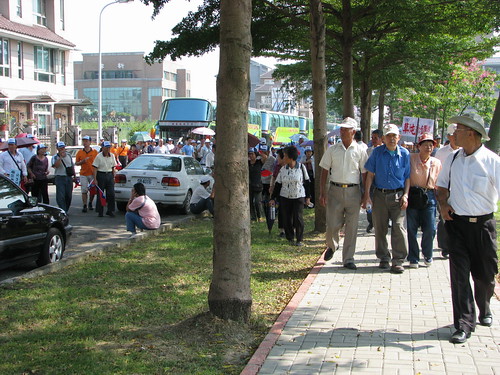
KMT supporters arrive for the big rally.

Massive rallies in Taiwan yesterday! I stopped by the KMT UN rally today for about an hour and a half during its opening moments, where I met the redoubtable Craig Ferguson of CFImages (Craig's beautiful images are up now on his blog), and watched my first rally from the Other Side.

Waiting in the shade on a bitterly hot afternoon.

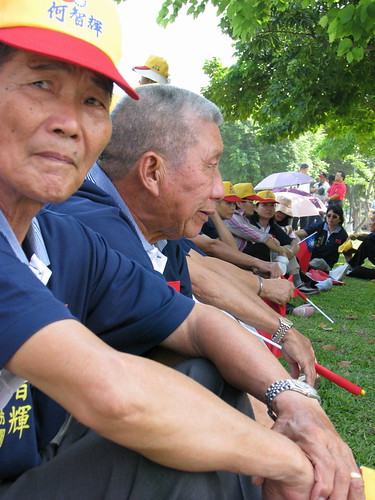
Step into the world of the Taiwanese KMT. Everyone at the rally was speaking Taiwanese, including the speakers on the stage, except for a few more formal remarks. The ralliers were asked to proclaim their love for Taiwan (ROC? What ROC?), and many led cheers calling for Chen to step down. Such remarks are so widespread, that one wonders whether the KMT realizes that it is running against Frank Hsieh, not Chen Shui-bian.

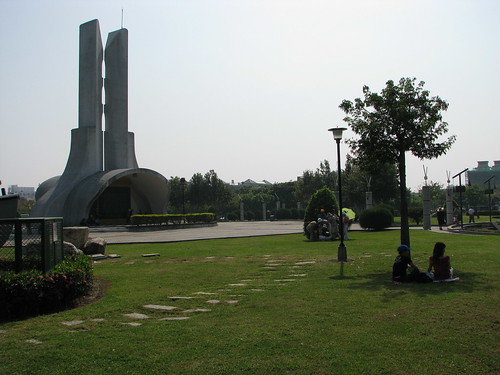
The Memorial at 823 Park.

The rally was held at the 8/23 Park in northern Taichung, which commemorates one of the great victories in the artillery war fought between ROC and PRC forces between the islands off the China coast in the 1950s.

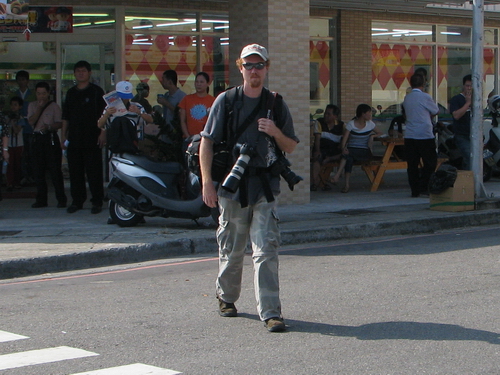
Craig Ferguson, loaded for bear.

Craig and I were the only white foreigners there, and we were just there to take pictures. I was approached by several media people, and left a verbal barb in the pro-KMT UDN reporter, telling him that I, like most foreigners here, was Green. I refused all requests to speak; God knows what I would have said with a microphone in my face.

Media and sound trucks poised for action.

The rally was attended by people from all over the central part of the island. There were a large number of people dressed in aboriginal costume.

A souvenir vendor hoists Ma Ying-jeou paraphenalia.

None of the major politicians had arrived by the time I left at 4:30. The heat was oppressive, and most people were sensibly hiding out in the shade.

Brightly colored flags make for pretty pictures.

Ralph Jennings of Reuters on the UN Rallies:
About 250,000 people demonstrated in two Taiwan cities on Saturday to back the island's doomed efforts at securing United Nations membership, a move condemned by rival Beijing and rejected by ally Washington.

Some 150,000 people, including President Chen Shui-bian, marched through the southern port city of Kaohsiung in pro-U.N. green shirts and waving flags. Political opposition forces in Taichung meanwhile marshaled at least 100,000 people.

"The biggest thing is for the United Nations and the United States to notice that this U.N. effort is not just something Chen Shui-bian is doing," said Kaohsiung demonstrator Wang Chun-kai, 35, a businessman from the nearby city of Tainan.

Government officials say they know the U.N. bid will fail, prompting speculation that the ruling Democratic Progressive Party (DPP) has used it to solidify a long-term agenda of greater independence from China by stirring anger at home.

The United Nations is expected to reject the bid on Tuesday.

"The U.N. bid, of course, has absolutely nothing to do with getting into the U.N.," said Ralph Cossa, president of the U.S.-based think tank Pacific Forum CSIS.

"I think it is mostly tied into the Taiwan identity issue and the DPP's efforts to lock future administrations into this mindset."
The last sentence shows the latest wisdom that is rattling about the Establishment echo chamber: that the UN bid is really the "radical" Chen's bid to control the "moderate" Hsieh so that the latter has to follow the "radical" independence path. Never mind that Hsieh and Chen, whatever the personal rivalries, belong to the same party, and have been advocating independence and UN entry for the better part of two decades, nor that Chen was widely seen as a "moderate" upon assuming office. Once the Establishment decides on something, no evidence to the contrary will get it to change the CW. Note that this position is essentially a pro-KMT propaganda theme that has been picked up in some of the more conservative publications -- that the whole UN thing is simply Chen's bid to control the future of the DPP.

The first requirement for a TV reporter is babeness.

The Associated Press reported:
Surrounded by cheering supporters, Chen led marchers through the Kaohsiung streets amid colorful banners and rippling flags, looking poised and confident.

Addressing a rally ending event at a downtown plaza, Chen declared his love for Taiwan as the crowd applauded wildly: "I pay respect and appreciation to you all."

It was a remarkable comeback for a man who only a year ago was written off as an embarrassment by the ruling Democratic Progressive Party, which feared that a series of corruption sandals involving his family and inner circle would doom it to defeat in the upcoming presidential poll.

But now it is the main opposition Nationalist Party that seems to be caught off balance, torn between its support for eventual unification with the mainland, and its recognition that U.N. membership is a huge vote-getter with the Taiwanese public.

Reflecting the party's dilemma, Nationalist presidential candidate Ma Ying-jeou held his own pro-U.N. membership rally on Saturday, attracting about 50,000 supporters to the central city of Taichung. But unlike the DPP rally 125 miles to the south, this one pushed for Taiwan's U.N. re-entry under its official Republic of China name.
"Remarkable comeback?" Only if you believe pro-KMT polls.

Watching the speakers.

The Taipei Times reported that "several members of Congress" had expressed their support for Taiwan:

Several members of the US Congress expressed their support for Taiwan's bid to gain membership in the UN ahead of a rally promoting the bid scheduled for yesterday in New York.

In a letter to the Formosan Association for Public Affairs (FAPA), one of the rally's main organizers, US Representative Anthony Weiner said he deeply regretted that the UN continues to disregard the sovereignty of Taiwan and deny the right of self-determination to its people.

"There is no question that the United States must stand strong and advocate Taiwan's independence from China and inclusion as a United Nations member state," Weiner said.

Releasing a statement on the issue, Representative Dana Rohrabacher said it was incongruous that a world body founded on the principles of universality and self-determination would exclude a free, democratic and independent nation whose population is larger than three-quarters of the UN' member states.

Rohrabacher said that with Taiwan possessing all the qualifications to become a UN member and ample resources to contribute to the work and funding of the UN, the country's accession to the world body is long overdue.

"Let's tell the world how unfair it has been to deny the 23 million people of Taiwan their voice and representation in the United Nations and especially their willingness to [help] other nations in need," he said.
Good to see a Dem, Weiner, in there pitching for Taiwan. Weiner represents Brooklyn and Queens in NY.

Volunteer grandmothers make the world go round.

The Taipei Times reported on the rally in Taichung:
Putting their 14-month-old boy on the father's shoulder, a Taichung resident surnamed Chang and her husband called on the DPP to reflect on its poor policies and urged the government to pay more attention to social problems.

"I closed my betel nut stand today to join the rally. We don't care about the UN referendum. What we want is a better life," said Chang, who declined to give her full name.

Dressed in traditional Amis clothing, Wang Chun-mei (王春梅) and dozens of her friends echoed Chang's demand for higher living standards.

"The people should stand up and fight for our economy. We want the government to take care of disadvantaged groups and develop the tourism industry," she said.

Legislative Speaker Wang Jin-pyng (王金平) did not attend the march, but showed up at the evening party afterwards.

Former KMT chairman Lien Chan (連戰) and People First Party Chairman James Soong (宋楚瑜) declined to attend the event.

Addressing the party, Ma condemned the DPP version of the referendum as an election gimmick designed to stir up emotions.

Ma said that the KMT version would not harm Taiwan's relationship with Washington.

Among the other KMT heavyweights NOT in attendance was Jason Hu, the mayor of Taichung, who had the excuse of being abroad.

Traditional music performers are an important part of any election activity.

The Beeb has pictures of the rallies up on its website here. Guess what: the whole world is talking about the UN bid. Go Grand Fenwick!

A KMT candidate exhorts her supporters.

AFP reported:

In contrast to the carnival atmosphere in central and southern Taiwan, dozens of people scuffled with police outside the Presidential Office in Taipei, where they were gathered to oppose the planned referendum.

Protestors sprayed red paint on photographs of the president and on government banners promoting the UN bid in a show of anger.

Some 15 of Taiwan's 24 allies have proposed the island's membership application to the General Assembly, which will decide whether to discuss it when the annual session opens on September 18.

Sounds like Shih's Red Ants were busy too....

Young performers ham it up for the camera.

These rallies announce the beginning of the serious election season here in Taiwan, which means that this issue will decline in importance as the DPP moves on to other activities -- meaning that This Too Shall Blow Over. Observe that all the KMT can do now is borrow ideas from the DPP and react to its thrusts, because -- as I've repeatedly noted -- the KMT has no platform of its own. Running on the economy is a dangerous idea, since Hsieh can co-opt its economic platform of opening to China very easily, and with greater credibility (and at present the economy is doing OK). The KMT has been totally defeated on the identity issue. If Ma loses or the legislative elections are a surprise, a profound identity crisis may grip the KMT. The Taiwanese KMT legislators have grumbled as ideologue Ma tightens his grip on the party, marginalizing their unofficial leader, Wang Jyn-ping, currently speaker of the legislature. They may be ripe for Wang to use as a base to form his own localized KMT party, or even to flip to the DPP.

And waiting out there somewhere is PFP Chairman James Soong, who may retain some shreds of popularity out there in the hinterlands somewhere......

The opening speakers. Everyone was pretty listless in the late afternoon heat at this point.

The Blue Sandal Babes.

The KMT symbol for this rally was the ubiquitous blue sandal, worn by Taiwanese everywhere, supposedly to symbolize the party's identification with the working classes (who, not by coincidence, form the core of the DPP's base). The Sandal Babes were followed everywhere by the media, and showed up in shots in the local newspapers. Smart marketing -- if you want something viewed, put a babe in it -- but the reality is that almost everyone at the rally came wearing ordinary shoes (sensibly too, since no one can walk any distance in flip-flops), at least when I was there.

Hope to see some great pics of the Kaohsiung rally from local bloggers. It may not reflect actual voting patterns, but it was nice to see the DPP rally crush the KMT rally. On to the elections!

Labels: , , ,

__________________________________________________
Thursday, September 06, 2007

permalink

Hsieh Attacks Ma for Colluding with China

International media reports on Taiwan's upcoming elections rarely mention, let alone analyze, the growing cooperation between the Chinese Communist Party and the KMT in Taiwan. Yet it is a major issue in the election here:

Democratic Progressive Party (DPP) presidential candidate Frank Hsieh (謝長廷) yesterday accused his Chinese Nationalist Party (KMT) counterpart, Ma Ying-jeou (馬英九), of colluding with Chinese leaders over the holding of a referendum on UN membership.

"Ma made promises to Chinese leaders when he was the KMT chairman," Hsieh said. "They most likely included carrying out the promises made by former KMT chairman Lien Chan [連戰]. Ma owes the public an explanation if he encounters any difficulties or contradictions in putting them into practice, because they could affect Taiwan's future."

Hsieh did not provide any evidence to substantiate his claims.

The remarks were occasioned by an article in the local Chinese-language China Times, the Xinhua of the KMT in the bad old days, that said the KMT had gotten a letter from Beijing:

A report in the Chinese-language China Times yesterday said Ting Yuan-chao (丁遠超), Lien's secretary, confirmed two weeks ago that Lien had received a letter from China and was asked to pass it on to the party's leaders.

The report said Chinese officials responsible for Taiwanese affairs had decided the referendum was "inappropriate."

Ting was unavailable for comment yesterday, while KMT leaders denied the letter existed.

KMT Secretary-General Wu Den-yih (吳敦義) said he didn't know anything about the letter, while KMT Spokesman Su Jun-pin (蘇俊賓) said the China Times report was "groundless."

"The KMT is pushing for the country's return to the UN. This will not change because of Chinese pressure," Wu said.

Wu said the party would go ahead with its plans to stage a rally in Taichung on Saturday to attract support for the party's referendum proposal.

The KMT can't be lying, because its senior members constantly go to China, obviating the need for a letter. For example, Lien Chan is on his way there right now:

Lien was accompanied by his wife, and will have to transfer airplanes in Hong Kong en route to China's Xinjiang province due to the lack of direct transport links between Taiwan and China.

Prior to his departure from the Taoyuan International Airport, Lien declined to answer reporters' questions regarding his role in a local newspaper report claiming that Chinese President Hu Jintao sent a letter to Ma Ying-jeou, the KMT's candidate in the March 2008 presidential election, voicing his objection to a KMT campaign aimed at holding a referendum on the country's U.N. bid.

According to the Taipei-based China Times, Hu sent a protest letter through Lien to Ma two weeks ago, but both Ma and the KMT central denied knowledge of receiving such a letter and said that they will not hold back in their efforts pushing for a U. N. referendum on the grounds that the issue has gained widespread public backing.

In April KMT Party Chairman Wu Po-hsiung announced that he would go to China immediately after being elected Chairman. Wu is widely reputed to be a Ma supporter.

In recent academic pieces on Ma, scholars have argued that Ma is a "moderate" because he has never gone to China. Why should he, when senior KMT officials go there for him? This "moderation" is typical of Ma -- while he has never gone there himself, neither has he criticized his fellows for kowtowing to Beijing.

Meanwhile, the closer the KMT gets to Beijing, the less well it will do in the polls here. Yeye, hurry home!

Labels: , , , ,

__________________________________________________
Wednesday, August 29, 2007

permalink

Contrasting Political Parties

While the DPP grooms itself for the future, the KMT is riven by internal strife.

The China Post reported the other day that Yeh Chu-lan, the wife of dissident and activist Chen Nan-jung, is under consideration by DPP Presidential candidate Frank Hsieh for the Premiership:

After I had served as Kaohsiung mayor, Yeh Chu-lan also served as Kaohsiung mayor. As I have been premier, Yeh Chu-lan may also become premier," Hsieh told supporters at a rally in Hsinchu.

Hsieh was flanked by both his running mate Su Tseng-chang and Yeh at the rally of supporters from the Hakka community, to which the campaign manager belongs.

"If I am elected president, one day a Hakka woman may also become president," Hsieh told the rally.

Observers said Hsieh's remarks were not just meant to be a gesture to attract the backing of the Hakka community.

The Central News Agency cited his close aides as commenting that it was actually an important announcement of Hsieh's that Yeh would be a potential candidate for the premier post if he was elected president.

Yeh reportedly had been Hsieh's number-one choice for running mate before the DPP standard bearer picked Su instead.

Yeh had lobbied hard for the Vice-Presidency, and the Premiership is an obvious choice for this increasingly important DPP politician, one of the many talents the DPP is bringing along for the future. Yeh is a Hakka and may help attract Hakka votes to the campaign. The Hakka ethnic group, a large minority in Taiwan -- something like 25% of the pre-1949 population was Hakka -- has traditionally been an important part of the KMT's ethnic coalition and a pillar of KMT support. The rally, as the CNA reported, was held in Hsinpu, an important Hakka community. The first of the new Hsieh-Su ticket, its kickoff in a key Hakka town was no accident:

Ruling Democratic Progressive Party (DPP) presidential candidate Frank Hsieh wooed Hakka voters Saturday with promises to promote Hakka language and culture as well as accelerate economic development in Hakka communities if he wins the presidency.

Hsieh made the pledges while attending a rally in front of the Yiming Temple in Hsinpu, a Hakka township in the northern county of Hsinchu, in the company of his running mate Su Tseng-chang and Presidential Office Secretary-General Yeh Chu-lan, who concurrently serves as the Hsieh campaign's top strategist.

It marked the first time that the three DPP bigwigs have attended a campaign rally together since the formation of the Hsieh-Su ticket for the 2008 presidential election earlier this month.

....

As Yeh is favored by many of her Hakka fellows to join Hsieh on the 2008 ticket, Hsieh deliberately chose the Hsinpu Hakka community as the place for his first campaign rally together with Su and Yeh to stage a tableau of unity and party coherence.

.....

Since the DPP won the presidency in 2000, Hsieh said a Hakka television station has been established and Hakka language has been actively promoted. Hsieh said he himself took a Hakka proficiency test during his premiership from 2005 to early 2006.

He promised to boost ethnic harmony and glorify Hakka culture if elected the next president.

Su, who succeeded Hsieh to serve as premier, addressed the rally in fluent Hakka as he once served as magistrate of the southern county of Pingtung which has a large Hakka population.

For her part, Yeh urged her Hakka fellows and friends to support the Hsieh-Su ticket to help the homegrown DPP retain its grip on power next year.

Many Hakka heavyweights residing in Hsinchu County, including former Hsinchu Magistrate Lin Kuang-hua, also attended the rally to lend their support.

Making inroads in the Hakka communities in the north will be an important step for the DPP in winning the Presidential campaign. Note that Vice Presidential candidate Su speaks Hakka, just as his counterpart Vincent Siew for the KMT does -- both parties have signaled that the struggle for the Hakka vote will be a crucial one.

By constrast, over in the KMT the grumbling from the Taiwanese legislators serving under the Ma regime continues. On August 26th a group of southern legislators, a code phrase for largely ethnic Taiwanese legislators in the KMT, blasted the party for its treatment of Speaker Wang Jin-pyng, a Taiwanese, and the unofficial leader of the Taiwanese legislators. Party officials responded the next day by saying that the whole thing was a misunderstanding:

The Chinese Nationalist Party (KMT) yesterday called for party unity amid harsh criticism from supporters of Legislative Speaker Wang Jin-pyng (王金平) of KMT Secretary-General Wu Den-yih (吳敦義) and Deputy Secretary-General Liao Feng-de (廖風德).

In response to a petition signed by several local-level politicians and grassroots groups in the south demanding that the party replace Wu Den-yih, who they said had damaged Wang's reputation, KMT Chairman Wu Poh-hsiung (吳伯雄) yesterday stood by the two top party officials and said the accusations against them were just a "misunderstanding."

"Wu [Den-yih] and Liao are important comrades who I rely on the most in each battle. No one knows better than me that the KMT will have to unite to win the elections," he said yesterday in Taichung City.

The petition, which was signed by Kaohsiung County Council Speaker Hsu Fu-sen (許福森), vice speaker Lu Shu-mei (陸淑美) and a number of councilors in Kaohsiung, Taichung and Hsinchu, accused Wu Den-yih and Liao of spreading rumors to tarnish Wang's name.

They threatened not to campaign for the party's candidates in next year's elections if the party did not fire both of them.

Wu Poh-hsiung said that the party supported Wang and called on the petitioners to end this "misunderstanding" and refrain from making more accusations.

KMT presidential candidate Ma Ying-jeou (馬英九) echoed the call for party unity.

"We are only five months away from the legislative elections and seven months away from the presidential election. We should be thinking about the overall situation and not get trapped by our opponents," he said in Taipei.


Wu Den-yih is the former mayor of Kaohsiung, while Wu Poh-hsiung, a Hakka, is the Party's Chairman and widely seen as a Ma supporter. Apparently there is a whispering campaign going on to the effect that Wang will not get a seat in the new legislature. This cutthroat rivalry may well lead to problems for KMT candidates in the upcoming elections. One need only compare the Ma-Wang rivalry with the Hsieh-Su rivalry -- the DPP did everything it could to put the two rivals on the ticket, patch up differences, find a plum spot for disappointed veep possibility Yeh Chu-lan, and put together a show of unity in an important ethnic community. Those are the moves of a winning political party. The KMT, by contrast, failed to put together the obvious Ma-Wang ticket, took a giant step backward with the selection of Siew, does not appear to have a broad list of future talent moving up the ranks, and can't seem to manage a display of unity. Instead, many of its local legislators are threatening to bolt the party. Still, it remains to be seen whether these rumbles on the horizon are an approaching forest fire, or just summer thunder....

Labels: , , , , ,

__________________________________________________
Sunday, August 19, 2007

permalink

Ma's Insider Problem

For the last year I've been noting how Ma Ying-jeou has faced opposition from within his own party, by insiders who dislike him. During the Chairmanship elections last year longtime political observer and commentator Lawrence Eyton noted:
Ma was widely touted by the media as the favorite, but he was certainly a very odd favorite. When the vote took place, three quarters of the party's legislators, many high-level party officials such as central executive committee head Chang Che-shen and more than 100 retired generals - the KMT is traditionally strong in the military - had thrown their support behind Wang.
Party insiders just plain don't like Ma, despite his being the right "ethnicity." His support comes overwhelmingly from the conservative rank and file who identify strongly with China and look down on Taiwanese. The insiders preferred Speaker of the Legislature Wang Jin-pyng, longtime foe of Ma Ying-jeou, and widely regarded as the unofficial leader of the Taiwanese KMT.

Today the Liberty Times ran a piece on the relationship between Wang Jin-pyng and Hou Kuan-jen, the prosecutor in the Ma case. Hou and his fellow prosecutors are currently appealing the verdict. This case has brought to light some of the innumerable connections that weld together the island's ruling elites. Not only was Ma the Witness at Hou's wedding, Hou is related to Wang:

王 金平對黨內高層在他拒絕的次日,就拿他與侯寬仁的親戚關係放話、作文章,甚至扭曲事實,感到相當憤怒。他說,侯寬仁是馬英九任法務部長的部屬,關係不是 更親密?讓他最生氣的是,那位高層既然要在他與侯的親戚關係上作文章,卻又找人來見他,要他勸請侯寬仁放棄上訴,「這到底是什麼意思?」

The second day that Wang Jin-pyng refused to use his family relationship with Hou, high-ranking KMT officials raised a stink, even twisting the facts. Wang was quite angry about it. Hou was under Ma when Ma was Justice Minister, Wang pointed out, and wasn't that an even closer relationship? What made him most angry was that on one hand, it was said he had a relationship with Hou, while on the other, people kept coming to talk to Wang about it and have Wang get Hou to not appeal the verdict in favor of Ma. Wang said: "What the hell is that shit?"*

KMT officials were trying to prevail on Wang to have Hou stop the appeals process and end the case. Wang, Ma's longtime rival and loser in the 2005 KMT Chairmanship election, was quoted later in the article as saying that putting he and Hou together is like confusing peanuts and pressed tofu (土豆仁與土豆干). The relationship that KMT officials are trying to leverage? Hou's wife is the sister of Wang's nephew's wife. That's farther than my family relationship to Chen Shui-bian. As Wang said, who doesn't have relatives somewhere?

Had Wang chosen, he might have found a way to make the relationship yield something. Yet, he chose not to do so. How much help will Ma have come election time from key members of his own party?


*I decided to translate the thought, not the words.

Labels: , , ,

__________________________________________________
Friday, June 22, 2007

permalink

Hsieh the Moderate

Frank Hsieh stands firmly behind the UN entry under the name Taiwan:

Ruling Democratic Progressive Party presidential candidate Frank Hsieh Friday threw his support behind the government effort to join the United Nations under the name of "Taiwan," saying it falls in line with his longstanding stance on the issue.

Hsieh made the remark while in Kaohsiung to cheer up the southen port city's mayor Chen Chu, whose electoral victory last December was annulled by a district court.

Though a moderate on cross-strait ties, Hsieh said he has consistently suggested the island apply for UN membership under the name of Taiwan. To that end, Hsieh said he led a delegation to the UN headquarters 15 years ago to promote the cause and engaged in a ferocious debate with opposition Kuomintang lawmaker John Chiang in the Legislature.

Note the frame that Hsieh gives it:

Asked how he is to handle protest from the United States, Hsieh said he values the friendship between Taipei and Washington but added the US must understand the proposed UN referendum will not upset the status quo across the Taiwan Strait.

The referendum will serve an extra purpose of building national consensus on a key issue, Hsieh pointed out.

Proponents and opponents of the UN bid can make known their views publicly during the process and allow the people to decide which way is better for Taiwan through democratic means, Hsieh said.
Two points here. First, the "moderate" Hsieh has most of the same positions that the "radical" Chen does. Second, Hsieh puts his finger on a problem -- when Taiwan attempts to build a consensus on cross-strait issues, the US objects. How else is Taiwan supposed to build consensus, except through public democracy?


Labels: , , , , ,

__________________________________________________
Wednesday, May 30, 2007

permalink

Swing Voters in Taiwan Redux

The Taipei Times offered up several views of the upcoming election cycle from local analysts yesterday. First it argued that parties are moving toward the "center".

The Democratic Progressive Party's (DPP) likely presidential candidate, former premier Frank Hsieh (謝長廷), is known for his moderate stance. He has been advocating the concept of "reconciliation and coexistence" and has said that he would be happy to team up with Chinese Nationalist Party (KMT) presidential candidate Ma Ying-jeou (馬英九) against the Chinese Communist Party if elected.

In a bid to court voters in the middle of the political spectrum, the KMT is expected to revise its party charter next month and include "Taiwan-centered" values in the revised version. The changes will mark the first ever mention of "Taiwan" in the party's charter.

Ma, who is born to Mainlander parents, has been trying to convince Legislative Speaker Wang Jin-pyng (王金平), a non-Mainlander, to pair up with him in the presidential race.


In some political theories, movement toward the center is known as the principle of minimum differentiation: since there is some amount of public policy X that is best to have, politicians in rational electoral systems will both move toward that, and after a while, will come to look like each other. That is essentially what had happened in the US until the rise of the Right after the late 1970s perturbed the cozy Republicrat political Establishment. That is also what has happened here in Taiwan: across a wide range of issues, there is broad agreement on what the System should look like. If only it weren't for that pesky national identity thing.....

One of the analysts they talked to appeared to have things down pretty well:

Wu Chih-chung (吳志中), a political science professor at Soochow University, said that it was logical for political parties to take a pragmatic approach, but added that he did not think there would be much room for moderate parties.

Hsieh may be a moderate and the KMT seems poised to change its party charter, but what the two parties do does not necessarily reflect their intention to move toward the center, Wu said.

Citing the recent wrangling over the name change of the Chiang Kai-shek Memorial Hall as an example, Wu said that the issue was a perfect example of an ideological battle between the pan-blue and pan-green camps.

As the upcoming legislative elections will adopt a new electoral system, Wu said the DPP and KMT would continue to dominate local politics and smaller parties would find it difficult to survive. In order to win votes, the two bigger parties will continue to use ideological issues as their political leverage to consolidate support.

The Chinese factor also plays a significant role, Wu said. The more Beijing suppresses Taiwan, the more the public resists and the more Taiwanese resist, the less room smaller parties have.

Wu said that many people detest the political bickering between the two camps, but when it comes to elections, voters stand by the two main parties.


This is what I have been saying too. Since only national identity issues separate the parties (along with renewable energy and a few other items), voters can only distinguish between the KMT and the DPP on national identity lines, and respond accordingly even if they do make noises now and then about the political bickering.

What of the other analyst? He noted:

Chao Yung-mau (趙永茂), a political science professor at National Taiwan University, said that it was clear that political parties wanted to move toward the center to win votes because they realized moderate voters played a significant role in elections.

It is a good sign that political parties want to adjust their course, Chao said, adding that they should map out details of their new policies rather than just touting their changes.

Chao said the KMT's plan to change its party charter was a move made in response to the DPP's efforts to tap into swing voters. It remains to be seen whether the two parties can quell the concerns of their party members while making changes.


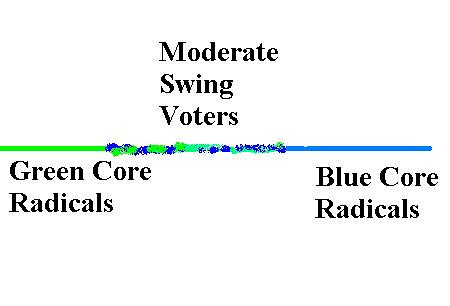
This analyst is still working with the mental that there is a "political spectrum" out there that voters move along, and the goal is to capture the undecided "moderate" voters in the middle. That one looks something like:


Under this view, people at the ends are basically unthinking robots who simply act out the political demands of their masters, while those smart moderates in the center can be captured by good public policy offerings. Reality is, of course, opposite -- anyone who lies between Green and Blue in Taiwan isn't a moderate swing voter, but someone totally apathetic about the system and not participating in voting. The fundamental assumption of the "spectrum" view above is that moderates shade into radicals on either end, and that there are a lot more moderates who can be captured by offering good public policy aimed at the center. That assumption used to be paradigmatic for the United States, but it doesn't work very well for Taiwan. In my opinion, Taiwan looks something like this:


Under this view, "swinging" takes place only when a voter shifts political identity from one line to the other. On the left end are the core voters who reliably come out to vote Green or Blue, who are generally labeled "deep". On the right end are voters who are meh about their own identities and stay home if they don't like the candidate, usually labeled "light" in the press. My view here recognizes several realities about Taiwan:

  • there is no spectrum. The light voters do not blend into each other at the end since these political identities have no overlap; they cancel each other out. Hence, the lines do not touch.

  • there are a lot more Green voters. More Greens are Light Greens.

  • there are fewer Blue voters overall. Relatively fewer Blues are Light Blues.

  • this works only at the national level. For the local level, apply to your local clan and patronage networks.

  • In this view the distinguishing characteristic of Core and Light voters is willingness to vote. The spectrum is not one of identity vs. policy, but of voter apathy. That is why the "middle" contains people who don't vote at all.

  • This raises the question of why, then, do parties behave as though there is a "center" full of moderates who must be appealed to? Why do they engage in last-minute electoral stunts that appear to assume some voters are undecided, such as Chen Chu's release of a videoing showing alleged vote-buying by her opponent's side the day before the latest Kaohsiung mayoral election, or a similar event in the previous cycle of county chief elections, in which supporters of DPP candidate Su were allegedly captured vote buying?

    In my view both sides get out the vote by appealing to their respective bases, not by appealing to undecided centrist voters. But that base consists of human beings who vote for a variety of reasons. While few voters will switch to the Other Side, the Light voters might not come out unless they are given other sweeteners in addition to appeals to political identity -- public policy and of course, stunts that make victims out of one's own side. Chen Chu's release of the vote-buying video was not an appeal to last minute undecided voters who make up their minds based on whether a politician is "corrupt", it was a statement of victimhood that appealed to her own side: See!? I'm getting the shaft! Come out and help! Such moves ask Light voters to come out and Stand By Their Man.

    I'm still working on it. But any "spectrum" model used to study Taiwan will fail to grasp Taiwan, in my view. As with so many other areas of human life, the analysis used to understand western industrialized democracies won't really work on The Beautiful Isle.

    (cross-posted from The View from Taiwan)

    Labels: , , ,

    __________________________________________________
    Sunday, May 20, 2007

    permalink

    Farmers Associations and Rural Politics

    The past few days the Taipei Times has been running articles on the changes at one of the most important of the nation's rural institutions, the farmer's associations. According to this 2005 paper, Taiwan has 281 local farmers' associations, 21 city and county farmers' associations and one provincial farmers' association. "These local farmers' associations are the most important social and economic cooperative organizations in local areas of Taiwan." They are critical for understanding how Taiwan's politics function.

    The farmers' associations were established in 1900 by local farmers during the Japanese colonial period. The colonial government took them over and operated them as an administrative arm of the government. They formed the core of the colonial government's agricultural extension program, which was involved in standardizing seed varieties, introducing new farming methods, and other developmentalist activities. Membership was required of all rural households. By the 1920s these were major institutions with 40,000 employees.

    In 1949, when the KMT fled to Taiwan the existing agricultural cooperatives and farmers associations were merged. In 1950 the US AID team came in, and the associations were reorganized based on the recommendations of the Joint Commission for Rural Reconstruction (JCRR). Again developmentalist in orientation, the purpose of the associations shifted to providing better credit facilities for finance of new technology. During the Japanese period rural credit had been a major agricultural issue, and high interest rates were the norm.

    The associations are organized in a hierarchy with the provincial farmers' association as the main management unit. Membership of the 300 such organizations includes anyone and everyone doing farm business in Taiwan, including owner-cultivators, tenants, hired hands, agricultural extension works, and employees of state-run firms. By the 1980s total membership consisted of over 85% of households, or 1.3 million people. Both full and associate memberships are available. Because these organizations are important sources of rural credit, small businessmen are often members, especially in urban and suburban areas. Another driver of membership in urban areas was land sales -- until the late 1990s, to buy and sell agricultural land, you had to be registered as a farmer. Many a white collar worker in a Taipei office was listed as a farmer somewhere so that he could engage in lucrative agricultural land deals on the city outskirts.

    Under the system, the general managers of these cooperatives are not elected, and never have been. Instead, the farmers elect representatives who elect a board of directors who in turn select the general managers of the cooperatives. The candidates are then officially appointed by the Department of Agriculture and Forestry. As Hung Mao-tien noted in his excellent work on the transition to democracy in Taiwan, The Great Transition:

    The general manager is the chief executive in charge of the daily operations of the association. As credit activities increased, the general manager assumed an additional role comparable to the president of a cooperative bank. The position is regarded as the most lucrative of all public offices in rural Taiwan, drawing a salary comparable to that of a cabinet minister in the national government. Furthermore, since the position offers a unique opportunity to help friends get jobs or win export quotas for agricultural products, it provides a bae that can lead to an exciting and lucrative political career."(p47)

    Because the resources controlled by these associations are so vast, local factions compete furiously for the positions of board members, general manager, and director (this situation is also true of local irrigation associations, which even during the 1980s were considered so lucrative that candidates would spend a million US dollars to run for office). In addition to the vast opportunities for graft, corruption, insider deals, and outright embezzlement, the farmers associations also elected representatives to the provincial and national legislatures under the old political system. This made them politically powerful in their own right, and for years they kept unofficial spokesman in those institutions to look after their interests. Numerous KMT politicians began their career in these associations, including former KMT legislative speaker Liu Sung-pan, who ended up fleeing to China from corruption charges a decade ago.

    During the martial law era the appointments were controlled by the KMT, and its influence remains strong at the rural level due to its grip on these organizations. Although the farmers themselves were less than 10% KMT members, virtually all association officials had to be in the Party.

    Corruption is easy and widespread because of changes made to the system back in 1974. Prior to that time the funds collected from members were owned under a share system by the members themselves, but in 1974 these assets were placed under the direct control of the association's appointed officials. With oversight non-existent, the associations became notorious for corrupt financial practices. At present the system is burdened with enormous sums in non-performing loans. Their financial dominance at the rural level was so great that as late as 2003 there were almost 100 townships on the island that had no commercial bank presence (source). As this Taiwan ThinkTank White Paper observes:

    Since [1974], the welfare and rights of farmers and fishermen have not been protected. After the system was abolished, the money from sale of shares in the association was used as a business fund. Although there was a rule that 70% had to be used for agricultural promotion, in fact it was raided by politicians and business people. Local political factions were able to empty out the credit units. Simply put, whoever won an election, and in those days the KMT allowed no real competition, would take charge of everything, including the huge sums of capital in the association credit units.

    One article describes in detail how the farmer's associations were integrated into the KMT's local faction alliances:

    In the organisation of Taiwan's local policy, local factions (difang paixi) are local-level clientelistic networks. Most of Taiwan's counties and municipalities have two, some three local factions, which compete for local economic and power resources. Factions usually are held together by ties of blood, kinship and marriage, but also by interpersonal relationships. The KMT made use of local factions basically by trading money for support via local-level elections. Getting elected at the local level was not very attractive in terms of political power, because local government was in the firm grip of the party state. Political office, however, granted access to local monopoly and oligopoly rights and "money machines" like the credit departments of the fishermen's associations (yuhui), the water conservancy associations (shuilihui), and the farmer's associations (nonghui). In addition, political protection of semi-legal or illegal projects such as brothels, gambling dens and karaoke bars guaranteed the local power-holders further resources.

    The organisational capacity of the KMT, a tailor-made electoral system and its clientelistic relationship to the local factions made influence on electoral outcomes highly effective during authoritarianism. All that was required was the subdivision of an electoral district into as many parts as there were candidates, and ensure that each candidate received just the right number of votes. This was achieved with the help of vote-brokers (zhuangjiao). In order to be successful in these elections, one usually had to be nominated by the KMT, who had the organisational means to co-ordinate votes and candidates, the financial means to co-finance the costly electoral campaigns, and the coercive means to deter non-authorised candidates from running. As a consequence, candidates of the various local factions competed for nomination by the KMT, and local alliances against the KMT were highly unlikely unless the KMT disregarded the factions by filing its own candidates. This was backed up by the rigorous enforcement of a policy that forbade factions to conclude alliances beyond the county level.

    These "local factions" continue to play a powerful role in Taiwan's politics, and the majority are still loyal to the KMT. They are integrated into the Party's Machine politics. In 1994 the KMT under Justice Minister Ma Ying-jeou, now the Party's Presidential candidate, launched a crackdown on vote buying at the local level whose effects still linger in the hatred of the Party's Machine politicians for Ma, and in disastrous results in the legislative elections. In 1996 Ma was removed from his post as justice minister, an event which many have claimed was due to his attacks on political corruption. Since then the local-level KMT has fought all attempts to reform the system.

    Consequently, the political role of the farmer's associations remains the same, although the financial effectiveness of the organizations themselves is on the wane. A recent commentary in the Taipei Times noted:

    Farmers' associations are no longer organizations for farmers. At best, they are companies trading in agricultural resources and materials as well as buying, distributing and marketing processed agricultural products. For example, Pai Tien-chih (白添枝), who became a legislator-at-large for the Chinese Nationalist Party (KMT) as an agricultural representative although he is chairman of a gravel company, said that farmers' associations were like privately owned companies, and their directors were like corporate chief executives.

    Pai Tien-chih is actually the Chairman of the Board for the Taipei County Farmers' Association, a powerful institution. Note the interconnection -- he also runs a gravel company, another key rural industry rife with corruption.

    In 2001 36 agricultural associations were taken over by State-run banks in a bid to clean up the tremendous non-performing loan problem. A 2002 Taiwan Journal article said:

    While acknowledging the important role that these organizations have played in Taiwan's economic development, ministry officials said the credit unions are losing money fast, especially compared with what they were able to earn five years ago. Farmers' credit unions, for example, earned roughly US$317 million in 1996--77 times last year's figure.

    Statistics also show that by the end of June, the average overdue loan ratio for farmers' and fishermen's cooperatives stood at 21.5 percent and 17.5 percent, respectively. This far surpasses the rate of 7.5 percent at local commercial banks and 14.3 percent of credit cooperatives.


    In November 2002, local farmers' and fishermen's associations organized a massive rally to request that the government suspend risk-control measures for association loans, switch supervisory control from the Ministry of Finance to the Council of Agriculture (CoA), and establish a national agricultural bank to offer loans for agricultural development as well as general businesses to help increase the competitiveness of grassroots credit units. The importance of this issue can be gauged from the fact that in the Chen Administration budgets, the Council of Agriculture is consistently the second largest item after Defense. However, financial reform has been opposed by the KMT, many of whose politicians make their power bases in the associations. Reform thus impacts the KMT right where it hurts.

    The Chen Administration has taken several shots are reforming the system, one that has provoked a backlash from the KMT, whose officials have long pillaged these institutions. In 2001 the Administration revised the laws on who can be a general manager, and in 2003 it clarified oversight. In a situation familiar to anyone who has interacted with the bureaucracy on Taiwan, accounting oversight for the agricultural cooperatives was completely unclear prior to 2003. Did the Ministry of Finance or the Council of Agriculture have oversight of the loan system? The Chen Administration assigned this to the CoA in 2004.

    The Administration also established the Agricultural Bank of Taiwan in 2005 to take over the activities of three previous institutions. According to Taiwan ThinkTank, the "Chen administration has also increased the subsidy for elderly farmers from NT$3000 to NT$4000, offered academic grants and loans for farmers’ and fishermen’s children, provided a 50% increase in subsidies for natural disasters, increased the subsidy for fallow farmland from NT$37,000 to NT$45,000 per hectare, increased the fuel benefit for fishing boats, provided for special agricultural loans at an annual rate of 1.5% to 2%, offered to purchase all produce when prices fall below 95% of direct costs, and funded a NT$76.5 billion subsidy for farmers to offset the impact of imported farm produce." The farmers associations have also become key marketing associations for farm products during the Chen era.

    The Chen Administration's fight to reform this system, which is an important source of financing and political coalition building for KMT politicos at the local level, has not gone unchallenged. The Taipei Times commentary chronicles the issues:

    After the Democratic Progressive Party took power in 2000, it sought to add an anti-corruption clause to the farmers' and fishermen's association acts. After negotiations and interruptions, a compromise amendment passed in 2001.

    Former Council of Agriculture chairman Chen Hsi-huang (陳希煌) said at the time that about one-third of the nation's more than 300 association directors had a history of corruption. Negotiations, however, watered down the law to the point that such people would lose their jobs only after they exhausted all appeals. That was still troublesome for these people, so legislators close to the associations have frequently tried to repeal the law.

    In 2004, then People First Party (PFP) legislator Chen Chao-jung (陳朝容), who is now a member of the KMT, joined PFP Legislator Tsai Sheng-chia (蔡勝佳) and others in signing a motion to eliminate the anti-corruption clause.

    Tsai recently raised the idea of voiding the anti-corruption clause again. At the time I strenuously objected, believing that one should not use farmers as an excuse to serve one's own ends.

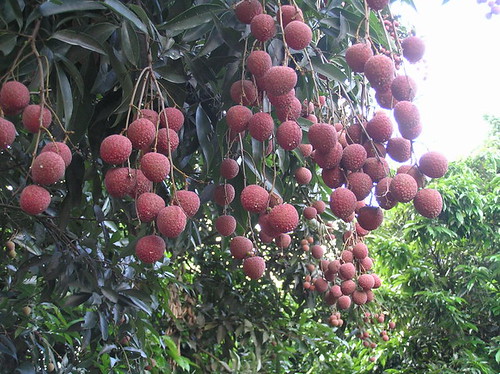
    I grew up in Changhua County's Fenyuan Township (芬園), where farmers mostly grow things like lychees and pineapples. About NT$900 million (US$27 million) of the money that farmers had saved in their associations' credit departments was repeatedly "lost" by their directors through high-risk loans.

    Tsai's latest amendment, which was passed last week, removes the rule that members be stripped of their position upon losing their second appeal, and imposes the more lenient condition that their conviction must be finalized before they are discharged. It also removes any term limits.


    Tsai Sheng-chia was one of the drivers of the campaign to market Taiwan's fruit in China. He led a group to China back in 2005, along with Pai Tieh-chih mentioned above.

    The changes he proposed basically evisecerate any attempt to remove corrupt officials at key financial institutions at the rural level, making it possible for the KMT to continue to use the associations as gold mines. Originally the secretary-generals of the associations were limited to three terms, but the new legislation abolishes this. The new legislation also means that since officials aren't removed until their convictions are finalized, convicted officials can remain in key offices in provincial financial institutions. The DPP responded:

    "The changes are an attempt by the pan-blue camp to consolidate their relationships with the associations," said Democratic Progressive Party (DPP) Legislator Wu Ming-ming (吳明敏).

    Wu, who has taught agriculture in colleges for 30 years, said that he was sad that the welfare of farmers and fishermen had been "sacrificed" to party interests.

    With the amendments, about 95 percent of current secretary-generals, whose loyalties traditionally lie with the KMT, will be able to dominate the organizations indefinitely despite the fact that many of them have criminal backgrounds, Wu told a press conference.

    According to Wu, 24 executives or staffers in the associations across the nation were convicted of crimes such as corruption, drug trafficking, bribery and violence at their first trials as of this month.


    Political blogger A-gu, commenting on this, observed:

    The goal is to help those secretary-generals to wield significant long-term power, which makes them good friends and easier to buy off, and to help protect them from prosecution in the cases where they are involved in shady deals. And they often are: "In the 2001 farmers' association election, 555 cases of vote-buying, violence, and violation of the election laws, involving 951 people, were sent to the court, an increase of 157 cases (42 people) compared with the 1997 election."

    One obvious solution to the ongoing crisis is a reform program that erects a national farmer's bank and eliminates the farmers' associations. This has been repeatedly proposed during the Chen Administration, but the KMT and its allies continue to fight reform of their lucrative power bases in Taiwan's Farmers' Associations.


    Labels: , , , , ,

    __________________________________________________
    Wednesday, May 09, 2007

    permalink

    Ma Wins Key Ruling

    Indicted KMT Presidential candidate Ma Ying-jeou took an important step toward squirming out of a conviction yesterday:

    The Taipei District Court ruled yesterday that a Ministry of Justice opinion which could prove favorable to former Taipei Mayor Ma Ying-jeou (馬英九) was admissable as evidence in his trial.

    At a Cabinet meeting last November, Justice Minister Morley Shih said that special allowance funds should be seen as a "substantive subsidy," an opinion similar to that being argued by Ma's defense team.

    The court did not resolve, however, whether the special allowance funds - allocated for the discretionary use of administrative chiefs - should be treated as public funds or personal benefits. Ma's case could turn on which definition the court accepts.

    While the latest hearing in Ma's case was being held, the nation's top prosecutors said it was improper for the prosecution to provide a unified definition on the use and character of special allowance funds.


    This ruling allows Ma to claim that the special funds, downloaded into personal accounts, were meant as a form of extra salary. That may be implicitly true -- they were one of the ways the KMT bought the bureaucracy's favor -- but that is obviously not the stated intent of the law.

    Note also that last paragraph -- the nation's prosecutors do not want the special funds defined, because if they are, prosecutors will lose discretion over how they charge politicians in the future. Ma's team has already pointed to a case in Tainan in which a public official did the same thing Ma did, but got off when the prosecutors concluded that the special funds were personal salary.

    The way to go here is obvious: an amnesty for all public officials, from the lowliest school principal to the President, and an end to the special funds. But I think we'll see a quasi-amnesty: the special funds will be treated as personal income, Ma will not be convicted, and they will continue to flow out of public coffers into personal pockets to corrupt another generation of public officials.

    Labels: ,

    __________________________________________________
    Tuesday, April 17, 2007

    permalink

    Referendums Redux

    In 2004 one of the ways the DPP stoked its base and powered its way to victory was the use of referendums held during the election. One purpose may have been to demonstrate a popular basis for DPP policies; another, to establish the use of popular referendum, thus taking another step toward independence of government, but mainly, the referendums were intended to get out the DPP base. The China Post described them yesterday:

    Taiwan held its first referendum alongside the presidential election of 2004. President Chen Shui-bian initiated the referendum on a dialogue between Taipei and Beijing and the purchase of defense missiles from the United States.

    The DPP is currently proposing adding two referendums to the '08 poll.

    Trong Chai, acting chairman of the Democratic Progressive Party, pledged yesterday no effort will be spared to have two referendums held alongside the presidential race of 2008.

    He told a press conference the party and the government have decided to push for the referendums on "ill-gotten" assets of the Kuomintang and the accession to the United Nations under the name of Taiwan.

    "We'll be doing whatever we can to have both held at the same time with the presidential election," Chai declared.

    The referendums (Note how the pro-KMT China Post puts the term ill-gotten in quotes) are aimed at popular topics -- support for entry into the UN is strong, and the stolen assets of the KMT are a major issue for Greens. This formula was successful in 2004, but it remains to be seen whether the DPP is fighting this war with the weapons of the last one. Last time around the KMT countered with a program of fei piao, urging Taiwanese to cast invalid ballots as a way to express disapproval of the system, through the "One Million Invalid Vote" alliance. Its success was demonstrated by a near-tripling of invalid ballots from 122,000 in 2000 to 330,000 in 2004 (due also in part to more stringent rules about what constituted a valid ballot). No doubt a similar 'grass-roots' movement will appear in 2008 as well.

    One key factor here is the Central Election Commission (CEC). The CEC will vet and approve the referendum process, and the KMT is out to gain control of that institution.

    Lawmaker Tseng Yung-chuan, Kuomintang legislative caucus whip, said yesterday it's unfair to let the Central Election Commission decide on whether to hold two referendums alongside the presidential election of 2008.

    At a press conference at the Legislative Yuan, Tseng characterized the CEC, founded in 1982 under the Executive Yuan to hold and supervise elections, as an "illegal institution."

    "It's unfair to let the illegal institution make a decision on such an important issue as referendums," Tseng pointed out.

    The ruling Democratic Progressive Party has control over the CEC, which the opposition Kuomintang has tried in vain to reorganize.

    A Kuomintang-sponsored bill to amend the appointment of commissioners according to the proportional representation in the Legislative Yuan has been stalled by the ruling party.


    Recently the KMT has been holding the national budget hostage by demanding that the DPP accede to its demands on the CEC. The CEC will determine whether the referendums get on the ballot. It also oversees the fairness of elections, and validates, and reports on, results. It triggers investigations of vote buying, crucial tactics of the KMT and its allies.

    Speculation: why is the KMT so concerned about the CEC? Cynical remarks about the KMT objecting to fair elections aside, there are repeated rumors that Shih Ming-teh, leader of the anti-Chen campaign, is getting Chinese money. Shih actually met with Chen Yu-hao, the accused embezzler who fled to China years ago, in Thailand, held to be a favored meeting ground of the CCP and the KMT. I'm wondering whether the KMT wants electoral law oversight to be lax because it is expecting an influx of Chinese money for use in the 2007 legislative elections and 2008 presidential elections. It sure is interesting that the first thing Wu Po-hsiung did after announcing his ascension to the Chairmanship of the KMT is to run to Beijing to hobnob with the CPP leadership.....

    Labels: , , , ,

    __________________________________________________
    Tuesday, March 20, 2007

    permalink

    Ma to go South?

    Local media are reporting that once and future presidential candidate Ma Ying-jeou is mulling relocation to southern Taiwan:

    The ex-mayor made the disclosure following Chinese-language newspaper China Times' report yesterday that he plans to move to Kaohsiung soon in order to seek more support from voters in the south.

    The report disclosed that Ma has planned to move to Kaohsiung in May or June to intensify his presidential campaign activities in southern counties, where candidates from pro-independence parties including the governing Democratic Progressive Party and Taiwan Solidarity Union have dominated major elections in the past.

    The report continued that a pan-blue supporter has offered the ex-Kuomintang chairman a residence in downtown Kaohsiung as Ma's temporary accommodation during the presidential campaign. The landlord hopes Ma will improve his understanding and relations with the southern electorate during the temporary stay.

    The report quoted an anonymous source in the end, however, that Ma and his supporters would decline to comment on plans at the moment, as the ex-mayor has not yet been formally selected as the KMT presidential candidate.

    Ma announced to run for the 2008 presidential race on February 13, hours after Taipei prosecutors indicted him on charges of corruption resulting from his handling of a special fund.

    The report came two weeks after Legislative Speaker Wang Jin-pyng (王金平), who is also seen by the public as a potential KMT presidential nominee, made a comment that "People of central and southern Taiwan have told me that they will not vote in favor of a China-originated candidate" in the presidential election.

    The Legislative Yuan leader explained that he made the remark as a warning to KMT members to watch out for the governing Democratic Progressive Party opponents' manipulation of an ethnic controversy, referring to a potential and protracted conflict of different ideologies and national identity between native Taiwanese and China-originated residents on the island. Wang, speaking during a magazine interview, cautioned that the ethnic issue would dominate the presidential campaign next year, according to his observation.


    It is curious how each party is performing the mirror operation of the other: the KMT is trying to see how its strength at the local level can be transformed into national level success, while the DPP has not yet managed to parlay its powerful hand at the national level into local level success. It will be interesting to see whether he makes this move -- the action is in Taipei, and that's where his base of Deep Blues is.


    Labels: , , ,

    __________________________________________________

    Thursday, March 15, 2007

    permalink

    DPP poll: 69% think Taiwan is an independent state

    DPP announced a poll :

    Who defines Taiwan status (台海現狀)Taiwanese 83.2%China
    government 1.7%
    Both 6.4%
    Is Taiwan an independent sovereignty state? Yes 69.2%  
    Is Taiwan part of China? Yes 14.6%  
    A referendum is required when signing sovereignty-related agreements with China Yes 84.8% No 9.7% 
    Join United Nations in the name of "Taiwan" Yes 70.6% No 19.6 

    It seems that Taiwanese conscience has already become the majority in Taiwan. I recalled President Chen said earlier that, by the time of the 2008 Presidential Election, Taiwanese consicience would rise to a level that any candidate advocating for "Unification with China" will have no chance at all of getting elected. I never truely believe in what he said like this one before ... :)

    Labels: , , ,

    __________________________________________________
    Tuesday, March 13, 2007

    permalink

    China Times Presidential Poll


    The China Times has a new poll out with early predictions of the election. It has Ma up over Su or Hsieh by 20 points, 48-29, with 23% having no opinion, while Su/Hsieh beat Wang 38-32 with 30% having no opinion. The China Times organization also polled on Ma as an independent:

    如果王金平代表國民黨、馬英九獨立參選,蘇貞昌或謝長廷代表民進黨出馬,受訪者的答案又有所不同,11.1%表示會支持王金平,42.5%表示支持馬英九,27.6%表示將會支持蘇貞昌或謝長廷,18.8%表示沒意見。

    If Wang Jin-pyng represents the KMT, and Ma Ying-jeou participates as an independent, and Su or Hsieh represents the DPP, among those surveyed, 11.1% said they would support Wang, 42.5% said they'd support Ma, 27.6% said they'd support [DPP candidate], and 18.8% had no opinion.

    The article went on to note that if Ma were convicted, those numbers are 13.5, 35.2, 31.1, and 20.2, respectively.

    The survey was conducted by phone, probably in northern Taiwan, since I deem it unlikely the organization would spend all that money making long distance calls. Polls from Blue organizations are notorious for their wild inaccuracy, and these numbers should be read as indicative of the preferences of the China Times rather than as a valid representation of the electorate. Laughably, the paper claims it has a margin of error of 2.9%. Yes, and did you know that 63.8% of statistics are made up on the spot?


    Labels: , , , , ,

    __________________________________________________
    permalink

    And in this corner, Wang....

    It seems a pity to leave the blogging day without a pointer to the ongoing discussions in the KMT over who will be on the ticket. Wang-Ma? Ma-Wang? Lien-Wang? Wang-Soong? Anything seems possible these days. But Wang Jin-pyng has the insightful comment:

    Meanwhile, Wang yesterday said that he favored a Wang-Ma rather than a Ma-Wang presidential ticket, saying that the former one was a winning combination.

    "If [I were to be paired up with Ma], of course it should be a Wang-Ma ticket," Wang told reporters when asked for comment on Ma's earlier remarks.

    "Everyone wants the best for himself and will strive for it. I don't remember whether I have spoken about this, but what I am thinking about in my heart is a Wang-Ma ticket," Wang said.

    Wang said that a Ma-Wang ticket would not be a threat to the DPP because the DPP has prepared itself for beating Ma in next year's presidential election.

    "Only a presidential ticket led by a pro-localization candidate can help the KMT win the election," Wang said, without elaborating.

    Not much else to be said; Wang hit the nail on the head. A ticket with Wang at the fore might do very well, but doesn't seem likely. That's Impossible doesn't think there is much chance of a Wang-Ma pair-up, either. The pro-KMT China Post, in an article by "China Post Staff" -- which usually indicates a translation from their sister publication -- noted the growing chill in the KMT leadership:

    An emerging chill in the relationship among top leaders of the Kuomintang (KMT) is likely to complicate an earlier emergence of a consensus candidate for the main opposition party.

    In spite of calls for restraining presidential hopefuls' aides from spreading public and controversial statements that might sow discord, the cold relations between Ma Ying-jeou, a former KMT chairman, and Legislative Yuan Speaker Wang Jin-pyng seemed to show no signs of improvement.

    The two are currently rated as the two front-runners to win the party's nomination for the 2008 presidential race, although Ma enjoys a commanding lead over Wang in all major public opinion polls.

    Analysts said that both of them have shown no genuine and concrete moves to form a team despite their open remarks that they will never cause any rift within the party that will hamper the KMT's campaign for returning to power next year.

    Ma has so far refrained to make a commitment on asking Wang to be his running mate as suggested by many, saying the decision should not be made since no one has even formally registered for the party primary.


    One thing about Ma -- the man is always on-message:

    In response to Legislative Speaker Wang Jin-pyng's (王金平) refusal to play second fiddle and run as the vice-presidential candidate on the party's ticket, Ma said he realized that grassroots supporters did not take the pair-up issue too seriously, adding that he would focus his attention on seeking solutions to Taiwan's economic difficulties.

    Bingo. Ma has announced that he's going to run on the economy -- "save Taiwan from poverty" was pretty much how he put it the other day -- and having done that, he's constantly on message: it's the economy, stupid.

    I'm beginning to wonder if Ma Ying-jeou, currently without a post in either the government or the KMT and thus, just an ordinary jeou, is fast approaching his sell-by date. If another six months go by it may dawn on some in the KMT that Ma's star has peaked. Time will only improve Wang's longshot bid for the Presidential candidacy. UberChairmanforLife Lien Chan is back in the public eye and liking it. The Taipei Times report mainly focused on the by-play between party insiders over who will get the nod for the KMT Chairmanship, with reference to the influence of Lien Chan, but the Taiwan News also mentioned six-term legislator Hung Hsiu-chu (洪秀柱), stirring up the pot with her bid:

    To enter the race, Hung needs to collect the signatures of 3 percent of eligible party members. She said in a press conference yesterday, however, that many party members' names, addresses, or telephone numbers were missing in the detailed membership list provided by party headquarters.

    The list showed that 278,000 party members had paid their annual membership fees and thus were eligible to vote in the election for chairman, she said, meaning she will need to collect nearly 8,500 signatures to enter the race.

    Looking for data

    Having paid an NT$2 million entry fee to participate in the election, Hung said she should have access to more complete data so that she can complete the signature-gathering process.

    If she cannot successfully register as a candidate in the election by March 18, the party could suffer a big blow to its image, she said.

    Soliciting support

    Hung urged all party members who hope to see at least two candidates vying for the chairmanship to contact her and help her meet the signature threshold.

    Hung, 59, has served six consecutive terms as a legislator and has a reputation for having a sharp tongue.

    Believed to be closely associated with KMT Legislative Speaker Wang Jin-pyng (王金平), she has denied her that her candidacy represents any factional interests, saying she made the decision to run on her own.

    The party has taken considerable effort to avoid a split between supporters of Ma and those of Wang and hopes to avoid a contentious internal election.

    One opponent

    Hung's only rival in the race will be Wu Po-hsiung, seen as an ally of Ma Ying-jeou.The 70-year-old Wu has served as secretary-general to former President Lee Teng-hui (李登輝) and as KMT secretary-general.

    Jason from Wandering to Tamshui pointed out over on That's Impossible! that she was the legislator who taught her dog to attack when it heard the phrase "A-Bian," the President's nickname. Say, wonder how the last chairmanship election was conducted, if so many dues-paying KMT members can't be verified.....cheating somehow? Naw. Not the KMT.

    Meanwhile the DPP is arguing over whether to have a primary or simply decide in the time-honored, smoke-filled room fashion.....


    Labels: , , , ,

    Labels: , , , , ,

    __________________________________________________